Executive summary
A pushing type machine for double pallet changing uses a moving push plate to slide a loaded pallet into a set position on the machine platform. In the demonstration the machine is tested with a wooden pallet carrying stacked cartons, while the push plate drives the load into place under a fixed front guard. Pallet size, load height and cycle travel are confirmed per project.
Table of Contents
- Why a push-type pallet changer
- What the machine does
- Machine layout and parts
- Cycle and control
- What the footage shows
- Typical configuration
- Selection checklist
- Operation and safety
- Engineering FAQ
- Next step
- Related reading
- Sources and standards
Why a push-type pallet changer
Loaded pallets are heavy, and sliding or repositioning them between stations by hand strains operators and slows a shift. A push-type changer moves the pallet at floor level, so the load stays flat and steady while it travels into the set position.
The machine does the pushing in one controlled stroke. Pallet travel and guard layout are confirmed per project.
What the machine does
The machine is a push-type pallet changer built for double pallet changing operations. A loaded pallet is placed on the platform, and the push plate slides it into a set position inside the machine for the next step of the cycle.
The sequence is run under operator control, and the load is checked before the next move. Load height and cycle travel are confirmed per project.
Machine layout and parts
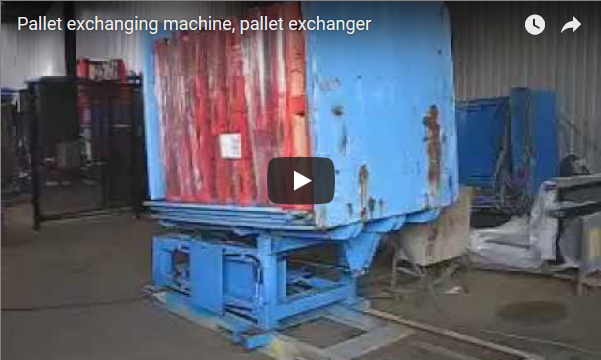
The machine has a steel frame finished in blue, with a fixed guard plate at the front and a load platform in the middle. The push plate travels along the machine track and does the pushing.
Yellow guard rails run around the machine, and the push plate moves until the pallet is seated at the set position. The frame and guards keep the load contained during the push.
Cycle and control
At the start of the cycle, a loaded pallet is placed on the platform. The push plate advances along the track and slides the pallet into the machine until the load seats in the set position.
The push plate then stops, and the operator checks that the cartons sit correctly before the next move. The sequence runs under operator control from the panel, and cycle travel is confirmed per project.
What the footage shows
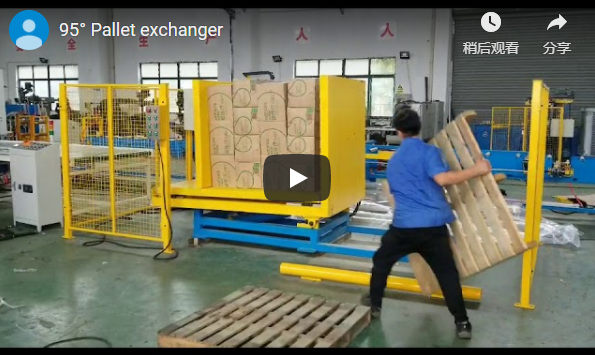
Our footage shows the machine standing in a workshop during a test run. A wooden pallet carrying stacked cartons rests on the platform, and the push plate then moves and slides the pallet into the machine under the fixed front guard.
A worker in dark overalls walks up to the load and adjusts the cartons after the push. Yellow guard rails ring the machine, and the load stays level through the push. This is a demonstration under workshop testing, so your pallet size, load height and travel distance are confirmed per project.
Typical configuration
The figures below list functional design boundaries rather than numeric values, and are confirmed per project.
| Parameter | Typical range, confirmed per project |
|---|---|
| Load | wooden pallet with stacked goods on the platform |
| Process | push plate slides the pallet into the set position |
| Transfer | loaded pallet in, repositioned pallet presented at the next step |
| Push plate | travels on the machine track until the pallet is seated |
| Guard | fixed front guard plate on the machine frame |
| Control | push buttons on the control panel, layout confirmed per project |
| Mount | floor mounted, in line with the pallet flow |
| Electrical supply | 380 V three phase 50 Hz, or 220 V single phase for light machines, selected per project |
Selection checklist
| Question | Confirm per project |
|---|---|
| Pallet range | footprint, load height and total load weight |
| Goods | carton or bag stacks, stability of the load on the pallet |
| Cycle | push speed, travel distance and dwell at the set position |
| Control | panel layout and guarding around the machine |
| Site | floor space and access at both ends |
| Electrical supply | voltage, phase and frequency on site |
Operation and safety
Place the loaded pallet on the platform, start the push, and supervise the stroke until the pallet is seated. Keep clear of the push plate travel path while the machine is moving.
Routine checks cover the push plate, the track and the front guard, following the machine manual. The operator checks the load on the pallet before the next cycle starts.
Engineering FAQ
Q: What does this machine do? A: It uses a moving push plate to slide a loaded pallet into a set position on the platform for pallet changing.
Q: Do we lift the pallet by hand? A: No, the push plate moves the pallet by sliding it at floor level, which reduces manual lifting and keeps the load flat.
Q: How does the push plate work? A: It travels along the machine track and slides the pallet into the machine, and the cycle stops when the load seats in the set position.
Q: What loads can it handle? A: The platform takes wooden pallets with stacked goods, and the pallet size and load height are confirmed per project when you send your details.
Q: What electrical supply does it need? A: The machine runs on 380 V three phase 50 Hz as standard, and light machines can be arranged for 220 V single phase, selected per project.
Next step
- Email us at info@fhopepack.com with your pallet and load sizes.
- We send a pallet changing proposal within 48 hours.
- We confirm the travel distance and guard layout for your loads.
Related reading
- Pushing type machine for double pallet changing testing in workshop
- Rotate arm stretch wrapping machine,pallet wrapping machine
- Partial film wrapping and packing by orbital wrapper
- FHOPE packing machinery product lines
Sources and standards
- ISO 12100:2010 Safety of machinery, general principles for design and risk assessment
- EN 415-10:2014 Safety of packaging machines, general requirements
- EN ISO 13849-1:2023 Safety of machinery, safety-related parts of control systems
FHOPE pushing type machine for double pallet changing, shown under workshop testing. Reviewed as a general demonstration; pallet size, load height and cycle travel are confirmed per project.
Last reviewed: 2026-10-12