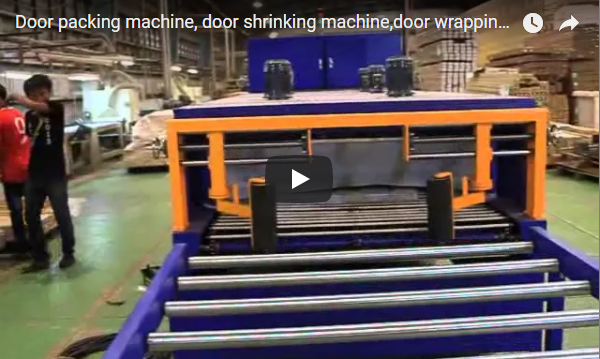
Executive summary This video shows a wood door protection film shrinking machine in continuous operation: a panel door enters bare, is covered with clear protective film, passes through a heated chamber where the film tightens around raised panels and edges, and exits with a smooth, wrinkle-free surface. No narration is present — everything below comes from direct frame analysis. For exact temperature, throughput, and dimensions, verify with the manufacturer.
Wooden doors are expensive to make and easy to damage. A raised four-panel door leaves the finishing line clean, and then a scratch, a fingerprint, or dust pressed into an uncoated surface can turn a sale into a rework job. The machine in this video addresses exactly that problem: it wraps a wooden door in clear protective film and then shrinks that film in a heated chamber so it hugs the door’s profile — recessed panels, edges, and all.
The footage runs roughly ninety seconds and shows more than one door going through the same line, which makes it useful evidence for a buyer asking a simple question: does the film actually conform to a paneled door surface? The answer, visible in the frames, is yes — the film pulls into the panel grooves and comes out flat, glossy, and bubble-free. This article walks through what the video shows, what it deliberately cannot tell you, and what you should confirm with the manufacturer before ordering.
How the process works, step by step
Following one door through the line, the sequence is continuous — the door never stops moving, and no operator intervention appears in the heated section.
| Stage | Approx. time in video | What happens |
|---|---|---|
| 1. Feeding | ~0–8s | An unwrapped, light-toned wooden door lies flat on the infeed conveyor, face up. Adjustable metal clamping blocks with bolts sit at the entry to position the door. |
| 2. Film application | ~8–16s | Clear protective film unspools from a top-mounted roll, passes over guide and pressure rollers, and is laid over the door surface as the door advances. |
| 3. Entry to heating chamber | ~16–24s | The loosely wrapped door enters the tunnel. A control panel with at least two red buttons and a small display is partially visible near the entry side. |
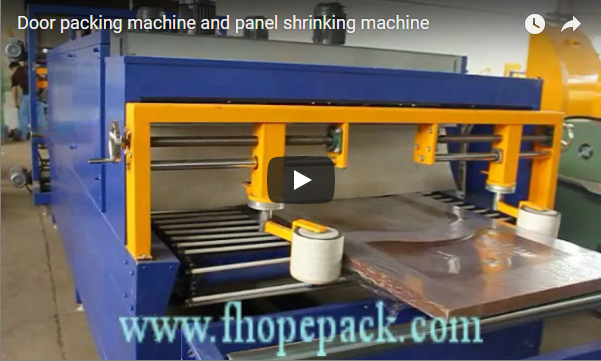
| 4. Heat shrinking | ~24–44s | Inside the chamber, rows of parallel heating elements (alternating red and silver) soften the film. It visibly contracts, stretches, and pulls tight into the raised panel recesses. White strip curtains hang at the chamber openings. |
| 5. Cooling and exit | ~48–56s | The film has set. The door rolls out onto the exit roller conveyor with the film smooth, glossy, and tightly bound at the edges. |
| 6. Unload | ~80–88s | A second door completes the same cycle; finished doors are set down near a staging area where staff work at nearby benches. |
Two details worth pausing on. First, the door travels face up and horizontal the whole way — no flipping, no rotating — which means the film covers only the visible face in this configuration; whether edges and the reverse face are handled separately is a question for the manufacturer. Second, the shrink result on a four-panel molded door is the hardest test for this kind of equipment, because the film must bridge recesses without wrinkling. The footage shows it doing so: after heating, the film follows the panel contours with high-gloss contact and no visible bubbles or loose flaps at the edges.
What the machine is built from
The visible structure suggests a straightforward, serviceable layout — an L-shaped flow with infeed on the left, heating chamber in the center, and exit to the right.
- Frame: white-painted metal body with blue-painted base sections; some exposed silver-grey structural beams.
- Infeed: black rubber belt with metal side panels, plus adjustable bolt-mounted clamps for door positioning. A later segment of the line uses coated red rollers with white ring markings and one stainless roller.
- Film unit: a top-mounted roll shaft with guide rollers and a pressure roller assembly that lays film onto the moving door.
- Heating chamber: multiple parallel heating elements in red/silver, with white sawtooth strip curtains at entry and exit to hold heat in while letting the door pass.
- Exit: roller conveyor with slightly wider spacing to release the finished door.
- Control panel: partially visible near the chamber entry — at least two red buttons, a small display screen, and indicator lights. The screen content is not readable in any frame.
- Guidance: a yellow metal arm or baffle near the exit, likely for positioning or drift correction.
Direct observation notes
The following is a dry, factual block kept close to the frame-by-frame analysis, with only light grammatical editing.
- At 0–4s, an unwrapped light-colored wooden door with a four-panel raised design lies flat at the conveyor entrance; a metal clamp and an L-shaped wrench sit in the foreground; a workshop floor and distant equipment are visible behind.
- At 8s, the door enters the machine from the left; clear protective film unspools from an upper roll and covers the door surface; a roller assembly begins contacting the door.
- At 12–16s, motion blur shows the door moving through the pre-heat zone, partially wrapped, with a silver reflective film edge visible.
- At 20s, the door reaches the heating chamber entrance; a control panel with a red button and part of a screen is visible.
- At 24–36s, inside the heating zone, the film visibly contracts and stretches, fitting tightly into the panel grooves and frame; white strip curtains hang above; the roller conveyor shows alternating red and silver rollers.
- At 48–56s, the door exits the heating zone into the cooling/output section; parallel heating elements and a yellow warning label below the chamber are visible; the operator’s position appears at the right side.
- In the later segment (60–88s), a second wrapped door travels in on red rollers, the film wrinkles, then stretches flat against the door inside the chamber, and the door exits with a smooth, reflective, tightly wrapped surface before being placed near a staging area with stacked untreated doors in the background.
- No readable text, nameplate, logo, or watermark appears in any frame; a yellow warning sticker contains only an unreadable graphic symbol.
What the video does not show
This is where buyers need to be careful. The footage is convincing about film conformance, but it is silent on nearly every specification that matters for a purchase decision. None of the following is observable:
- Rated power, voltage, and frequency
- Heating method (infrared vs. hot air) and temperature settings
- Throughput — doors per hour or cycle time per door
- Machine overall dimensions and weight
- Film specifications: material (PE, PVC, POF), thickness, recommended supplier
- Door size range — minimum and maximum length, width, thickness, and whether shaped or narrow-stile doors are supported
- Safety certifications (CE or others), emergency-stop locations, and interlock design
- Control system details (PLC/HMI brand), fault diagnostics, or film-break alarms
- Maintenance intervals, spare parts availability, and service response terms
Treat every one of these as verify with the manufacturer. A supplier who can answer all of them quickly is itself a useful signal.
Safety observations worth acting on
The video gives an honest look at an open-tunnel design, and it raises points any buyer should discuss:
- The heating chamber appears open at both ends, with only strip curtains as a physical barrier. Hot surfaces near an open zone are a burn risk, especially during loading or jam clearing.
- No independent emergency-stop button, light curtain, or safety interlock is visible in any frame. A stop control may exist off-camera, but you should confirm its location and type.
- A yellow warning label with a graphic symbol is visible below the chamber, but no text is readable.
- A floor boundary line marks the work area, which helps but is not machine guarding.
If your plant operates under modern machine-safety expectations, ask the manufacturer about enclosure options, light curtains, and interlocked access as part of the quotation, not as an afterthought.
Who this machine suits
Based on the visible process, the fit is clearest for:
| Good fit | Less certain — ask first |
|---|---|
| Standard rectangular panel doors, flush doors, cabinet doors | Strongly shaped or carved doors (custom clamping may be needed) |
| Protecting raw or finished surfaces from scratches and dust before transport | Two-sided wrapping in one pass (video shows one face) |
| Batch production where manual wrapping is slow and inconsistent | Fully automatic load/unload integration (video shows manual handling at both ends) |
| Windows, frames, and flat wood components of similar height | Very small or very thin parts — roller spacing and film width need confirmation |
The core benefit is qualitative but real: shrunken film conforms without bubbles or wrinkles, which loose wrapping cannot achieve on paneled surfaces. That tightness also improves tear resistance during handling and transit, and the clear film does not interfere with later finishing or inspection.
Buyer checklist before you request a quote
Use this list when you contact a supplier about a wood door protection film shrinking machine:
- Door size range and how positioning is adjusted between sizes
- Heating type, temperature control method, and whether fault alarms are included
- Film materials and thickness ranges the machine accepts
- Whether single-face wrapping is standard and what a two-sided option costs
- Safety package: e-stop placement, guards, light curtain or interlock options
- Throughput rating and the resulting line speed match with your upstream process
FAQ
Does the machine wrap both sides of the door? The video shows film applied to the upward-facing surface only, with no flipping or rotation. Confirm with the manufacturer whether edge and back-face coverage is done in a separate step or an additional module.
What film does it use? Not observable in the footage. The shrink behavior is consistent with common polyolefin or PVC shrink films, but material, thickness range, and compatibility must be verified with the manufacturer.
How fast does it run? The doors in the video move continuously with no pauses, which suggests an inline process rather than batch operation. No doors-per-hour figure can be read from the video — verify with the manufacturer.
Is any operator intervention needed inside the chamber? No. In the footage, the door travels through the heating zone untouched, and operators appear only at the sides of the line and at the staging area.
Is it safe as shown? The open tunnel and the absence of visible e-stop or interlock hardware are genuine concerns for untrained staff. Ask about optional guarding and confirm where emergency stops are located before accepting the standard configuration.
Related reading
- See the full shrinking machine range for other heat-shrink applications.
- Browse packaged solutions combining wrapping and shrinking equipment.
- For stretch-based protection lines, review the stretch wrapping machine overview.
- Compare semi-automatic pallet wrapping machines for downstream unit loads.
- Or automatic pallet wrapping machines if your line needs hands-off containment.
Next step
If panel doors or other wood components are part of your product line and transit damage is a recurring cost, this machine type deserves a serious look. Send us your door dimensions, film preference, and daily volume through the contact page, and we will confirm configuration, safety options, and a matching layout for your line.
Source and method: This article is based solely on the embedded video. Analysis was performed with a vision model on frames sampled every 4 seconds; the video contains background music only, with no narration or speech, so no transcript was used. Specifications, temperatures, capacities, and dimensions are not visible in the footage and should be confirmed directly with the manufacturer.
Published: 2026-09-03