Executive summary An orbital stretch wrapper turns a ring of film around a long load while rollers feed it through, so a profile many metres long is wrapped as it passes. Our semi-automatic model does this with a blue frame, a guarded ring and white roller tables on both sides, and the operator starts and ends the film by hand. Overlap follows from the feed speed and the ring speed. Both are set per project.
Table of Contents
- What the video shows
- How semi-automatic orbital wrapping works
- Film overlap: feed speed vs ring speed
- Film per profile
- Controls and safety
- Selection checklist for a semi-automatic orbital wrapper
- Engineering FAQ
- Next step
- Related reading
- Sources
What the video shows
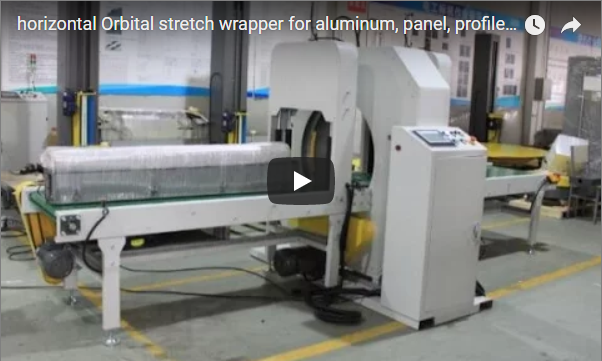
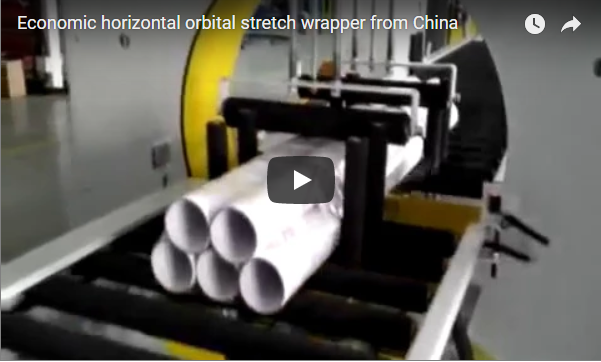
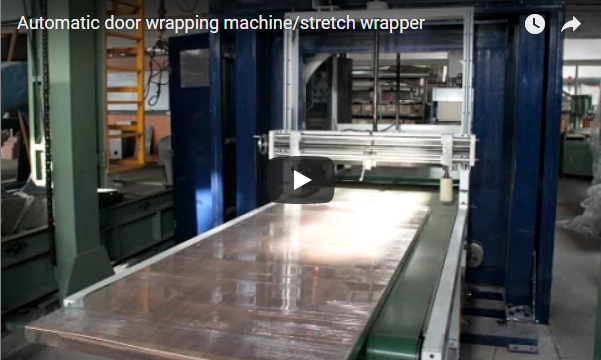
A long, flat metal profile lies on the white rollers of the infeed table and runs into our orbital wrapper. The ring sits inside a yellow mesh guard on a blue frame, with a white film roll on its carriage.
The ring turns around the profile as it moves through, and the film spirals along it. A grey control cabinet stands beside the machine, and a second roller table carries the wrapped profile out.
How semi-automatic orbital wrapping works
| Step | Who does it |
|---|---|
| Place the profile on the infeed rollers | Operator or crane |
| Tie the film end to the profile | Operator |
| Feed through the turning ring | Machine |
| Cut the film and tuck the tail | Operator |
| Lift the wrapped profile off the outfeed | Operator or crane |
The ring and the feed run on their own once started, so the wrap is even along the length. The operator only handles the film at the start and the end.
Film overlap: feed speed vs ring speed
Each ring turn lays one band of film. The load moves forward between turns, so:
Advance per turn = feed speed ÷ ring speed
Illustrative example with 250 mm film at half overlap:
| Item | Value |
|---|---|
| Advance per turn wanted, half of 250 mm | 125 mm |
| Feed speed needed | 125 mm × ring speed in r/min |
| Time for a 6 m profile | 6 m ÷ feed speed |
Slow the feed for more overlap, or speed it up for less. Our horizontal ring orbital stretch wrapper with press-down devices uses the same relation on a larger ring. If the ring speed changes, the feed must change with it to keep the same cover.
Film per profile
Illustrative example for a profile bundle 200 mm wide and 100 mm high, 6 m long, at the 125 mm advance above:
| Item | Value |
|---|---|
| Bundle perimeter, 2 × (200 + 100) | 600 mm |
| Turns per metre, 1,000 ÷ 125 | 8 |
| Film per metre, 8 × 0.6 m | about 4.8 m |
| Film per 6 m profile, 6 × 4.8 m | about 29 m |
This covers the spiral along the length only. Extra turns at each end, which hold the profile ends, add to it, and the figures are film laid on the load; pre-stretch means the roll pays out less.
Controls and safety
The ring turns at speed inside its yellow mesh guard. Keep hands outside the guard while it runs, and tie or cut the film only when the ring has stopped.
The standards that apply depend on the destination market. For CE markets, ISO 12100 sets the risk-assessment method and EN 415-10 sets general requirements for packaging machines.
Selection checklist for a semi-automatic orbital wrapper
- Profile or bundle width, height and length.
- Heaviest piece.
- Pieces per shift (for bar loads, see our automatic bar wrapping machine and small orbital wrapper).
- Overlap and number of layers wanted.
- Roller table length on each side.
- Floor space and power supply.
Engineering FAQ
Q: What does semi-automatic mean here? A: The ring and feed run on their own; the operator starts and ends the film by hand.
Q: How do I set the overlap? A: Advance per turn equals feed speed divided by ring speed. For half overlap on 250 mm film, the feed must advance 125 mm per ring turn.
Q: How much film does a 6 m profile take? A: About 29 m for a 200 × 100 mm bundle at half overlap in our example.
Q: Does the operator guide the profile through the ring? A: No. Once started, the ring and feed run on their own; the operator only fixes the film at the start and cuts it at the end.
Q: Can it wrap single profiles and bundles? A: Yes, as long as the piece passes through the ring and rests on the rollers.
Q: Why roller tables on both sides? A: Long pieces need support in and out, so the profile stays straight through the ring.
Next step
We plan your orbital wrapper in three steps:
- Submit your layout drawing with profile sizes, lengths and output to info@fhopepack.com.
- Receive a proposal within 48 hours, with the ring and feed plan.
- Book a site survey to check the roller table layout and floor space.
Related reading
- Video: economic horizontal orbital stretch wrapper for pipe and tube
- Video: rod orbital wrapper and bar wrapping machine
- Horizontal orbital stretch wrapper
Sources
- Machine content: FHOPE engineering team, 2026-10-04
- Overlap and film examples: our worked examples, illustrative values
- Machine in action: our video on YouTube
- Standards scope: ISO 12100:2010, EN 415-10:2014
Last reviewed: 2026-10-04