Installed in 2 Weeks: Steel Coil Strapping, Labeling, Wrapping & Stacking Line

Executive summary: This factory-floor clip is presented as a steel coil strapping, labeling, wrapping, and stacking line that was installed in just two weeks. What the video shows is a complete steel coil packing line inside a clean factory hall: film-wrapping stations with rotating arms and film rolls, roller-conveyor transport, rotating platforms, PLC control panels, and FHOPE-family branding on the machines and coils. What the video does not show is the installation site, the two-week schedule, or confirmable strapping, labeling, and stacking steps in the footage — those points must be verified with the manufacturer before they are quoted.

The original video page calls this line “Installed in 2 Weeks” and appends a six-point “true information” block describing how the line is built, tested, and commissioned. This article walks through what the footage actually shows frame by frame, then compares each of the six claims against the visual evidence, and flags anything the clip cannot prove. The “two weeks” figure in the title is a schedule claim, and it is one of the things the footage cannot demonstrate.

What the video shows

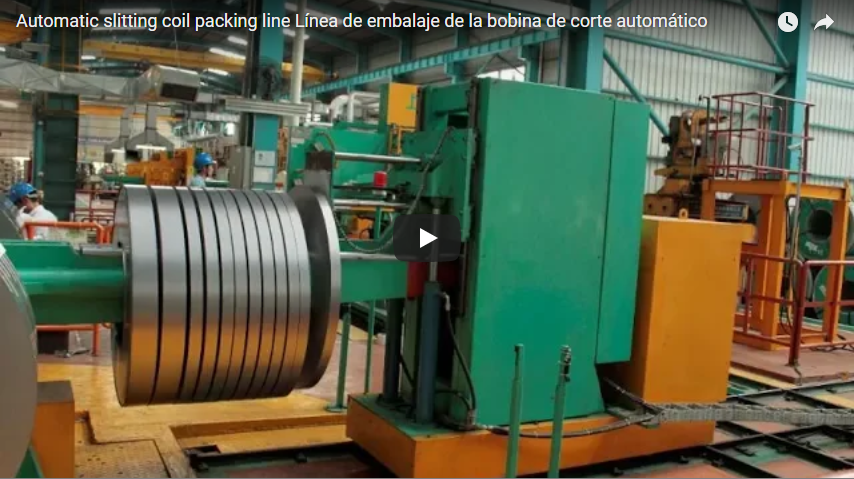
The clip is a touring take of a complete steel coil packing line inside one factory hall, and it divides into clear areas:

  • Factory-floor setting. Chinese production and safety signs appear on the hall walls — phrases such as the ones read as “safe production,” “quality,” and a blade-edge hazard warning — which places the line inside a Chinese factory hall rather than at a named customer site. There is no address, country marker, or installation landmark anywhere in the clip.
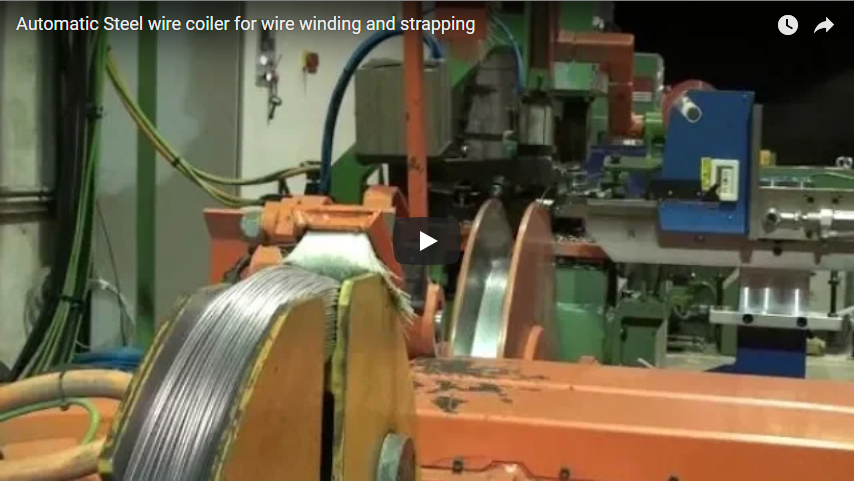
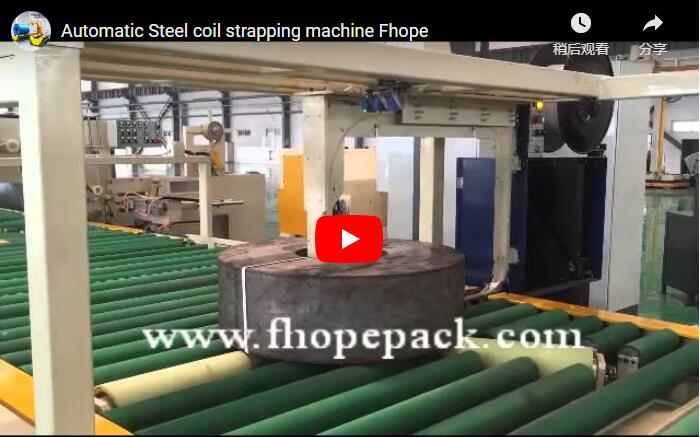
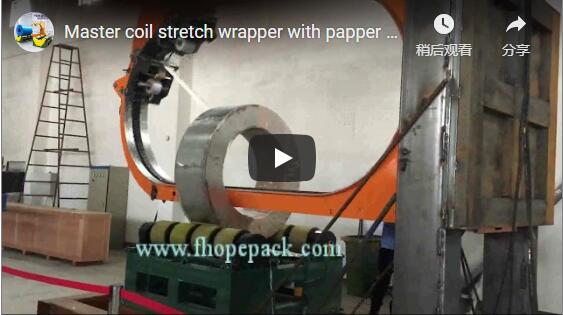
  • Film wrapping dominates the footage. The clearest and most repeated evidence is wrapping: rotating-arm wrap mechanisms, film rolls mounted beside the line, film being fed toward coils, and many coils already covered in transparent stretch film.
  • Transport and platforms. Steel coils travel on roller conveyors and sit on central rotating platforms at several stations, with a conveyor carrying coils through the line and past a pallet-like support near the machine.
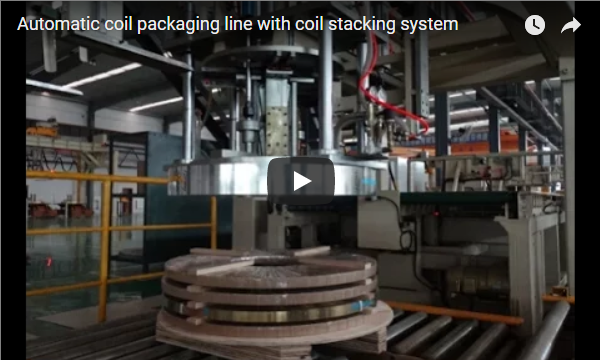
  • Overhead stations. Several frames show a vertical press or overhead head positioned above a coil, with the structure and control elements of a packing station around it.
  • Control panels. PLC cabinets with digital displays and red emergency-stop buttons appear at multiple points along the line, including next to an operator.
  • Branding throughout. Machine plates and coil labels carry the line builder’s branding — read across frames in a family of spelling variants (all the same FHOPE-family mark) and on some coil labels paired with words like “packing solution.”
  • Operators are intermittent. A worker stands at a control panel in some frames, an operator’s leg appears at the infeed, and a couple of workers are visible near the machines or on an observation platform — but most frames are empty of people.

Direct observation notes

Staying close to the visual evidence:

  • The line is a real, complete steel coil packing system — conveyors, wrap stations, rotating platforms, and control panels are all physically present and coherent.
  • The footage is taken in a clean factory hall with Chinese signage, consistent with a manufacturer’s own test or demo floor rather than a busy customer production site.
  • Wrapping is the operation clearly shown. Film rolls, feed arms, and film-wrapped coils appear in the majority of sampled frames.
  • No coil stacking is visible. Every frame shows a single coil on a conveyor, platform, or pallet; there is no palletizer, no multi-coil stack, and no finished-coil accumulation.
  • Strapping and labeling are not confirmable. On close re-check of the frames a label-like mark and some darker bands first read as steel strap and a label head were re-read as the same soft stretch film and machine structure — the camera resolution does not let a strap or label station be confirmed.
  • Static-in-still reality: the sampled frames mostly show coils already wrapped and machines at rest; still frames cannot prove a completed wrap cycle, continuous running, or line speed.
  • The “two weeks” figure has no on-screen support — there is no installation timeline, no calendar, no site handover, and no commissioning log in the clip.

The six “true information” claims vs the footage

The original post appends a six-point block of manufacturer claims. The footage supports some of these directly; the rest must be confirmed with the manufacturer:

Manufacturer claim Shown in the footage? Verdict for this article
Factory Pre-Assembly — stations assembled and tested before shipment No — the line is shown assembled and operational; its pre-shipment history is invisible Verify with manufacturer
Modular Line Design — built in modules for faster transport and installation Partly — several discrete stations sit along one conveyor, a modular-looking layout Modular layout visible; build and transport methods verify with manufacturer
Pre-Shipment Testing — full line runs in the factory to verify function and coordination Partly — a complete line runs on a factory floor with Chinese signage, consistent with a factory test run Factory run visible; whether it is a specific pre-shipment acceptance test must be verified with manufacturer
Four-Station Configuration — strapping, labeling, wrapping, and stacking in one line Wrapping is clearly shown; strapping and labeling are not confirmable at frame resolution; stacking is not shown at all Partial — wrapping only; verify the full four-station scope with manufacturer
On-Site Commissioning — installation and trial running with engineering support Not demonstrated — a few frames show workers near panels, but no installation or trial activity Verify with manufacturer
Reduced Production Downtime — earlier start shortens the gap before output, i.e. the “installed in 2 weeks” claim Not demonstrated — no installation-site footage, schedule, or downtime data Verify with manufacturer

The honest read: the clip is genuine factory documentation of a FHOPE steel coil packing line with wrapping at its core. What it is not is proof of a two-week install, of all four named stations running, or of any downtime reduction — none of that can be measured in the video.

What the video does not show

For a buying decision, the following are not observable in the footage and must be confirmed with the manufacturer:

Missing information Why it matters
The two-week installation schedule and the actual install site The “installed in 2 weeks” promise is the title’s central claim and has no on-screen support
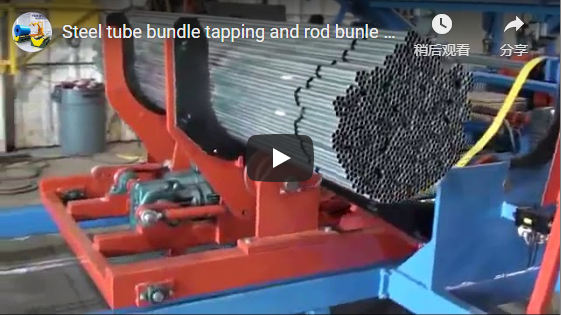
A confirmable strapping station or steel strap application The line name promises strapping; only stretch film is reliably visible
A confirmable label-printing or label-application station The line name promises labeling; only product labels on individual coils appear
Stacking or palletizing of finished coils No finished-coil accumulation appears anywhere in the clip
Continuous-operation proof, cycle time, and throughput Capacity matching for your plant
Coil size and weight range handled by the line Whether your coil mix fits the line
Commissioning and trial-run records, and support scope What installation and after-sales support the manufacturer actually provides
Film type, thickness, and wrap tension Packaging cost and coil surface protection

How to read factory-floor coil footage when a two-week install is claimed

Factory demos are useful evidence that a line exists, but a schedule claim needs a different standard of proof:

  • Trust the hardware, not the copy. The conveyors, wrap stations, rotating platforms, and control panels are visible and credible. Treat the six-point block and the “two weeks” headline as marketing claims until confirmed.
  • Separate “line exists” from “installed fast.” The clip proves a complete line is built and set up on a factory floor. It cannot prove how long installation took anywhere.
  • Ask for the missing stations by name. Wrapping is on camera; strapping, labeling, and stacking are not. Ask which of the four named stations this exact line really includes, and for photos or run records of each.
  • Request the install record. Ask for the site, the start and handover dates, and the commissioning report behind a “two weeks” claim.

On-site verification checklist

Use this checklist when you follow up on the clip:

  • Ask which stations the delivered line includes: strapping, labeling, wrapping, stacking — and confirm each against run records.
  • Request the installation schedule, site name, and handover dates behind the “installed in 2 weeks” figure.
  • Request the pre-shipment test report and the factory trial-run data for this exact line.
  • Ask for measured cycle time, coils per hour, and film consumption for your coil size.
  • Get film material, thickness, and wrap tension specifications.
  • Confirm the handled coil size and weight range.
  • Confirm engineering support, commissioning, and after-sales terms in writing.
  • Schedule a live call or a demonstration before making a decision.

FAQ

Is this video showing a line installed at a customer site in two weeks? No. The footage shows a complete steel coil packing line inside a clean factory hall with Chinese signage — there is no customer site, no installation timeline, and nothing that documents a two-week schedule. The “installed in 2 weeks” figure is a manufacturer claim to verify with the manufacturer.

Does the clip show strapping, labeling, wrapping, and stacking all running? Wrapping is clearly and repeatedly shown. Strapping and labeling are not confirmable at the frame resolution (close re-check read the dark band-like marks as soft stretch film, not steel strap), and no stacking or palletizing appears anywhere. The full four-station scope must be confirmed with the manufacturer.

Does the factory footage prove the line was pre-shipment tested? The clip shows a complete line set up and running on a factory floor, which is consistent with a test run. Whether that run is the specific pre-shipment acceptance testing described in the claims block cannot be proven from the video and must be verified with the manufacturer.

Can I use the “reduced production downtime” claim in an evaluation? Only with confirmation. The downtime-reduction and earlier-output claims in the block depend on installation speed, which the footage does not demonstrate. Ask the manufacturer for install and startup records before quoting any savings.

Can I use this video as a basis for a purchase decision? As evidence that the line exists and is built with wrapping at its core, yes. For the schedule, the missing stations, throughput, reliability, and support terms, request written specifications and measured production data from the manufacturer — those are exactly the points the footage does not show.

Related reading

Next step

If this steel coil line matches the kind of packing operation you are planning, turn the clip into a verification conversation: send your coil dimensions, weight range, and target output, and ask the manufacturer to confirm which of the four named stations the line really includes, the install site and dates behind the “two weeks” claim, the pre-shipment test report, and measured throughput for your coil size. Use the contact page to start that exchange and to arrange a live demonstration or a factory visit, and verify every schedule and capability claim from the video with the manufacturer before you commit.

Published: 2026-09-17