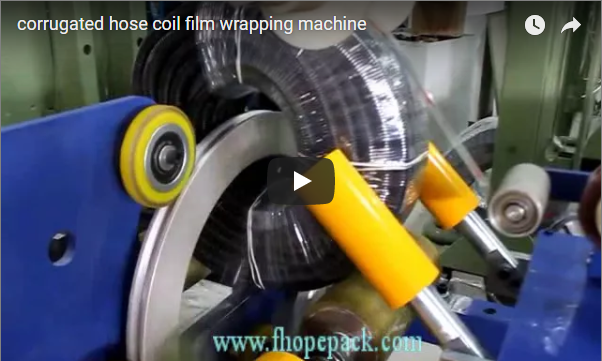
Executive summary This clip shows one of our slit coil lines in our workshop. A teal upender turns each coil, an orbital ring wraps it eye-through on a green conveyor line, and a yellow hooded gantry stacks the wrapped coils on a long outfeed conveyor. Conveyor sections between the stations act as buffers, so a short stop at one station does not stop the slitter upstream.
Table of Contents
- What the clip shows
- Why buffers between stations
- Buffer length
- What we set per line
- Selection checklist
- Safety
- Engineering FAQ
- Next step
- Related reading
- Sources
What the clip shows
| Step | What you see |
|---|---|
| Workshop | Several of our coil lines in assembly |
| Upending | A teal upender with a large rotary disc turns the coil |
| Wrapping | An orbital ring wraps the coil eye-through while an operator watches |
| Stacking | A yellow hooded gantry picks and stacks wrapped coils |
| Outfeed | Stacks travel along a long conveyor |
Why buffers between stations
- Short stops are absorbed. A film change or strap jam fills the buffer instead of stopping the line.
- Stations run at their own pace. Each one takes the next coil when ready.
- The slitter keeps cutting. Coils keep leaving the slitter while the buffer has room.
- Fewer restarts. Less stop-start means steadier cycle times.
Buffer length
Worked example (illustrative).
| Item | Value |
|---|---|
| Slitter output (illustrative) | 1 coil per 60 s |
| Stop to absorb, film change (illustrative) | 5 min |
| Coils arriving during the stop, 5 × 60 ÷ 60 | 5 coils |
| Conveyor length per coil position (illustrative) | 1,500 mm |
| Buffer length needed, 5 × 1,500 | 7,500 mm |
The length per coil position includes the coil itself plus the gap between coils.
What we set per line
| Setting | Depends on |
|---|---|
| Buffer length | Slitter output and longest stop |
| Upender | Coil weight and position |
| Wrapping | Film layers and overlap |
| Stacking | Coils per stack |
Selection checklist
- Coil OD, ID, width and weight.
- Slitter output in coils per hour.
- Longest stop to absorb.
- Floor length for buffers.
- Wrapping and strapping needed.
- Stack pattern.
Safety
- Keep clear of the upender, ring and gantry while they move.
- Stay outside the fenced gantry area.
- Lock out before clearing a jam.
- For CE markets, the machine is designed to ISO 12100 and EN 415-10.
Engineering FAQ
Q: Why add buffers? A: So a short stop at one station does not stop the slitter.
Q: How long should a buffer be? A: Coils arriving during the longest stop times the conveyor length per coil; 7,500 mm in the worked example.
Q: Does the line upend coils? A: Yes, a teal upender turns each coil before wrapping, as in the clip.
Q: What does the gantry do? A: It picks wrapped coils and builds stacks on the outfeed.
Q: Can buffers be added to an existing line? A: Often yes, if there is floor length.
Q: Which standards apply? A: For CE markets, ISO 12100 and EN 415-10.
Next step
We match a slit coil packing line in three steps:
- Submit your layout drawing with coil sizes, slitter output and floor layout, to info@fhopepack.com.
- Receive a proposal within 48 hours with the machine data and layout.
- Book a site survey so we confirm the slitter exit and floor length.
Related reading
- Slit Coil Tilting, Eye-Through Wrapping and Stacking Line
- Narrow Steel Coil Packing Line
- Automatic Steel Coil Stacking and Palletizing Gantry
- Slit coil packing line
Sources
- Machine content: FHOPE engineering team, 2026-10-10
- Clip: the video on YouTube
- Buffer length: our worked example, illustrative values
- Standards scope: ISO 12100:2010; EN 415-10:2014
- Proposal timing: approved house CTA (proposal within 48 hours)
Last reviewed: 2026-10-10