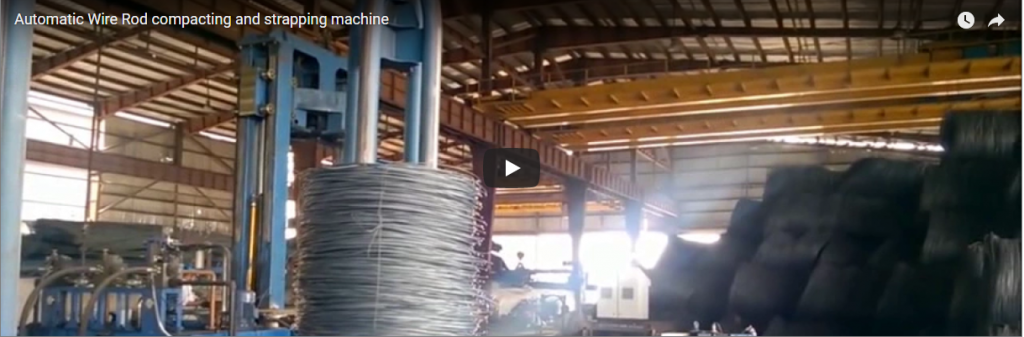
Executive summary This video shows an automatic rebar tying machine bundling ribbed steel bars with wire in a single continuous flow: bars feed in from the left, mechanical arms wrap and cut wire at multiple points, and the finished tied bundle exits to the right. The footage demonstrates the feed–tie–exit sequence end to end, but does not show cycle time, rated capacity, machine dimensions, or control panel details. Use this article to understand how automatic rebar tying works and what to verify with the manufacturer before buying.
Why automatic rebar tying matters
Anyone who has worked around construction supply yards or rebar fabrication shops knows the manual version of this job: workers crouch over piles of long steel bars, twisting wire ties by hand, bundle after bundle. It is slow, repetitive, and hard on the body. Hand-tied bundles also vary — one tie is tight, the next is loose — and loose ties come apart during lifting, transport, or concrete pouring.
An automatic tying machine replaces that manual loop with a mechanical arm that wraps wire around the whole bundle, cuts it, and secures it at consistent intervals. The result is a bundle that holds its shape from the moment it leaves the machine to the moment it reaches the jobsite. The video on this page shows exactly that process running on a factory floor, with no operator intervention visible in the frame.
How it works: the three stages you can see
Following the video from start to finish, the process falls into three clear stages:
- Feed (0s–10s). A bundle of ribbed rebar enters the machine from the left side, guided along a feed path. The bars align into a single bundle as they move into the central processing area.
- Tie (0s–10s). The machine’s articulated mechanical arms move around the bundle and wrap thin wire at multiple points. The wire is cut and secured after each wrap, producing tight, uniform ties. This step runs continuously and automatically — the footage shows repeated tying without pauses or manual adjustment.
- Exit (10s–12s). The completed bundle is pushed out toward the right side of the machine, where it can be collected or moved to the next stage, such as stacking or wrapping.
The whole sequence is hands-free in what the camera captures. The operator’s role is presumably loading and unloading, but no manual action appears in the footage itself.
What the video shows
- A large bundle of ribbed deformed steel rebar being fed into the machine from the left, in a stationary camera shot that holds for the first ten seconds.
- A mechanical arm assembly with multiple articulated joints actively wrapping wire around the bundle at several points.
- A wire feeding and cutting mechanism completing each tie automatically.
- Visible hydraulic cylinders and silver structural components working alongside the dark gray and black painted frame.
- The finished, tightly bound bundle exiting toward the right at around the ten-second mark.
- A second camera angle (10s–12s) from a higher vantage point showing the machine in the context of the surrounding factory floor.
What the video does not show
Honest limits matter when you are evaluating equipment. The following are not observable in this footage, and each should be confirmed with the manufacturer before you make any purchase decision:
| Item | Status | Why it matters |
|---|---|---|
| Rated capacity (bars per bundle, max weight) | Not shown | Determines whether the machine fits your product range |
| Cycle time per tie | Not shown | Sets your real throughput |
| Machine dimensions | Not shown | Needed for floor planning |
| Rebar diameter range | Not shown | The video shows medium-diameter bars (roughly 12–16 mm by visual scale); larger or smaller bars need confirmation |
| Control panel layout | Not clearly visible | You cannot judge ease of use from this video |
| Emergency stop, warning labels, interlocks | Not visible | Safety features must be verified in person |
| Power source and consumption | Not shown | Affects installation cost |
| Model number and certifications | Not shown | Affects documentation and compliance |
None of these gaps are unusual for a short demonstration clip, but treat them as open questions, not as facts.
Direct observation notes
The block below stays close to what the footage actually shows, with only light grammatical smoothing — no interpretation, no added claims.
- The video opens on a stationary shot of a rebar tying machine in operation; a large bundle of rebar is fed into the machine from the left, and the machine’s mechanical arms move actively as the bundle is tied with wire.
- The camera remains relatively still during the first ten seconds, giving a clear view of continuous tying.
- At roughly 10–12 seconds the camera pans right and tilts upward, showing the machine from a higher angle along with other machinery and materials on the factory floor.
- The machine is built from dark gray and black painted metal, with silver-colored components such as hydraulic cylinders and structural beams.
- Key visible components: a horizontal feed mechanism, a large articulated mechanical arm assembly, a wire feeding and cutting mechanism, visible hydraulic cylinders, and a conveyor or guide system feeding the rebar in.
- The product is a bundle of deformed steel reinforcing bars with a ribbed surface, metallic gray in color, of medium diameter estimated around 12–16 mm based on machine scale; the bundles are tightly bound with thin wire.
- A protective guard is present around the moving arms and wire-feeding mechanism.
- The control panel is present but not clearly visible; no emergency stop button, warning labels, or interlocks are visible in the frames.
- No readable text, labels, or watermarks appear in any frame.
What automatic tying changes for your operation
Based on what the footage demonstrates, the practical benefits are straightforward:
- Consistency. Every tie is wrapped and cut the same way, so bundle integrity does not depend on which worker performed the tie or how tired they were.
- Continuous flow. The video shows tying running nonstop for the full first segment — the machine does not stop between ties in the captured sequence.
- Reduced repetitive strain. Hand tying is a classic repetitive-motion injury task. Automating the wrap-and-twist motion removes that exposure.
- Cleaner bundle handling downstream. Uniform ties make the bundle easier to lift, move, stack, and later unwrap at the jobsite.
The trade-offs worth thinking through: the machine appears sized for a specific range of bar diameters, so shops handling very small or very large bars need to confirm compatibility. And because the moving arms and wire mechanism carry real entanglement risk, training and guarding procedures are not optional extras — they are part of the installation.
A buyer’s verification checklist
If this type of machine fits your product, work through this list with the manufacturer before ordering:
- Confirm the rated bundle capacity (number of bars and maximum weight per cycle).
- Confirm the supported rebar diameter range against your product mix.
- Request the actual cycle time per tie and realistic hourly throughput.
- Get machine dimensions and installation footprint for floor planning.
- Inspect the control panel in person or via a live demo — it is not visible in this video.
- Verify safety equipment: emergency stop, interlocks, guarding coverage, and warning labels.
- Confirm power supply requirements and hydraulic system specifications.
- Ask about wire specification and wire consumption per tie, an ongoing operating cost.
Frequently asked questions
What does the machine tie — single bars or bundles? The video shows a bundle of multiple ribbed rebar rods being tied together in one operation. The maximum number of bars per bundle is not shown — check with the manufacturer.
Does the machine tie automatically, or does an operator tie each point? The footage shows the process running continuously and automatically, with no manual tying action visible. The arms wrap, the wire is cut, and the tie is secured without operator input in the frame.
How fast does it tie? Cycle time is not observable in the video. Ask the manufacturer for cycle-time data on your specific bar diameter and bundle size.
What safety features does it have? A protective guard around the moving arms and wire-feeding mechanism is visible. No emergency stop, warning labels, or interlocks can be seen in the footage, so safety features must be verified directly with the manufacturer.
What sizes of rebar can it handle? The video shows medium-diameter bars, roughly 12–16 mm by visual estimate. The full supported diameter range is not shown and should be confirmed with the manufacturer.
Source and method
The facts in this article come from the video above — the only factual source used. The footage was analyzed by a vision model on sampled frames; the video contains background music only, with no narration or speech, so no spoken content was transcribed. Statements not observable in the footage are explicitly marked as needing manufacturer confirmation.
Related reading
- Automatic horizontal stretch wrapper — for bundling and wrapping long products after tying.
- Automatic pallet wrapping machine — downstream protection for stacked bundles.
- Semi-auto pallet wrapping machine — a lower-volume wrapping option for mixed operations.
- Automatic packing line — how tying fits into a full end-of-line setup.
Next step
If automatic rebar tying looks like a fit for your line, the fastest way to move forward is to send us your bar diameter range, typical bundle size, and target output. We will confirm machine compatibility, real cycle times, and the safety configuration for your installation. Visit our contact page to start the conversation.
Published: 2026-09-03