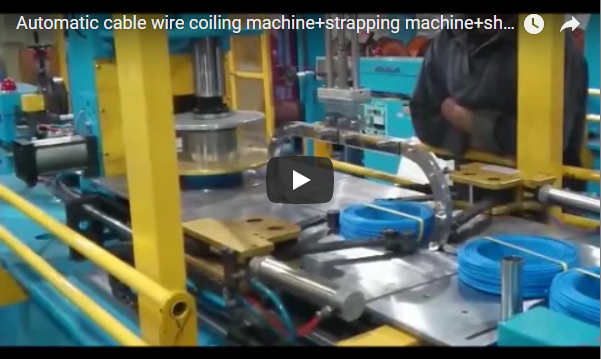
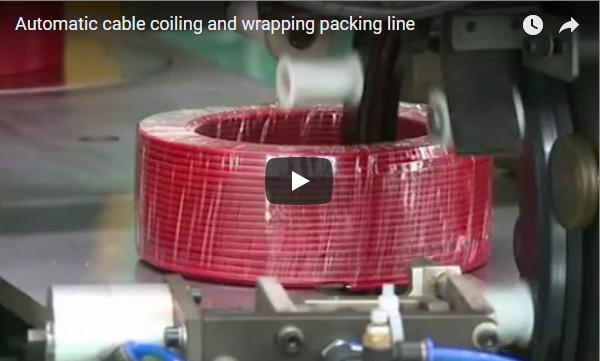
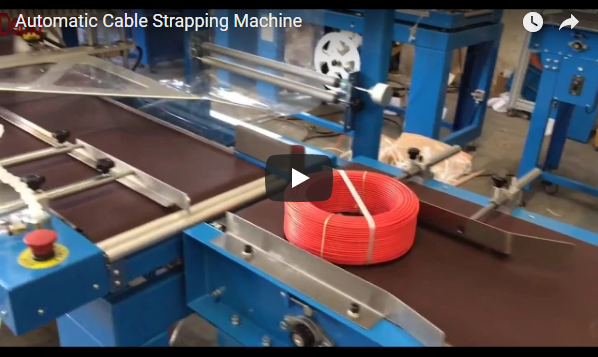
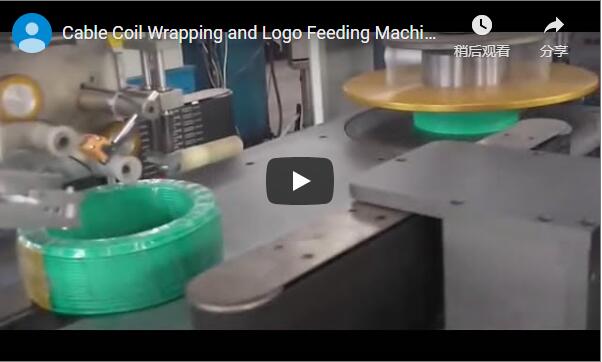
Executive summary This clip shows one of our hose packing cells: a bright green corrugated hose is wound on a rotating spool by yellow-and-silver guide arms, then the finished coil is strapped and sent out on a roller conveyor. Below we walk through the stations, list the published FCL hose-coiler ranges as sizing anchors, and set out what to fix before an online coiler is linked to an extruder. Big-hose cells are built to the hose OD of the project; the FCL catalogue covers the smaller OD bands.
Table of Contents
- What the clip shows
- How online hose coiling and strapping works
- FCL hose coiler ranges (catalogue anchors)
- Selection checklist for a hose coiler
- Controls and safety
- Engineering FAQ
- Next step
- Related reading
- Sources
What the clip shows
| Clip time | What is on screen |
|---|---|
| 0–12 s | Green corrugated hose fed and wound on the rotating central spool; yellow/silver guide arms |
| 12–22 s | Coil completed; transfer toward the roller conveyor; white straps on the finished coil |
| 22–23 s | Strapped coil on the conveyor; machine starting the next cycle in the background |
Machine frame is yellow and silver. A yellow warning triangle sits on the electrical cabinet. A yellow safety railing is in the foreground.
How online hose coiling and strapping works
- Hose length is counted in the PLC/HMI program.
- Guide arms lay the hose in a spiral on the rotating spool.
- At the set length the hose is cut.
- PP straps (typically 2 or 4) hold the coil.
- The coil is ejected to the roller conveyor for take-away.
Online cells are built to keep pace with the extruder so the line does not stop for coiling. Twin-coil layouts can switch stations without dropping extruder speed.
FCL hose coiler ranges (catalogue anchors)
Published FCL-V400 variants from our automatic hose coiler page (starting points; machines can be modified for other coil sizes):
| Model | Tube OD | Coil OD | Coil ID | Coil height | Meter counter (page) | Air |
|---|---|---|---|---|---|---|
| FCL-V400A | 4–10 mm | 300–400 mm | 200–300 mm | 40–120 mm | 10–50 | 6 bar |
| FCL-V400B | 10–20 mm | 300–500 mm | 250–400 mm | 80–200 mm | 20–100 | 6 bar |
| FCL-V400C | 15–30 mm | 300–500 mm | 250–400 mm | 150–300 mm | 20–100 | 6 bar |
Features on the page include automatic PP 2/4 tape, automatic cut, automatic ejection, Siemens PLC/HMI, and length set in the HMI. The clip shows a larger corrugated hose than the FCL-V400 OD bands, so a big-hose cell is sized to the project hose OD and coil OD/ID/height rather than copied from the V400 table.
Selection checklist for a hose coiler
- Hose OD / ID and wall type (corrugated, smooth, reinforced).
- Target coil OD, ID and height.
- Cut length range and meter-counter precision.
- Straps per coil (2 or 4 PP) and strap positions.
- Single or twin coiler for continuous extruder feed.
- Conveyor height and take-away method.
- Destination market for the risk assessment package.
Controls and safety
The standards that apply depend on the destination market. For CE markets, ISO 12100 sets the risk-assessment method and EN 415-10 covers general requirements for packaging machines, which fixes guarding and the emergency-stop arrangement.
On the clip: yellow railing in front of the coiler and a warning label on the cabinet. Production cells add interlocks and marked access routes fixed in the risk assessment.
Engineering FAQ
Q: Is the machine in the clip an FCL-V400? A: No. The clip shows a big-hose cell; FCL-V400A/B/C cover smaller tube OD bands up to 30 mm, and big-hose cells are sized to the project.
Q: What tube OD do FCL-V400 models cover? A: 4–10 mm (A), 10–20 mm (B) and 15–30 mm (C).
Q: How many straps are published for the FCL coiler? A: Automatic PP 2/4 tape.
Q: Can the coiler keep pace with an extruder? A: Yes. Twin-coil layouts switch stations so extruder speed is not reduced for coiling (online cell).
Q: What air supply is published? A: 6 bar on the FCL-V400 page.
Q: Which standards apply? A: For CE markets, ISO 12100 and EN 415-10.
Next step
We plan a hose coiling and strapping cell in three steps:
- Submit your layout drawing with hose OD, cut length and coil size, to info@fhopepack.com.
- Receive a proposal within 48 hours, with coiler layout, strap pattern and conveyor height.
- Book a site survey so we confirm extruder link, floor space and guarding.
Related reading
- Double Wall Corrugated Hose Coiling and Strapping Machine: Coil Sizing and Output
- Automatic Hose Coiler for Corrugated Hose, with Strapped Coils
- Automatic Pipe Coiling and Wrapping Machine for Hose and Plastic Tubes
- Automatic hose coiler
Sources
- Machine in action (our shop footage): the video on YouTube
- FCL-V400A/B/C tube OD, coil OD/ID/height, meter counter, 6 bar, PP 2/4 tape, PLC/HMI, extruder link: Automatic hose coiler
- Standards scope: ISO 12100:2010; EN 415-10:2014
- Proposal timing: approved house CTA (proposal within 48 hours)
Last reviewed: 2026-10-07