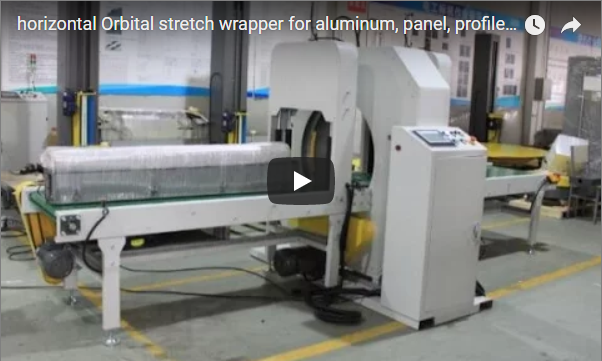
Executive summary This factory test-run clip demonstrates a horizontal orbital wrapping machine on a conveyor-fed work zone. A long, black, metal workpiece is carried on a roller conveyor through a fixed circular wrapping ring; the ring rotates around the bar and draws transparent stretch film from an overhead roll, and a fully film-covered bundle exits the far side. The footage confirms the conveyor pass-through wrapping cycle working end to end. The mobile-bridge longitudinal travel that the product name refers to, plus rated throughput, overlap settings, and certifications, is not demonstrated in this clip and must be confirmed with the manufacturer.
What the Test Run Shows, Frame by Frame
The clip runs about seventy seconds. Frames in the analysis are roughly three seconds apart, so the phase boundaries below are approximate — the important part is the order of operations, which is consistent across every frame.
- A long workpiece is already staged on the line. A black, elongated metal bar sits on a roller conveyor, its length running along the machine axis. The bar is glossy and flat-profiled — many times longer than it is wide.
- The operator hand-starts the film. In the opening moments a worker pulls the leading edge of the transparent stretch film by hand, feeding the film end toward the wrapping zone. After this lead-in the machine runs the rest of the cycle on its own.
- The piece passes through a fixed orbital ring. The conveyor carries the bar from left to right straight through the centre of a circular wrapping ring. The ring itself stays in place — it is the workpiece that travels through it.
- The ring rotates and applies the film. As the bar moves through, the ring spins around it, taking film from an overhead roll and wrapping it around the sides and top of the bar in successive revolutions. By the middle of the clip the bar’s surface is progressively covered in a tight transparent layer.
- A sealed, film-covered bundle exits. Once the trailing end clears the ring, the wrapped bar continues out of the machine, fully enclosed in film, with the sheet cut and sealed at the finish.
The whole demonstrated sequence is one continuous belt-fed flow: stage, hand film lead-in, pass through the ring, orbit-wrap in transit, and discharge a covered bundle. The motion that the model name highlights — a bridge that travels along the product’s longitudinal axis — does not appear in this particular footage; here the ring is stationary and the product moves.
Direct observation notes
The statements below are limited to what is actually visible in the video frames. No inference has been added.
- Machine — A long, mostly white metal wrapper with a conveyor running through it. The circular wrapping ring sits in the middle of the line and is enclosed by a white metal-mesh guard, so the ring’s turning arc is visible through the mesh while the operator stays outside the wrap zone.
- Workpiece — A black, long, flat-profiled metal bar, glossy and smooth-surfaced, carried horizontally on the conveyor the whole time.
- Wrapping material — A transparent stretch film fed from an overhead roll. The rotating ring draws the film around the bar; no printed or coloured film is visible apart from brand lettering on the sheet (see below).
- Operator — At the start of the clip a worker pulls the film’s leading edge by hand to begin the wrap. From then on the pass-through, rotation, wrapping, and discharge run automatically with no one touching the bar or the film.
- Controls — A white control cabinet sits at the right of the line with a touchscreen interface, round push buttons, and indicator lights. A red emergency-stop button is clearly visible at the upper right of the panel, with green start and yellow pause buttons beneath it.
- Branding — “FHOPE GROUP” is printed on the wrap film, with the line “PACKING SOLUTION” beneath it; the same brand name appears on the control-cabinet screen. FHOPE GROUP is the manufacturer’s own brand, visible here both on the sheet and on the machine’s display.
- Safety hardware — A metal-mesh guard surrounds the orbital area and a red emergency-stop button is present. No light curtain, warning signage, or door interlock appears in the clip; that absence does not prove the production machine lacks them — it must be confirmed with the manufacturer.
- Not observable — Rated packages per hour, ring speed, overlap range, bar size capacity, power draw, machine dimensions, model number, and any certification marks (CE, ISO) are not shown anywhere in the footage.
Confirmed by Footage vs. Confirmed by Manufacturer
| Area | What the footage confirms | What you must verify with the supplier |
|---|---|---|
| Wrapping mechanism | A fixed circular orbital ring rotates around the bar while the conveyor moves the piece through it | Whether the production unit is the mobile-bridge variant whose ring travels along the product, and the travel distance available |
| Film feed | Transparent film drawn from an overhead roll and wrapped around the bar by the rotating ring | Film width, gauge, and whether printed/coloured film options are available |
| Workpiece | A long black metal bar passes through the ring and exits fully film-covered | Minimum and maximum bar/profile length, width, height, and weight the line accepts |
| Control | Touchscreen cabinet with a red e-stop, green start, and yellow pause buttons plus indicator lights | Recipe/HMI options, programmable overlap settings, and remote/IoT integration |
| Safety | Metal-mesh guard around the orbit area and a visible emergency-stop button | Standard vs. optional safety packages and certification documents (e.g. CE, DIN EN ISO 13849-1) |
| Performance | An automatic wrap cycle completes entirely within the clip | Rated packages per hour, orbital ring speed, overlap range, and electrical requirements |
Who This Machine Is Designed For
The demo suits anyone who has to protect long, heavy, easily scratched products, because the orbital wrap in the video removes the two things people least want to do by hand with a long bar: wrapping it in film along its whole length and doing so at a consistent tension.
- Long-product producers — copper and aluminium bars, pipes, tubes, extrusions, and profiles that travel in single long bundles.
- Building-material and timber plants — wrapped lengths of moulding, skirting, trim, and insulation board.
- Metal-service centres handling bar stock that must arrive clean and scratch-free after finishing.
- Lines that feed downstream packing, where the wrapped bundle needs a uniform film layer before strapping, palletizing, or labelling.
Only the one black bar is demonstrated in this clip, so size limits and the range of profile shapes supported are items to confirm with the builder rather than statements this video can support.
What to Verify Before You Buy
None of the following appears in the video, so add these to your request-for-quote checklist:
- Which configuration you need: the mobile-bridge version (ring travels along the product) or the fixed-ring conveyor-fed version shown here.
- Bar/bundle size range supported — length, width, height, and maximum weight.
- Rated packages per hour and orbital ring speed for your required overlap.
- Film options — standard transparent film, width, gauge, and printed or coloured film.
- Control options — HMI language, recipe storage, remote access, and how overlap/tension are programmed.
- Standard and optional safety equipment, plus the certification documents that apply in your region.
- Electrical supply — voltage, phase, and power draw — and floor-space/footprint dimensions.
- How the machine integrates with your existing infeed/outfeed conveyors or with an automatic strapping stage.
FAQ
Does this video show the “mobile bridge” moving? No. In this clip the orbital ring is fixed and the bar travels through it on the conveyor. The mobile-bridge motion named in the product is not demonstrated here, so ask the supplier for a demo or specification showing the bridge travelling along a product if that feature is why you are interested.
What kinds of products can an orbital wrapper handle? Horizontal orbital wrappers are built for long, uniform-profile items — bars, pipes, extrusions, mouldings, and bundles. Only one black metal bar is shown in this video, so confirm the actual size and shape range with the manufacturer for your products.
Does the machine strap as well as wrap? Strapping is not shown as a step in this clip. Some FHOPE lines combine orbital wrapping with strapping and palletizing, but that configuration is something to confirm for the specific machine you are quoted, not something this video demonstrates.
How automated is the process? Almost entirely. A worker pulls the film lead by hand at the start; from there the conveyor feed, ring rotation, film wrapping, and discharge run automatically in the footage. Confirm how infeed, discharge, and any tail-sealing are handled in your layout.
Is it safe to run near operators? The visible protection is a metal-mesh guard around the orbital area plus a red emergency-stop button. Light curtains, interlocked doors, and certification documents are not shown in the clip, so ask which safety package comes standard and which certifications apply before committing.
Related reading
- Orbital Stretch Wrapper — the orbital wrapping family this machine belongs to.
- Automatic Horizontal Stretch Wrapper — automatic horizontal orbital wrapping for long products.
- Customize Orbital Wrapper — configuration options when your bar or bundle dimensions are outside standard ranges.
- Semi-auto Horizontal Wrapper — a lower-footprint alternative for simpler wrapping duties.
- Pipe Packing Machine — companion wrapping line for long pipe and tube products.
Next step
If this horizontal orbital wrapper looks like a fit for your bar, pipe, or profile line, send us your product sizes, bundle weights, and target output so our team can match you with the right configuration — fixed-ring conveyor type or mobile-bridge version.
Published: 2026-09-09