Executive summary
An automatic horizontal stretch wrapper winds clear film around a small carton as the box travels straight through, so the load keeps its orientation and the film stays tight. The finished box is taken off by hand at the end of the conveyor. Throughput, film spec and guarding are confirmed per project, with 380 V three phase 50 Hz supply selected per project.
Table of Contents
- Why wrap a small box horizontally
- What the machine does
- Infeed conveyor and film grip
- Wrap pass and take-off
- What the footage shows
- Typical configuration
- Selection checklist
- Operation and safety
- Engineering FAQ
- Next step
- Related reading
- Sources and standards
Why wrap a small box horizontally
Small cartons are the awkward ones on a line: quick to fill by hand but slow to wrap consistently. A horizontal stretch wrapper lays film around the box as it passes, so every carton leaves with the same tight, clean cover. Because the load never turns, a light small box stays flat and stable during the wrap. Box size and film grade are confirmed per project.
What the machine does
The machine is a horizontal stretch wrapper laid out as a straight line. A small carton sits on the infeed roller conveyor. The film grip brings the film over the top of the box, and the film winds around the load as the box passes the roll. The wrapped carton continues on the outfeed, where an operator lifts it off by hand at the take-off point. Line speed and film width are confirmed per project.
Infeed conveyor and film grip
The infeed is a roller conveyor at machine height, with the film roll mounted above the working section. A grip assembly rises and falls over the line: at the start of the cycle it comes down, takes the film and holds it against the box so the wrap starts clean. A transparent door covers the wrap zone while the machine runs. Roller spacing and film width are confirmed per project.
Wrap pass and take-off
With the film held at the top of the box, the load moves forward and the film winds around it in the working section. The wrap ends when the box clears the film path, and the wrapped carton reaches the outfeed on the same conveyor. An operator takes the box off by hand and places it on a pallet or into the next station. Wrap coverage and pass speed are confirmed per project.
What the footage shows
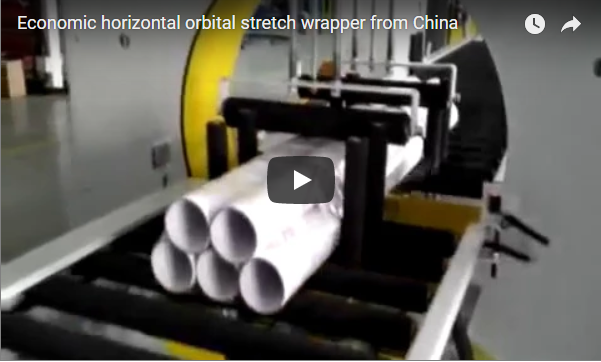
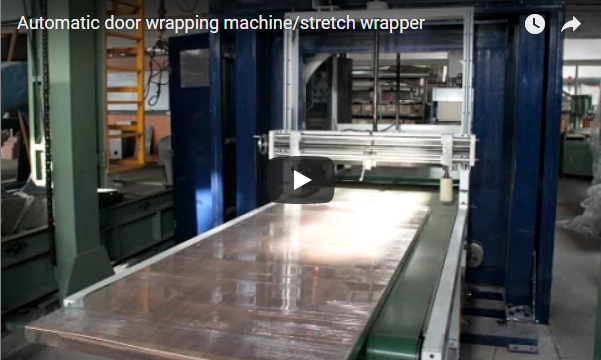
Our footage shows the machine at idle with the grip held high and a brown carton on the infeed. The grip comes down as the box enters the working section, the film is wound around the carton, and the finished box is taken off by hand. It is a general demonstration, so your box size, film spec and pass speed are confirmed per project.
Typical configuration
Figures below list functional design boundaries rather than numeric values, and are confirmed per project.
| Parameter | Typical range, confirmed per project |
|---|---|
| Load | small carton, kept flat on the roller conveyor |
| Feeding | infeed roller conveyor, box placed by an operator |
| Film | clear stretch film from the overhead roll |
| Grip | assembly descends and holds the film to the box |
| Wrap pass | film wound around the load as it moves through |
| Discharge | outfeed to a manual take-off point |
| Guarding | transparent door around the wrap zone |
| Electrical supply | 380 V three phase 50 Hz, or 220 V single phase for light machines, selected per project |
Selection checklist
| Question | Confirm per project |
|---|---|
| Box range | width, height, length and boxes per run |
| Film | film width, thickness and pre-stretch |
| Pass | conveyor speed and wrap coverage per box |
| Guarding | guard door, light curtain and stop layout |
| Line | conveyor height and take-off point height |
| Electrical supply | voltage, phase and frequency on site |
Operation and safety
Set the box flat on the infeed, run the cycle and let the grip and the wrap pass do the work, then lift the finished box at the take-off. Keep hands clear of the grip, the film path and the conveyor while the machine runs, and keep the transparent guard door closed during the pass. Routine checks cover the grip pads, the film roll and the conveyor, per the machine manual. Confirm the box is seated before each run.
Engineering FAQ
Q: What does this horizontal stretch wrapper do? A: A small carton travels straight through on the conveyor while clear film is wound around it, and the wrapped box exits to a manual take-off point.
Q: How is the film held during the wrap? A: A grip descends from above, takes the film and holds it against the top of the box, so the wrap is laid on as the box passes the film roll.
Q: Does the machine rotate the load? A: No — the box keeps its flat orientation on the conveyor, and the film is wound around it, which suits light small cartons.
Q: Where does the wrapped box go? A: The box leaves on the outfeed and an operator lifts it onto a pallet or into the next station, per the line layout confirmed with you.
Q: What electrical supply does it need? A: The machine runs on 380 V three phase 50 Hz as standard, and light machines can be arranged for 220 V single phase, selected per project.
Next step
- Email us at info@fhopepack.com with your box width, height and length.
- We send a horizontal stretch wrapper proposal within 48 hours.
- We confirm the film grade and pass speed for your boxes, and we confirm the infeed height, take-off layout and electrical supply for your line per project.
Related reading
- How automatic horizontal stretch wrapper for 300mm small box wrapping
- Automatic Door Wrapping Machine: Sizing a Horizontal Orbital Stretch Wrapper
- Automatic Bar Wrapping Machine and Small Orbital Wrapper: Sizes, Speeds and Film Pitch
- FHOPE packing machinery product lines
Sources and standards
- ISO 12100:2010 Safety of machinery, general principles for design and risk assessment
- EN 415-10:2014 Safety of packaging machines, general requirements
- EN ISO 13849-1:2023 Safety of machinery, safety-related parts of control systems
FHOPE automatic horizontal stretch wrapper demonstration video. Reviewed as a general demonstration; box size, film spec and pass speed confirmed per project.
Last reviewed: 2026-10-12