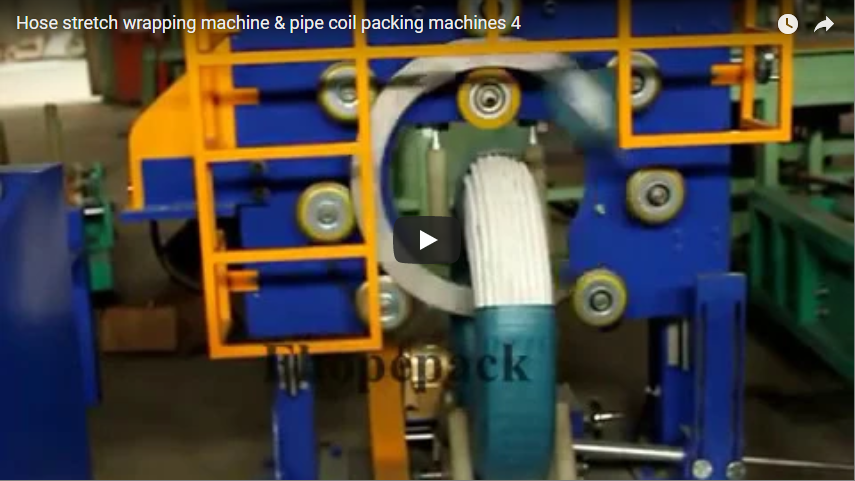
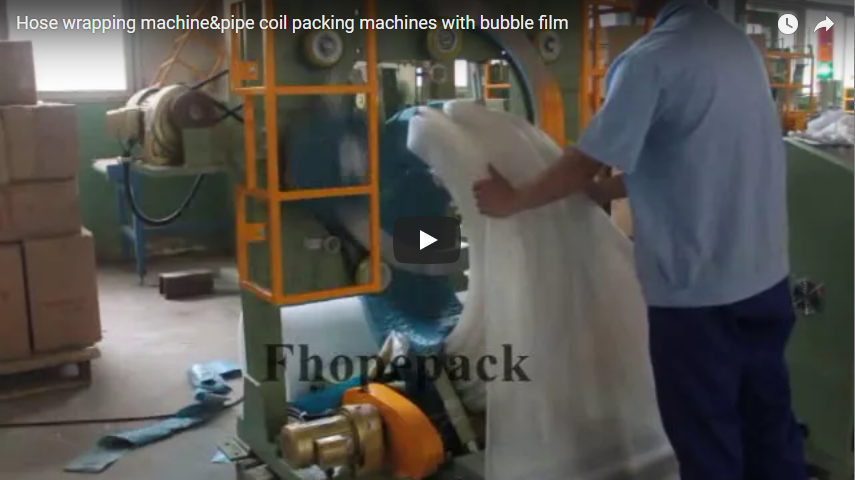
Executive summary A film wrap through the eye keeps a hose or pipe coil clean and holds its turns together for shipping. Our machine in this video turns an orange hose coil on its table while the arched ring with yellow rollers wraps clear film through the eye and round the coil. Film per coil follows from the wraps round the coil times the section perimeter.
Table of Contents
- What the video shows
- How the hose coil is wrapped
- Film per coil
- Controls and safety
- Selection checklist for a hose coil wrapping machine
- Engineering FAQ
- Next step
- Related reading
- Sources
What the video shows
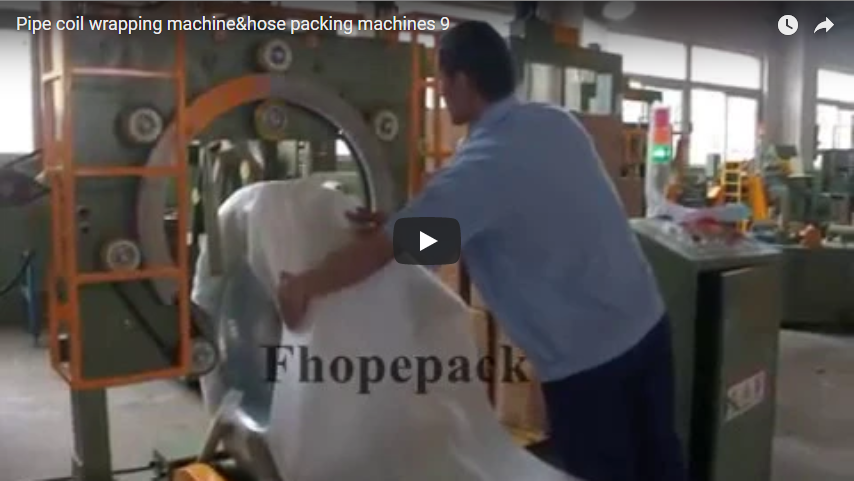
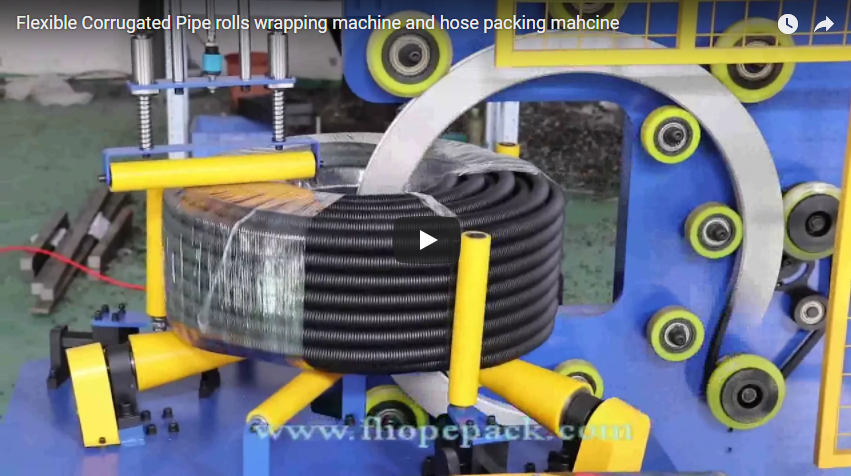
An orange hose coil sits on the turning table of our blue-based machine. Above it, an arched ring fitted with yellow rollers passes through the coil’s eye.
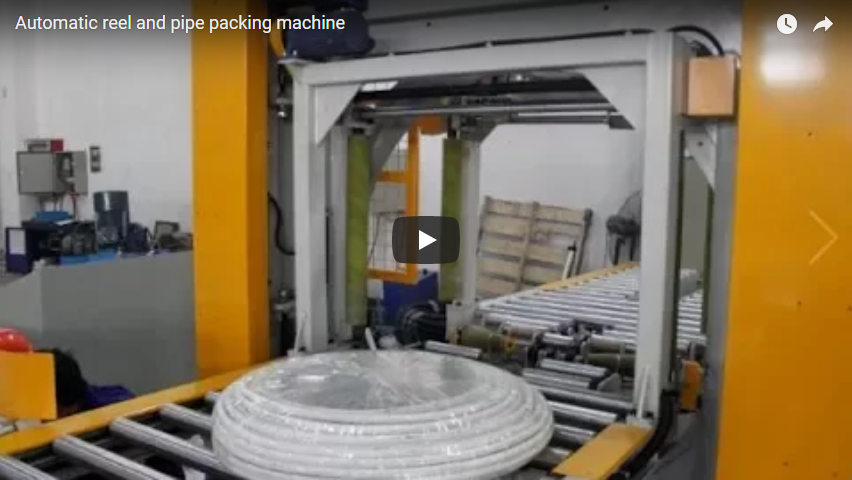
The ring turns and draws clear film from the roll, wrapping it through the eye and round the coil section, while the table turns the coil so the wraps move round its whole circumference. At the end the coil is fully covered and ready to lift off. A control panel on the right has a red button, a green button and a green indicator light. The fhopepack.com watermark shows in the corner.
How the hose coil is wrapped
Times are read from the video timestamps.
| Step | What happens | Video time |
|---|---|---|
| Load | The coil is set on the table | about 0–15 s |
| Wrap | The ring wraps film through the eye as the table turns | about 0–42 s |
| Finish | The coil is fully covered, ready to lift off | about 30–42 s |
The steps overlap in the video: wrapping starts as soon as the coil is in place, and the finished cover shows over the last part of the run. The two motions together, ring through the eye and table round, cover the whole coil.
Film per coil
Illustrative example:
| Item | Value |
|---|---|
| Outer and inner diameter (illustrative) | 600 and 350 mm |
| Coil height (illustrative) | 150 mm |
| Coil wall, (600 − 350) ÷ 2 | 125 mm |
| Section perimeter, 2 × (125 + 150) | 550 mm |
| Mean circumference, π × 0.475 m | about 1.49 m |
| Advance per wrap (illustrative) | 50 mm |
| Wraps, 1,490 ÷ 50 | about 30 |
| Film laid, 30 × 0.55 m | about 16.5 m |
A smaller advance per wrap gives more overlap and more film per coil.
Controls and safety
The ring turns through the coil eye and the table turns the coil. Keep hands out of the ring while it turns, and load, unload or change film only with the machine stopped.
The standards that apply depend on the destination market. For CE markets, ISO 12100 sets the risk-assessment method and EN 415-10 sets general requirements for packaging machines.
Selection checklist for a hose coil wrapping machine
- Coil outer and inner diameter and height.
- Heaviest coil.
- Film type and overlap.
- Manual or conveyor loading.
- Coils per shift.
- Labelling after wrapping.
Engineering FAQ
Q: How does the machine cover the whole coil? A: The table turns the coil round its circumference while the ring wraps film through the eye.
Q: How much film does a coil take? A: Wraps times section perimeter: 30 × 0.55 m gives about 16.5 m in our example.
Q: How many wraps go round a coil? A: Mean circumference over advance per wrap: 1,490 ÷ 50 mm gives about 30.
Q: Where are the controls? A: On a panel at the right with red and green buttons and a green light.
Q: Can it take my coil sizes? A: Send the coil diameters, heights and weights and we size the ring and table.
Next step
We plan your hose coil wrapping machine in three steps:
- Submit your layout drawing with coil diameters, heights and weights to info@fhopepack.com.
- Receive a proposal within 48 hours, with film type and overlap.
- Book a site survey to check loading method and coils per shift.
Related reading
- Hose packaging machine
- Video: hose wrapping machine for HDPE pipe coils
- Video: rubber hose coiling and wrapping machine
Sources
- Machine content: FHOPE engineering team, 2026-10-04
- Film example: our worked example, illustrative values
- Machine in action: our video on YouTube
- Standards scope: ISO 12100:2010, EN 415-10:2014
Last reviewed: 2026-10-04