Executive summary
A copper sheet and bronze bar wrapping machine feeds long, narrow non-ferrous pieces along a roller conveyor through an orbital ring, which wraps them spirally from end to end. The wrap keeps the bright surface clean and stops pieces rubbing in the bundle. Our semi-automatic S200 takes pieces longer than 300 mm, up to 200 mm across and 10–100 kg, with a ring speed of 20–120 r/min.
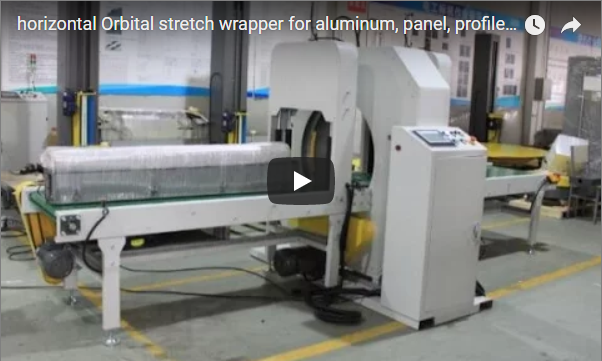
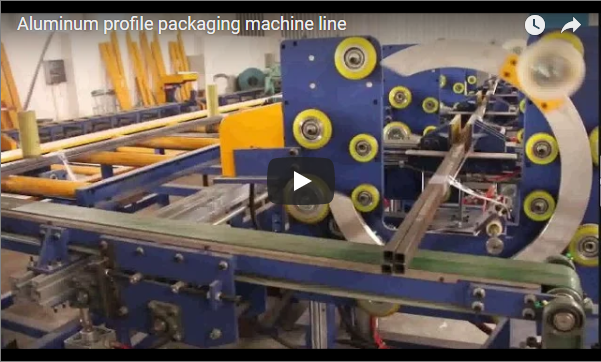
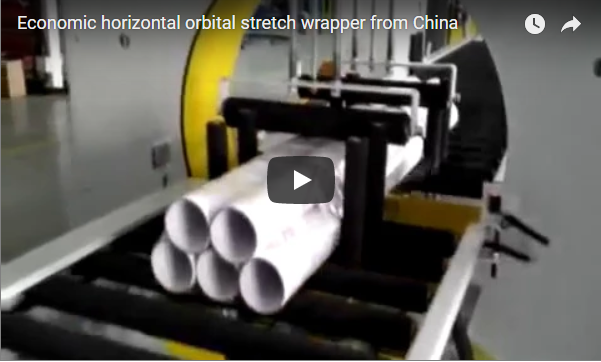
This layout is built for flat copper strip and bronze bar. A blue roller conveyor carries each piece into a compact ring inside a yellow guard frame, and a pneumatic hold-down unit over the conveyor keeps the flat piece steady while it is wrapped.
Table of Contents
- Why copper sheet and bronze bar are wrapped
- How the orbital wrapper works
- Flat strip vs round bar
- S200 data
- Worked example: a copper bar
- Selection checklist
- Safety: EN 415-10 and ISO 12100
- Engineering FAQ
- Next step
- Related reading
- Sources
Why copper sheet and bronze bar are wrapped
Copper and bronze are sold on their surface. Fingerprints, moisture and contact with other pieces leave marks and tarnish that a buyer can reject. Copper is also soft, so pieces that rub together in a bundle scratch each other. Wrapping each piece, or a small bundle, end to end keeps the surface covered from the mill to the customer.
How the orbital wrapper works
The piece travels on a motor-driven entrance conveyor into the ring. The ring turns around the piece and lays the material on in a spiral while the conveyor moves the piece forward. Ring speed is set by inverter, film tension is set by a brake device, and conveyors start and stop softly. A photocell finds the start and end of each piece.
The overlap comes from matching the two speeds. Advance per ring turn equals conveyor speed divided by ring speed. A faster conveyor or a slower ring gives less overlap. The material width minus the advance is the overlapped part of each turn.
Flat strip vs round bar
| Point | Flat copper strip or sheet | Round bronze bar |
|---|---|---|
| Fit in ring | Diagonal of the section must stay within 200 mm | Diameter must stay within 200 mm |
| Holding | Hold-down roller stops a thin strip lifting or twisting | Rollers centre the bar; little hold-down needed |
| Wrap per turn | Perimeter 2 × (width + thickness) | Perimeter π × diameter |
| Main risk | Edge marks and twisting | Rolling and end damage |
S200 data
| Item | S200 |
|---|---|
| Piece length | > 300 mm |
| Piece size (OD) | 10–200 mm |
| Piece weight | 10–100 kg |
| Entrance / outlet conveyor | 2,000 mm each, motor driven |
| Conveyor speed | 4–12 m/min |
| Ring speed | 20–120 r/min |
| Power | approx. 2.1 kW, AC 380 V 60 Hz |
| Film | LLDPE stretch film, width 120–200 mm, roll OD 150–200 mm, core ID 50 mm |
Paper or VCI wrapping instead of film, and the hold-down unit for flat strip, are confirmed at quote.
Film gauge matters on sheared copper strip, because a sharp burr can puncture thin film. Our quotations are based on 25 micron stretch film, and 32–50 micron film also runs. For burred edges, use the heavier film or deburr the edges before wrapping. Whether the film tail is cut and fixed by the operator or by an automatic clamp and cutter is confirmed at quote.
Worked example: a copper bar
Take a flat copper bar of 100 × 10 mm, 3,000 mm long, wrapped with 120 mm film at 50% overlap. Copper density is 8,960 kg/m³.
| Step | Calculation | Result |
|---|---|---|
| Volume | 0.10 × 0.01 × 3.0 | 0.003 m³ |
| Weight | 0.003 × 8,960 | about 27 kg |
| Section diagonal | √(100² + 10²) | about 100.5 mm |
| Fits S200? | length > 300 mm (actual 3,000 mm); size ≤ 200 mm (actual 100.5 mm); 10–100 kg (actual 27 kg) | yes |
| Advance per turn | 120 × 50% | 60 mm |
| Ring turns | 3,000 ÷ 60 | 50 |
| Conveyor at 80 r/min | 60 mm × 80 | 4.8 m/min |
| Wrap time | 3.0 m ÷ 4.8 m/min | about 37.5 s |
| Film per bar | 50 × 2 × (0.10 + 0.01) m | about 11 m |
Result. The bar fits the S200, and its 27 kg is well inside the 10–100 kg range. The 11 m is body coverage only; extra reinforcement turns at the head and tail add to it. Note the speed check: at 60 r/min the 60 mm advance would need 3.6 m/min, below the 4 m/min conveyor minimum. Running the ring at 80 r/min keeps both speeds inside their ranges and holds the 50% overlap.
Selection checklist
- Metal and surface finish: copper, bronze, brass.
- Section: flat width × thickness, or round diameter.
- Length range and weight per piece.
- Single pieces or small bundles.
- Material: stretch film, paper or VCI.
- Pieces per hour and line connections.
Safety: EN 415-10 and ISO 12100
The wrapper is built to EN 415-10, the general safety requirements for packaging machines, with the risk assessment done to ISO 12100. A guard frame closes the ring, guardrails line the conveyor and the machine shows alarms and faults on the panel.
Engineering FAQ
Q: Can it wrap brass as well as copper and bronze? A: Yes. The machine works on the section size and weight, not the alloy.
Q: How is the overlap set? A: By the ratio of conveyor speed to ring speed. Advance per turn equals conveyor speed divided by ring speed.
Q: Can several thin strips be wrapped as one bundle? A: Yes, if the bundle’s section diagonal stays within 200 mm and the weight within 100 kg. A wide, thin bundle is checked by its diagonal, not its width.
Q: What power does the S200 need? A: About 2.1 kW at AC 380 V 60 Hz.
Next step
- Send your section, length and weight to info@fhopepack.com.
- We match the ring, conveyors and hold-down to your pieces.
- We reply within 24 hours with a proposal and quotation.
Related reading
- Semi-automatic horizontal orbital wrapper S200 (product)
- Profile horizontal orbital wrapping machine (product)
- Rod wrapping machine
- Manual horizontal wrapping machine
Sources
- FHOPE product pages: S200 semi-automatic horizontal orbital wrapper; profile horizontal orbital wrapper
- EN 415-10; ISO 12100:2010
- Our copper and bronze wrapper shown above
Last reviewed: 2026-10-19