Executive summary
A rotary arm pallet wrapping machine turns the film around the load instead of turning the load. That keeps light, tall or loose loads, such as stacked bags, steady during the wrap, and lets the wrapper sit over a conveyor in a packing line. Our automatic rotary arm wrapper runs the arm at 10–14 r/min, wraps loads up to 1,200 × 1,200 × 1,600 mm and handles about 20–40 pallets per hour.
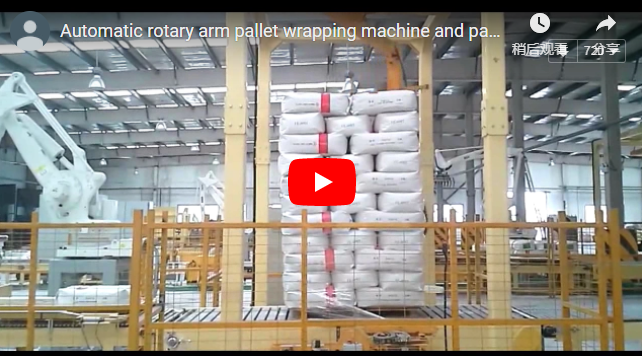
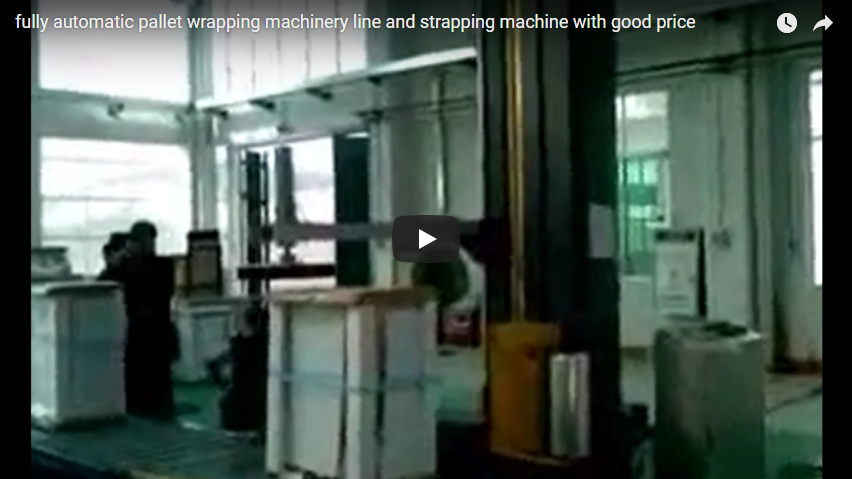
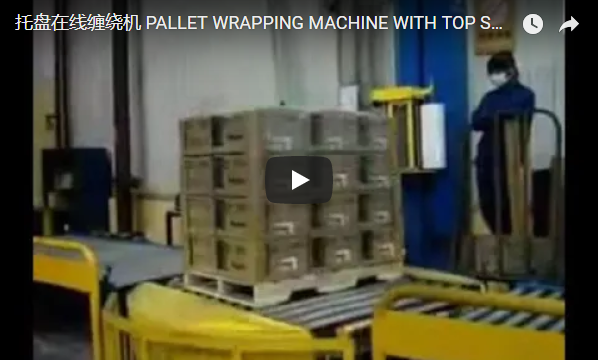
The white gantry frame carries the rotating arm over a chain conveyor. A pallet of white bags stops under the frame and the overhead top press comes down on the top layer. The arm then circles the load, and an orange clamp arm at the base holds and cuts the film tail. The white control cabinet beside the line carries a red, yellow and green signal tower.
Table of Contents
- Loads that suit a rotary arm
- Setting carriage speed for the film overlap
- Cycle time and pallets per hour
- Top press for bags and loose stacks
- Automatic film clamp, cut and wipe
- Main data
- Selection checklist
- Safety: EN 415-6 and ISO 12100
- Engineering FAQ
- Next step
- Related reading
- Sources
Loads that suit a rotary arm
| Load | Why the arm helps |
|---|---|
| Stacked bags or sacks | the stack is not spun, so bags do not slide out |
| Tall, narrow stacks | no centrifugal force on the top layers |
| Light cartons | the load stays square while the film goes on |
| Pallets on a conveyor line | the arm works above the conveyor, no turntable in the line |
| Heavy pallets | the load weight does not pass through a turning table |
Setting carriage speed for the film overlap
The film carriage rises while the arm turns. Each arm turn lays one band of film, and the carriage travel per turn sets how much the bands overlap:
Pitch per turn = carriage speed ÷ arm speed. Overlap = 1 − pitch ÷ film width.
With 500 mm film and the arm at 12 r/min:
| Carriage speed | Pitch per turn | Overlap |
|---|---|---|
| 4 m/min | 4,000 ÷ 12 = 333 mm | 1 − 333 ÷ 500 = 33% |
| 3 m/min | 3,000 ÷ 12 = 250 mm | 50% |
Result. For 50% overlap at 12 r/min, set the carriage to 3 m/min. The carriage runs at 2–6 m/min and the arm at 10–14 r/min, so both can be tuned on the panel to the load.
Cycle time and pallets per hour
Worked example: a 1,200 × 1,200 × 1,600 mm load, carriage at 3 m/min, arm at 12 r/min.
| Step | Calculation | Result |
|---|---|---|
| One pass up | 1.6 ÷ 3 | 0.53 min, about 32 s |
| Up and down | 2 × 32 | 64 s |
| Arm turns in that time | 64 × 12 ÷ 60 | 12.8 turns |
| Reinforcing turns, 2 bottom + 2 top | 4 × 60 ÷ 12 | 4 turns, 20 s |
| Wrapping time | 64 + 20 | 84 s |
| Total turns | 12.8 + 4 | 16.8 turns |
| Load perimeter | 4 × 1.2 | 4.8 m |
| Film on the load | 16.8 × 4.8 | 81 m |
| Film from the roll at 200% pre-stretch | 81 ÷ 3 | about 27 m |
The packing speed of about 20–40 pallets per hour means 3,600 ÷ 20 = 180 s down to 3,600 ÷ 40 = 90 s per pallet, including conveying, the top press and the film cut. The 84 s wrap above leaves about 96 s of a 180 s slot at 20 pallets per hour. A one-pass-up wrap at a faster carriage speed reaches the high end; a full up-and-down wrap on tall loads sits at the low end.
Top press for bags and loose stacks
The arm does not spin the load, but the film still pulls on the top layers. On stacked bags the top press holds the top layer down for the whole wrap and lifts once the film is cut. We decide on it from the smallest and lightest load on the line; stroke, actuator and plate size are confirmed at quote.
Automatic film clamp, cut and wipe
In unmanned mode the wrapper feeds the film, wraps, cuts, smooths the film tail and conveys the pallet out with no operator. The optional pneumatic system does this in three steps:
- Clamp. Scissors-like gripper bars hold the film tail for the next start.
- Cut. An instant heating wire cuts the film.
- Wipe. A soft brush presses the tail flat onto the load.
The cylinders run on air at 6–8 kgf/cm² (about 0.6–0.8 MPa). Without this option, film setting, cutting and smoothing are done by hand.
Main data
| Item | Value |
|---|---|
| Arm speed | 10–14 r/min, by inverter |
| Film carriage speed | 2–6 m/min |
| Packing speed | about 20–40 pallets per hour |
| Max packing size | 1,200 × 1,200 × 1,600 mm |
| Pallet height | 800–1,600 mm |
| Pre-stretch | powered, up to 200% |
| Film | 500 mm wide, 76 mm core |
| Arm motor / carriage motor | about 0.75 kW / about 0.37 kW |
| Machine weight | about 600 kg |
| Power | AC 380 V, 50 Hz |
| Conveyors (option) | chain conveyor as shown, or driven roller conveyor with roller size and spacing to the pallet; about 12 m/min; photo-eye pallet sensing |
| Top press | option, stroke and actuator confirmed at quote |
Selection checklist
- Load size, height and weight.
- Load type: bags, cartons, loose or stable.
- Pallets per hour.
- Manual or automatic film cut.
- Conveyor type, speed and direction.
- Air supply and power at site.
Safety: EN 415-6 and ISO 12100
Pallet wrapping machines are covered by EN 415-6, with the risk assessment to ISO 12100:2010. The turning arm and the film carriage are the main hazards. The arm zone is closed by fencing or light curtains, with interlocked access, and the signal tower shows the running state. The machine must stand on flat, hard ground. Guarding and CE documents are agreed per project.
Engineering FAQ
Q: Why choose a rotary arm instead of a turntable? A: The load does not turn, so light or loose loads stay square and the wrapper fits over a conveyor.
Q: How do I set the film overlap? A: Divide the carriage speed by the arm speed to get the pitch per turn, then compare it with the film width, as in the table above.
Q: How many pallets per hour? A: About 20–40 pallets per hour, depending on the wrap pattern and load height.
Q: Is the film cut automatic? A: It is an option: pneumatic clamp, heating wire cut and brush wipe.
Q: What is the largest load? A: 1,200 × 1,200 × 1,600 mm on this model. Larger sizes are confirmed at quote.
Next step
- Send your load size, weight, type and pallets per hour to info@fhopepack.com.
- We set the arm speed, carriage speed and conveyor layout.
- We reply within 24 hours with a proposal and quotation.
Related reading
- Rotary arm pallet wrapping machine (automatic line)
- Online pallet wrapper with top press
- R100 rotary arm pallet wrapper with film cutter
- Height pallet packing machine with top press device
- B200 automatic pallet wrapping machine (product)
Sources
- FHOPE rotating arm automatic pallet wrapper quotation (2017) and R200 quotation (2022)
- EN 415-6; ISO 12100:2010
- The rotary arm wrapper shown above
Last reviewed: 2026-10-19