Executive summary A rotary arm wrapper keeps the pallet still and turns the film around it, so tall or light loads such as bottled water do not sway. A top sheet device lays a cover on the load first, and the wrap locks its edges down. Our equivalent, the RAS100, is rated for 10–30 pallets per hour at 10–14 rpm, on a powered conveyor that carries loads up to 4 t.
Table of Contents
- When to choose a rotary arm
- The top sheet and wrap sequence
- RAS100 data
- Estimate pallets per hour
- Utilities and safety
- Selection checklist
- Engineering FAQ
- Next step
- Related reading
- Sources
When to choose a rotary arm
On a turntable wrapper the load spins. On a rotary arm wrapper the load stays still and the arm carries the film around it. That suits tall, light or unstable stacks, such as shrink-packed bottles, which can shift or tip when spun. It also suits heavy loads, because nothing has to turn the weight.
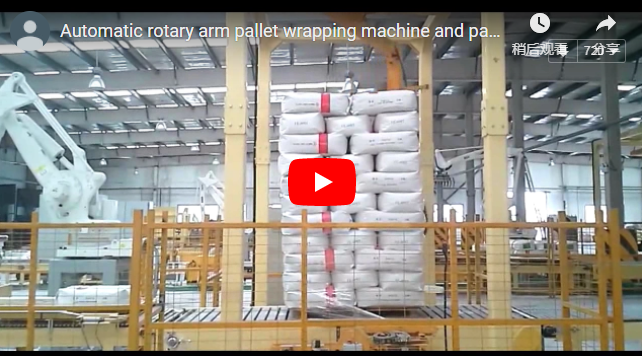
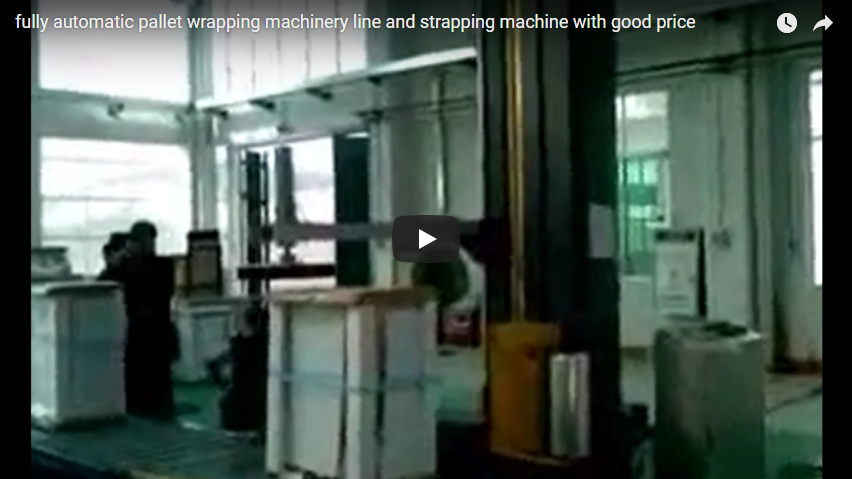
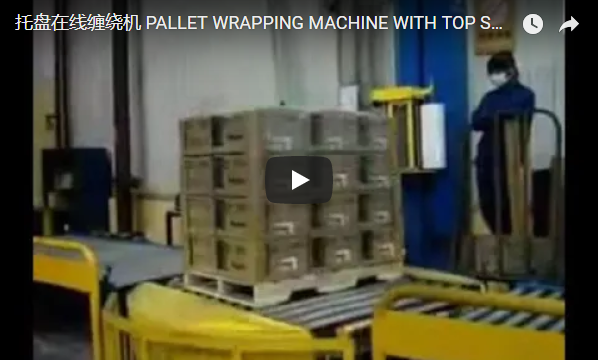
The video shows a rotary arm wrapper on pallets of bottled water. The arm turns around the still stack while a clear cover is pulled from the device above and laid over the top. Our equivalent for this job is the RAS100.

The top sheet and wrap sequence
- The conveyor moves the pallet under the rotary arm.
- The top cover device moves down to the top of the load, unreels the cover material and cuts it.
- The device returns to its start position, and the stabilizer plate comes down onto the load to hold it.
- The arm wraps the load. At the top, the film catches the edges of the cover and holds them down.
- Depending on the program, wrapping continues as the film carriage moves down.
- The sealing arm seals the film end onto the wrap and cuts it, the stabilizer plate lifts and the pallet leaves.
The top cover keeps dust and water off the top layer, and the stabilizer plate stops light items moving while the film tightens. Sizing the cover sheet itself is covered in our pallet wrapping machinery post.
RAS100 data
| Item | RAS100 |
|---|---|
| Operation | Automatic |
| Output | 10–30 pallets per hour |
| Arm speed | 10–14 rpm, set by inverter |
| Maximum load size | 1,400 × 1,400 mm |
| Film | LLDPE, 500 mm wide, 76 mm core |
| Film carriage speed | 2.9 m/min |
| Wrap counts | Bottom, middle and top layers, 0–99 turns each |
| Film cut | Pneumatic clamp, hot wire cut, brush wipe |
| Conveyor | All rollers driven, 4 t max, 1.5 m infeed and outfeed, about 12 m/min |
| Machine weight | About 1,500 kg |
Estimate pallets per hour
Illustrative cycle for a 1.8 m tall load, with bottom and top turns and one film pass up and one pass down:
| Step | Time |
|---|---|
| 3 bottom turns at 12 rpm | 15 s |
| Carriage up 1.8 m at 2.9 m/min | about 37 s |
| Carriage down 1.8 m | about 37 s |
| 3 top turns at 12 rpm | 15 s |
| Pallet out and next pallet in, 1.5 m each at 12 m/min | 15 s |
| Top sheet laying (illustrative) | 20 s |
| Total cycle | about 139 s |
| Pallets per hour | about 26 |
The film clamp and cut add a few seconds on top, so this sits near the top of the rated 10–30 range. Bottom turns anchor the film to the pallet, so we never leave them out to gain speed. More layers, extra top or bottom turns, or a taller load lengthen the cycle, so we work out output from your own load height and wrap program.
Utilities and safety
The RAS100 needs clean, dry compressed air at 6–8 kgf/cm² for the film clamp and cut. The electrical supply is set to your local voltage. Controls include a photo eye for load height and pallet sensing, a lockable electrical disconnect and a red mushroom-head emergency stop. An anti-collision device on the arm stops the machine if it touches an obstacle.
The standards that apply depend on the destination market. For CE markets, ISO 12100 sets the risk-assessment method and EN 415-10 sets general requirements for packaging machines.
Selection checklist for a rotary arm wrapper with top sheet
- Load size and height, smallest to largest.
- Heaviest pallet, for the conveyor.
- Is the load unstable when spun?
- Top cover needed against dust or water?
- Pallets per hour needed.
- Wrap program: bottom, middle and top turns.
- Local power supply and compressed air.
Engineering FAQ
Q: Why use a rotary arm instead of a turntable? A: The load stays still, so tall, light or unstable stacks do not sway or tip.
Q: How is the top sheet held in place? A: The film catches the edges of the cover at the top of the wrap, and extra top turns, counted separately from the bottom turns, lock it down.
Q: How many pallets per hour on a beverage line? A: The RAS100 is rated for 10–30 pallets per hour, depending on load height and wrap program.
Q: What is the largest load? A: 1,400 × 1,400 mm, on a conveyor rated for 4 t.
Q: What air supply does it need? A: Clean, dry air at 6–8 kgf/cm².
Next step
We plan your rotary arm wrapper in three steps:
- Submit your layout drawing with load sizes and pallets per hour to info@fhopepack.com.
- Receive a proposal within 48 hours, with the wrap program and conveyor layout.
- Book a site survey to check the line layout and utilities.
Related reading
- Rotary arm stretch wrapper RAS100
- Rotary arm wrapper RAS200
- Video: pallet wrapping machinery
- Video: automatic pallet stretch wrapping machine with film cutter
Sources
- RAS100 data and sequence: rotary arm stretch wrapper RAS100 page
- Machine type in action: arm stretch wrapper video on YouTube
- Standards scope: ISO 12100:2010 and EN 415-10:2014
Last reviewed: 2026-10-04