Executive summary Our corrugated hose coiling and strapping machine winds double wall pipe straight from the extruder onto a six-arm reel, then straps the finished coil so it holds its shape. Our standard machine coils at 1–60 m/min on two coiling stations, so one coil is strapped and unloaded while the next one winds. Coil size is set by the reel: the standard window is 500–800 mm outside diameter, and larger corrugated pipe gets a larger reel built for the project.
Table of Contents
- How the coiler works
- Why corrugated pipe needs a strapped coil
- Working out coil length
- Two stations and extruder speed
- Standard machine data
- Larger corrugated pipe
- Selection checklist
- Engineering FAQ
- Next step
- Related reading
- Sources
How the coiler works
The machine measures the pipe length, cuts the pipe, winds it into a coil, fixes the coil, straps it and moves it out. Every one of those steps is set in the PLC program, so the coil length and the number of straps are recipes rather than operator decisions.
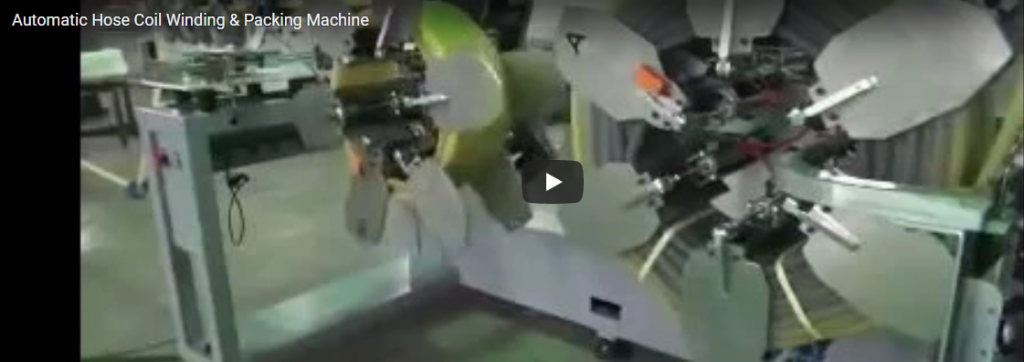
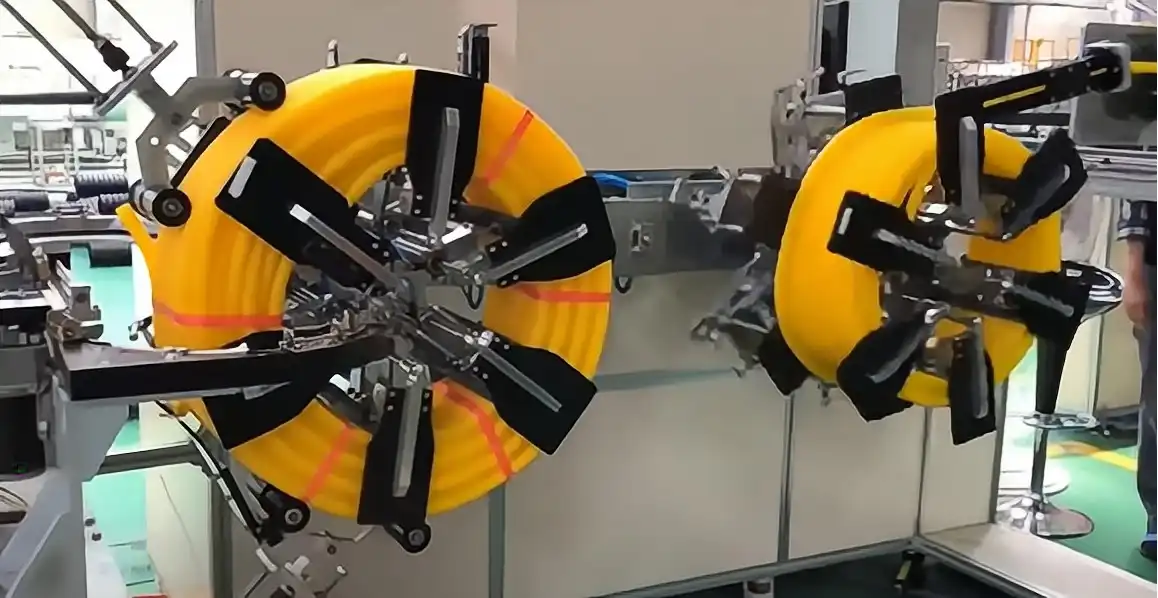
The reel has six radial arms. They hold the inside of the coil while it winds, and they close in or open out to set the coil’s inside diameter.
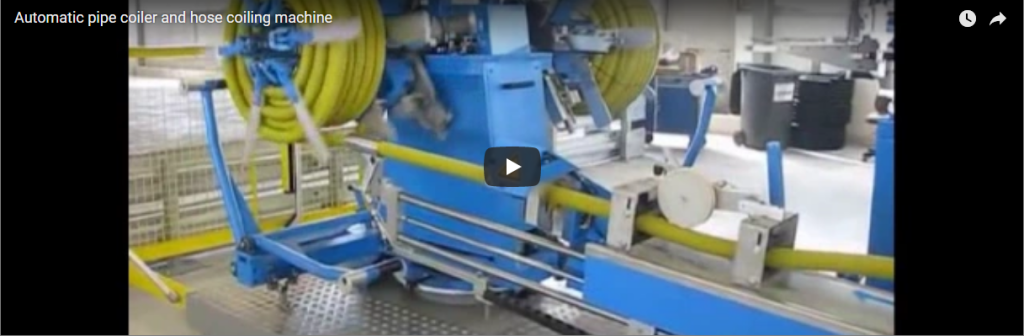
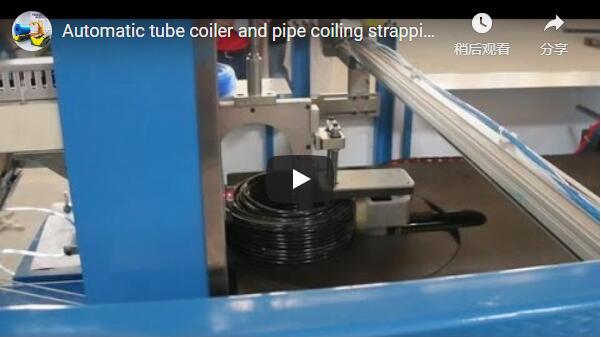
In our video, the arms hold the green double wall pipe in tight layers as the reel turns, so the corrugations nest against each other instead of sliding. The strapping arm then ties straps across the coil section while the coil is still held in shape, and only then does the coil go out onto the roller conveyor. A mesh fence keeps people away from the reel and the strapping arm while they move.
Why corrugated pipe needs a strapped coil
Corrugated pipe acts like a spring. Once it is cut, a loose coil tries to open up, and the outer layers slide off the inner ones. The straps lock the layers together across the coil section, so the coil keeps its diameter on the pallet, in the truck and on the job site.
The straps also set the coil’s handling shape. A tight round coil stacks on a pallet and rolls without unwinding. A loose one takes more space and is hard to lift.
Working out coil length
Coil length comes from the coil dimensions and the pipe diameter:
Coil length ≈ turns per layer × number of layers × π × mean coil diameter
Turns per layer = coil width ÷ pipe OD. Number of layers = (coil OD − coil ID) ÷ 2 ÷ pipe OD.
Illustrative example for 50 mm pipe:
| Item | Value |
|---|---|
| Coil ID (example) | 400 mm |
| Coil OD (example) | 800 mm |
| Coil width (example) | 300 mm |
| Turns per layer, 300 ÷ 50 | 6 |
| Layers, (800 − 400) ÷ 2 ÷ 50 | 4 |
| Mean coil diameter | 600 mm |
| Coil length, 24 × π × 0.6 m | about 45 m |
The coil ID also has to stay above the pipe’s minimum bending radius, or the corrugations kink on the inner turns. We set the reel ID from your pipe’s bending limit first, then fit the width and OD around it.
Run the formula backwards to choose the reel. If your customer wants 50 m coils of a given pipe, it tells you the coil OD, ID and width the reel must make.
Two stations and extruder speed
The extruder never stops, so the coiler must take pipe all the time. With two coiling stations, the pipe switches to the empty reel when the first coil reaches its length, and the full coil is strapped and unloaded while the second one winds.
At the top speed of 60 m/min, the 45 m example coil winds in about 45 s. The other station then has about 45 s to strap and unload its coil. A slower extruder gives the strapping more time. A short coil at high speed gives it less, and if the strapping cannot finish before the other reel is full, the line has to slow down. That is why coil length and line speed belong together in the recipe.
Standard machine data
| Item | Hose coiling and strapping machine |
|---|---|
| Coil ID | 350–550 mm |
| Coil OD | 500–800 mm |
| Coil width | 150–300 mm |
| Coil weight | 5–35 kg |
| Coiling speed | 1–60 m/min |
| Coiling stations | 2 |
| Power consumption | 4.5 kW |
| Strapping band thickness | 0.6–0.75 mm |
| Control | PLC: length, cutting, coiling, strapping, unloading |
Larger corrugated pipe
The coil in our video is larger than the standard window, and that is normal for double wall corrugated pipe. The reel, the arm length and the strapping reach are set for each project, from the pipe OD and the coil the customer wants. Use the coil length formula with your own sizes, and we build the reel to suit.
The standards that apply depend on the destination market. For CE markets, ISO 12100 sets the risk-assessment method and EN 415-10 sets general requirements for packaging machines.
Selection checklist for a corrugated hose coiler
- Pipe OD and wall type: single or double wall.
- Coil length your customers order.
- Coil ID, OD and width limits.
- Extruder line speed in m/min.
- Number and position of straps per coil.
- Coil weight, and how coils leave the machine.
- Film wrapping after strapping, if needed.
Engineering FAQ
Q: How fast does the coiler run? A: Our standard machine coils at 1–60 m/min and follows the extruder speed.
Q: Why two coiling stations? A: So the extruder never waits. One station winds while the other straps and unloads.
Q: How do I work out the coil length? A: Turns per layer times layers times π times the mean coil diameter. A 400/800 mm coil, 300 mm wide, of 50 mm pipe holds about 45 m.
Q: What coil sizes does the standard machine make? A: Coil ID 350–550 mm, OD 500–800 mm and width 150–300 mm, up to 35 kg.
Q: Can it coil larger double wall pipe? A: Yes. For larger pipe, we build the reel, the arms and the strapping reach to your coil size.
Next step
We plan your corrugated hose coiling line in three steps:
- Submit your layout drawing with pipe sizes, coil lengths and extruder speed to info@fhopepack.com.
- Receive a proposal within 48 hours, with the reel size and strapping plan.
- Book a site survey to check the extruder outfeed and the coil handling area.
Related reading
- Hose coiling and strapping machine
- Corrugated hose packing machine
- Video: hose wrapping machine and HDPE pipe coil packing
Sources
- Standard machine data and PLC functions: hose coiling and strapping machine page
- Machine in action: our corrugated hose coiling video on YouTube
- Coil length and timing examples: our worked examples, illustrative values
- Standards scope: ISO 12100:2010, EN 415-10:2014
Last reviewed: 2026-10-04