Overview
Written for coil rollers, service centres and packaging buyers, this guide explains how the FPCA-1000 horizontal wrapper works — and how to set overlap so the outside of the coil stays sealed. Eye-through packaging seals a coil lying flat: a ring carries film through the eye and round the section while rollers turn the coil once. The FPCA-1000 takes coils 700–1,600 mm OD, 20–400 mm wide, 100–2,000 kg, overlap from 20% to 90%.
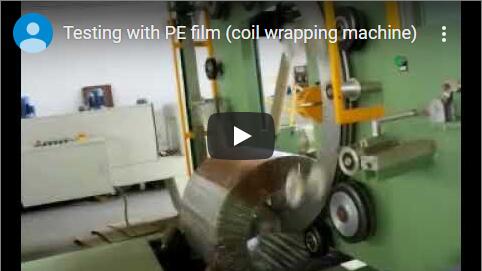
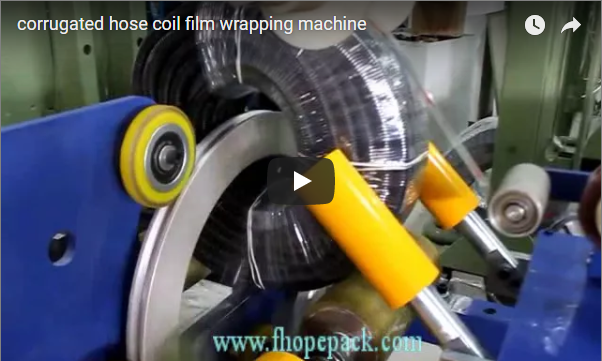
The video below shows a coil running in, the ring passing through the eye, and the wrapped coil leaving:
Why eye-through film packaging for coils
A coil wrapped only round the OD is still open at the eye and the two faces, where dust, moisture and handling damage get in. Eye-through wrapping carries the film through the eye and round the whole section, sealing every face. A horizontal machine keeps the coil flat, which suits narrow coils and slit strip that would topple on edge.
Our horizontal eye-through wrapper on roller conveyors
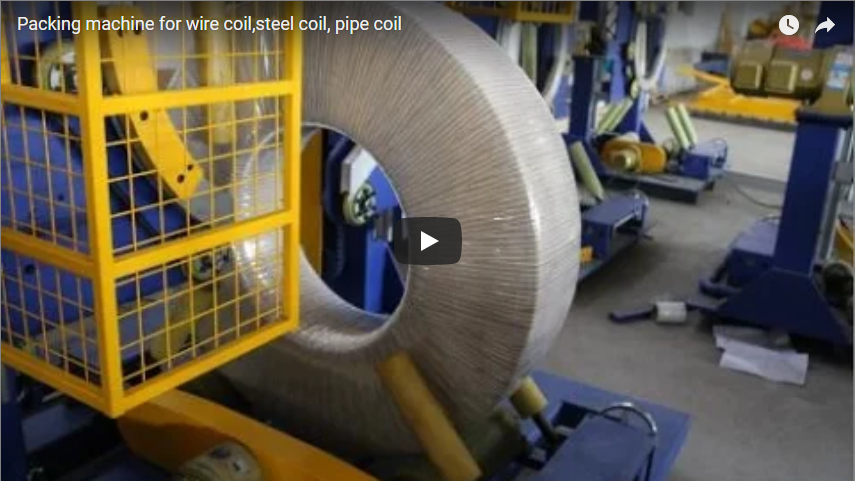
The coil lies flat on a yellow powered roller conveyor; the vertical ring passes through the eye while an arm with white rollers holds the coil as it turns. A yellow mesh guard closes the wrapping area, and the out-feed conveyor takes the coil away — one automatic cell.
The wrapping cycle
- In-feed. The coil runs in on the roller conveyor and stops.
- Ring through the eye. The ring opens, passes through the eye and closes.
- Hold. The top roller arm comes down onto the coil.
- Wrap. The ring carries the film round the section while rollers turn the coil through 360°.
- Cut and out. The film is cut and held, the ring opens, the coil runs out.
- Stretch film (LLDPE/PE): sealed, see-through; the usual choice.
- PVC or HDPE film: stiffer, for sharp edges.
- Paper: breathable, where coils must not sweat.
- Two layers: paper first and film over it, where the coil needs both.
- Coil ID, OD, width and weight range.
- Coil type: slit strip, strap, wire or tube.
- Packing material and overlap at the OD.
- Coils per hour.
- In-feed and out-feed: conveyor, crane or forklift.
- Voltage and country of installation.
- Roller-line speed, load interface and line interlock signals at in-feed and out-feed.
- FPCA-1000 data: FHOPE horizontal coil wrapper product page.
- Film use per coil: FHOPE project notes, illustrative figures.
- Machine demo: our horizontal wrapping cell, embedded above.
- Standards: EN 415-10; ISO 12100:2010.
FPCA-1000 data
From our horizontal coil wrapper page:
| Item | FPCA-1000 |
|---|---|
| Coil ID | 508 / 610 mm |
| Coil OD | 700–1,600 mm |
| Coil width | 20–400 mm |
| Coil weight | 100–2,000 kg |
| Overlap | 20–90% |
| Power | approx. 4.5 kW |
| Voltage | 380 V 50 Hz 3-phase 5-wire, can be customized |
| Air supply | 5–7 kgf/cm² (about 0.5–0.7 MPa) |
| Materials | PVC, LLDPE, PE, HDPE, paper; roll size set by coil size |
Other coil sizes are built to order.
Worked example: setting overlap from the OD
Illustrative coil: ID 508 mm, OD 1,000 mm, width 200 mm, 120 mm film. The section the film goes round is 246 mm deep and 200 mm wide, so each wrap uses 2 × (246 + 200) ≈ 0.89 m.
| Setting | Wraps | Overlap at ID | Overlap at OD | Film on coil |
|---|---|---|---|---|
| 50% at the ID (60 mm advance) | π × 508 ÷ 60 ≈ 27 | 50% | 3,142 ÷ 27 ≈ 116 mm spacing, ≈ 3% | 27 × 0.89 ≈ 24 m |
| 30% at the OD (84 mm spacing) | π × 1,000 ÷ 84 ≈ 38 | ≈ 65% | 30% | 38 × 0.89 ≈ 34 m |
Result. The film fans out from the eye to the OD. With 50% at the ID, the OD is covered with only about 3% overlap and can open in handling. For a sealed coil we set the wrap count from the OD and accept the heavier overlap at the eye, here about 10 m more film per coil.
Check against a real coil. On a coil of 1,400 mm OD, 508 mm ID, 300 mm width, 120 mm film and a 30 mm advance at the ID, our figure was about 80 m per coil — the formula gives π × 508 ÷ 30 ≈ 53 wraps × 1.49 m ≈ 80 m.
Packing materials
Selection checklist
Safety
The wrapper is designed with EN 415-10 as the reference and assessed to ISO 12100. The ring through the eye, the top roller arm and the conveyors are the hazards; the yellow mesh guard is interlocked through the PLC, so opening a gate stops ring, rollers and conveyors together. Film change and threading happen with the cell stopped.
Engineering FAQ
Why set overlap at the OD and not the ID? Because the film spreads out towards the OD — a setting that looks generous at the eye can leave the outside barely covered.
What does the top roller arm do? It holds the coil down so it turns without slip, walk or tipping — important on light, narrow slit coils.
Can the machine wrap paper? Yes, paper and film are both used, alone or one over the other.
Which standard applies? EN 415-10 and ISO 12100, referenced for the CE-market delivery and assessment.
Next step
Send coil ID, OD, width and weight to info@fhopepack.com; we work out the wrap count and film use per coil, then send a layout and quotation.