Executive summary The FPCA-200 orbital cable coil wrapping machine encapsulates loose or pre-bound wire coils in stretch film, PE, or PVC by driving an orbital shuttle ring through the center eye while powered cradle rollers rotate the coil. Factory commissioning data shows pneumatic side-guide clamping takes 3 s, vertical elevation 6 s, orbital wrapping 9 s (at 80 rpm with 50% overlap), and decompression reset 6 s, delivering an active machine cycle time of 24 s per coil. Designed for wire drawing and extrusion take-up packaging, the standard FPCA-200 manages coil weights from 2 to 50 kg, outer diameters from 250 to 500 mm, and sustains line speeds up to 120 coils per hour under continuous industrial duty.
Table of Contents
- Kinematic cycle sequence
- Cycle time breakdown and motion analysis
- How the FPCA-200 wraps a cable coil
- FPCA-200 specifications
- Extruder line takt check and capacity sizing
- Selection checklist for a cable coil wrapping machine
- Machine controls and CE safety compliance
- Engineering FAQ
- Next step
- Related reading
- Sources
Kinematic cycle sequence
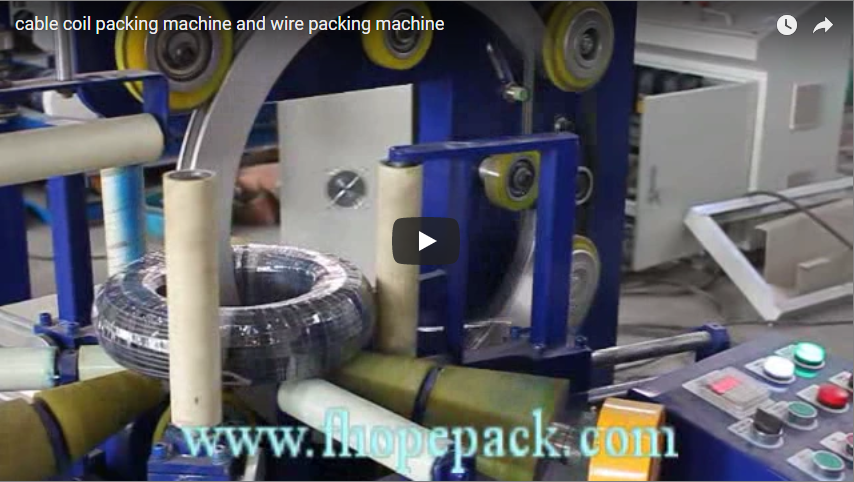
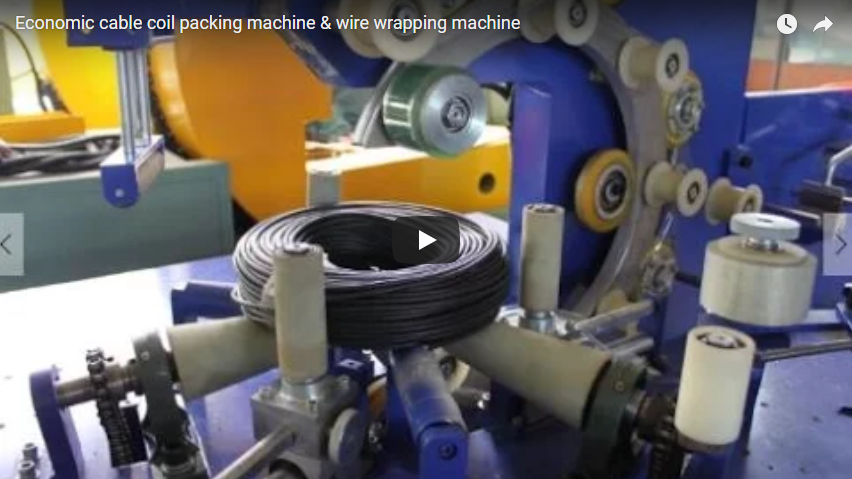
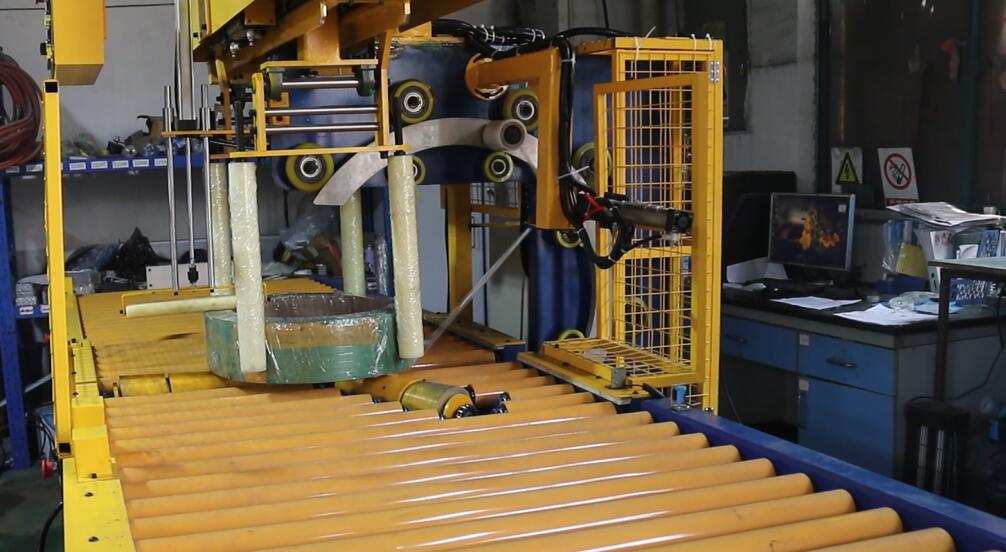
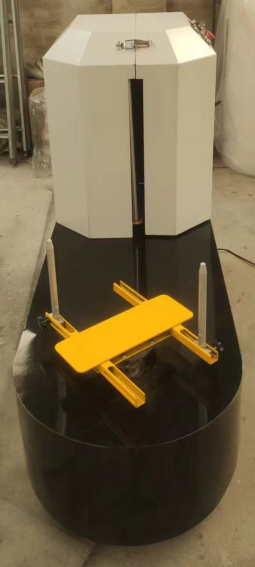
The machine structural platform comprises a structural steel chassis, an integrated orbital rotating ring, dual polyurethane-coated bottom cradle rollers, and four-point pneumatic lateral stabilizing arms. Process operational status is signaled through an industrial three-tier LED stack light and monitored at a dedicated control desk equipped with a dual-channel emergency stop button.
- 0 to 6 s — Infeed indexing and coil positioning: The machine remains in a zero-energy static condition. The unbound or taped cable coil rests vertically within the polyurethane-coated cradle rollers, aligned with the centerline of the orbital ring eye.
- 9 to 12 s — Lateral stabilization clamp: The pneumatic side-guide units articulate inward to hold the coil sidewalls. This prevents lateral telescoping and guarantees vertical stability before ring rotation commences.
- 15 to 21 s — Concentric height positioning: The lower cradle elevation mechanism lifts the coil to align its horizontal geometric center with the rotational center of the orbital ring.
- 24 to 27 s — Shuttle feed initiation and primary layer anchoring: The orbital ring accelerates via variable frequency drive (VFD). The film carriage dispenses transparent stretch film through the eye of the coil, applying primary holding wraps directly across the cross-section.
- 30 to 33 s — Synchronous rotation and overlap application: The cradle rollers turn the coil at a matched speed ratio while the orbital ring runs at selected packaging speed. This lays down a uniform overlap across the outer circumference, core inner diameter, and sidewalls.
- 36 to 42 s — Pneumatic cut, wipe, and descent: The automatic film cutter cuts and clamps the film tail, lateral stabilizing units retract, the lift cradle descends to line pass-line height, and the encapsulated coil settles into home position.
- 45 to 81 s — Discharge window and cycle reset: The finished coil sits ready for manual discharge or downstream conveyor transfer. The system resets internal safety interlocks to green status for the subsequent packaging cycle.
Cycle time breakdown and motion analysis
| Kinematic phase | Time window | Duration | Motion control and actuator state |
|---|---|---|---|
| Infeed standby, coil indexed | 0 to 6 s | 6 s | Ring stationary, lateral arms fully open |
| Lateral arm centering and clamping | 9 to 12 s | 3 s | Pneumatic cylinders engage side guide rollers |
| Vertical elevation to wrapping center | 15 to 21 s | 6 s | Hydraulic/pneumatic lift stages coil to ring eye axis |
| Orbital film wrapping (steady state) | 24 to 33 s | 9 s | Inverter-controlled ring rotates at 60–100 rpm |
| Arm release, cut/wipe, and lower | 36 to 42 s | 6 s | Film severed; cradle lowers to baseline conveyor level |
| Total active cycle time | 9 to 42 s | 33 s | Floor-to-floor cycle (24 s active wrap + indexing) |
The active wrapping sequence spans 33 s during initial manual staging commissioning. Under configured PLC automated continuous indexing mode, mechanical dead-time reduces to allow a reliable 20 to 30 s packaging cycle per coil.
How the FPCA-200 wraps a cable coil
The FPCA-200 mechanical architecture integrates three coupled sub-assemblies: the rotating ring drive assembly, the driven supportive cradle rollers, and the central PLC process controller. The cable coil sits directly on durable polyurethane-coated rollers that rotate the coil smoothly along its toroidal axis. This controlled rotation enables loose-wound, memory-elastic cables to maintain cross-sectional geometry without prior manual steel or polyester strapping.
Four groups of adjustable guide assemblies center the coil dynamically relative to the ring center. The cast-aluminum rotating ring guides the pre-stretch film dispenser continuously through the coil inner eye. Uniform overlap across the inner diameter (ID) and outer diameter (OD) is achieved by coordinating ring rotational speed with cradle roller surface drive speed.
+--------------------------------------------------------------+
|                     FPCA-200 WRAPPING PROCESS                |
|                                                              |
|        [Orbital Ring: 10-120 rpm]                            |
|             |          |                                     |
|             v          v                                     |
|         +-------------------+       [Pneumatic Side Arms]    |
|         |    Coil Eye (ID)  | <---- (Prevent core/sidewall   |
|         +-------------------+        telescoping)            |
|                  |                                           |
|                  v                                           |
|      [Polyurethane Cradle Rollers]                           |
|      (Dual-axis driven rotation)                             |
+--------------------------------------------------------------+| FPCA-200 sub-system | Technical function and performance characteristics |
|---|---|
| Four-point lateral guide arms | Pneumatically driven, self-centering to maintain vertical stability |
| Inverter-driven orbital ring | 10 to 120 rpm variable speed control; dynamically establishes film overlap |
| Siemens PLC and color HMI | Stores wrapping programs, tracks coil counts, and optimizes film usage |
| Automatic film cut-and-clamp | Cuts film mechanically and holds the leader for the next cycle |
| Soft start/stop and position indexing | Limits mechanical shock to the ring drive and guarantees homing alignment |
FPCA-200 specifications
| Parameter | Metric specification | Engineering unit / note |
|---|---|---|
| Coil inner diameter (ID) | 150 to 400 | mm |
| Coil outer diameter (OD) | 250 to 500 | mm |
| Coil package width | 80 to 200 | mm |
| Coil weight capacity | 2 to 50 | kg |
| Compatible wrapping media | Stretch film, cast PE, PVC | Film width: 50 to 100 mm |
| Orbital ring speed | 10 to 120 | rpm (inverter regulated) |
| Active wrapping time | 20 to 30 | s per coil (depending on overlap) |
| Film overlap ratio | 20% to 80% | Adjustable via HMI touchscreen |
| Installed power rating | 2.0 | kW (380 V, 50 Hz, 3-Phase / to order) |
| Operating air pressure | 0.5 to 0.7 | MPa (clean dry industrial air) |
For larger wire bundles and heavy industrial building cables, the FPCA-300 handles 400 to 900 mm OD with coil payloads up to 200 kg, supporting dual-material synchronized wrapping (e.g., woven PP tape plus stretch film).
Extruder line takt check and capacity sizing
For an extrusion coiling and binding line producing 60 coils per hour:
- Line takt time calculation:
T_takt = 3,600 s ÷ 60 coils = 60 s per coil - Machine packaging time:
T_wrap = 24 s(at 50% overlap, 80 rpm) - Operator loading/unloading buffer:
T_buffer = 60 s - 24 s = 36 s
A 36 s window allows one station operator to transfer coils, apply identification barcodes, and stack finished packages without throttling the upstream continuous extruder.
When line velocity increases above 100 coils per hour, allowable takt time drops to 36 s (3,600 ÷ 100), leaving an operational margin of only 12 s for manual handling. Under these conditions, the machine pairs with an automated walking-beam or pneumatic arm infeed to eliminate labor bottlenecks.
Selection checklist for a cable coil wrapping machine
- Coil envelope dimensions: Confirm ID, OD, core height, and total package weight against the FPCA-200 design window.
- Packaging material selection: Define film type (LLDPE stretch film, rigid PVC, or VCI anti-corrosion film) and specify required overlap percentage (typically 30% to 50%).
- Continuous line output: Calculate line takt time (in seconds per unit) from the upstream coiler output rate.
- Interface integration: Determine if material transfer relies on manual staging, an automatic gravity rollway, or an integrated robotic pick-and-place cell.
- Secondary post-wrap steps: Assess requirements for online thermal labeling, carton packaging, or downstream palletization.
Machine controls and CE safety compliance
The FPCA-200 isolates operational pinch zones by separating the main electrical control desk from the rotating orbital ring. Operator interfaces feature an IP54-rated console housing standard industrial pushbuttons, a three-color signal beacon, and a dual-channel Category 0 emergency stop button wired into a monitored safety relay circuit.
The high-speed orbital shuttle ring and inward-moving lateral clamping arms present potential mechanical pinch and shear hazards. The system protects against unintended access via integrated interlocks:
- Cycle interlock: Wrapping cycles initiate only through deliberate dual-hand control or interlocked foot switch validation while the operator remains outside the hazard envelope.
- Maintenance lockout: Film roll changeover, ring drive tensioning, and cutter blade maintenance require full electrical and pneumatic isolation via OSHA 1910.147 / EN 1037 Lockout-Tagout (LOTO) points.
- Harmonized standard compliance: The equipment is engineered according to ISO 12100:2010 (Risk Assessment and Reduction Principles) and EN 415-10:2014 (Safety Requirements for Wrapping Machines), incorporating mechanical guarding, interlocked perimeter access doors, and motor thermal over-torque monitoring.
Engineering FAQ
Q: What is the typical floor-to-floor cycle time for a standard building wire coil? A: For a 300 mm OD building wire coil, the active orbital wrap takes 12 to 18 s. Total floor-to-floor cycle time—including clamping, centering, wrapping, cutting, and unclamp—ranges from 20 to 30 s per coil.
Q: Can the FPCA-200 wrap soft or loose coils without pre-strapping? A: Yes. The four-point stabilizing guide rollers support the coil perimeter directly during initial ring acceleration. This prevents core de-coiling and telescoping without requiring manual strapping or tape binding.
Q: What consumables are compatible with the orbital film carriage? A: The carriage accepts machine-grade stretch film, PE film, and PVC wraps with film widths of 50 to 100 mm and roll outer diameters up to 150 mm on standard 50 mm / 76 mm cores.
Next step
To size an orbital coil wrapping system for your extrusion or coiling line:
- Submit coil specifications: Send coil minimum/maximum ID, OD, width, weight, and hourly production requirements to info@fhopepack.com.
- Review technical layout: Receive a detailed 2D/3D integration layout and cycle-time calculation within 48 hours.
- Validate integration requirements: Coordinate with our packaging engineers to verify line centerlines, transfer heights, and electrical enclosure standards.
Related reading
- FPCA-200 Cable Coil Wrapping Machine Technical Details
- FPCA-300 Heavy-Duty Coil Packaging Station
- Industrial Cable and Wire Packaging Line Configurations
- Automatic Hose Coil Winding and Orbital Wrapping Solutions
Sources
- Equipment specifications and mechanical data: Fhopepack FPCA-200 Product Page
- International safety and risk standards: ISO 12100:2010 Machine Safety
- European packaging machinery directives: EN 415-10:2014 Safety of Packaging Machines
Last reviewed: 2026-10-05