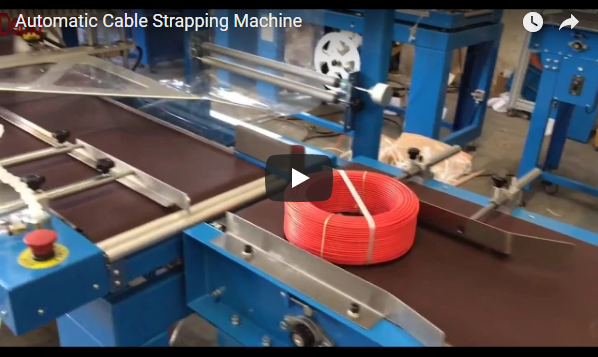
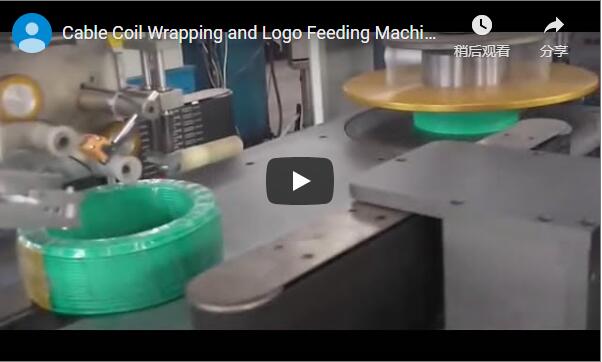
Executive summary Small cable coils come off the line fast, so wrapping has to keep up with the coiler without a person in between. Our online machine in this video holds a green cable coil in a clamp, wraps it with film, presses it, and sends it down a roller conveyor into a carton. Whether wrapping keeps up follows from the line speed and the coil length. We check both per project.
Table of Contents
- What the video shows
- How the online cycle works
- Matching wrap cycle to line speed (takt time)
- Options for cable coil packing
- Controls and safety
- Selection checklist for an online cable coil wrapper
- Engineering FAQ
- Next step
- Related reading
- Sources
What the video shows
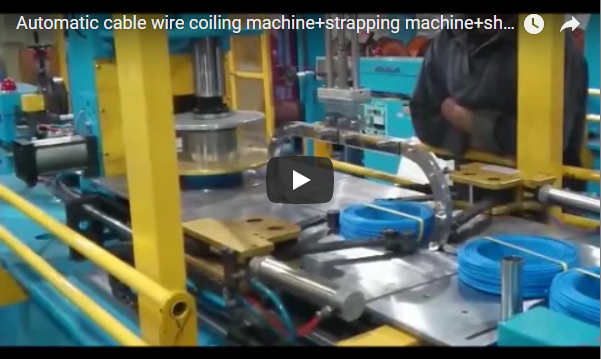
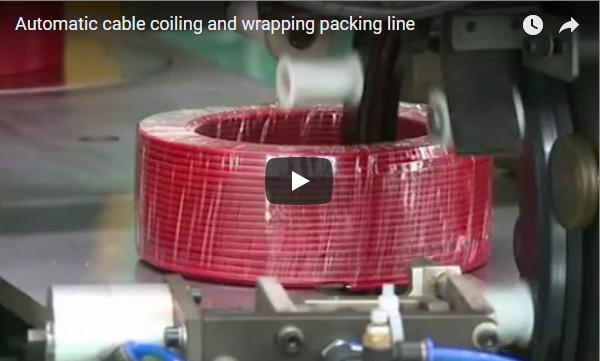
A ring-shaped green cable coil stands in the black clamp in the middle of the machine, with a yellow turntable to the left. The curved wrapping wheel on the right starts to turn and lays film round the coil while the turntable turns slowly.
When wrapping stops, a head presses down on the wrapped coil and the clamp releases it. The coil, now covered in green film with a yellow label band, runs along the roller conveyor and drops into a carton below. Red and blue air lines run to the actuators.
How the online cycle works
| Step | What happens |
|---|---|
| Clamp | The cable coil is held upright in the clamp |
| Wrap | The wrapping wheel lays film round the coil |
| Press | A head presses the wrapped coil |
| Release | The clamp opens and the coil moves to the conveyor |
| Box | The coil drops into the carton below |
Boxing at the end of the conveyor means the coil goes from coiler to carton without being touched.
Matching wrap cycle to line speed (takt time)
The wrapper must finish each coil before the next one is coiled. Illustrative example:
| Item | Value |
|---|---|
| Line speed (illustrative) | 60 m/min |
| Coil length (illustrative) | 100 m |
| Coiling time, (100 m ÷ 60 m/min) × 60 s/min | 100 s |
| Clamp, wrap, press and release | Must take less than 100 s |
Shorter coils leave less time, so we check the shortest coil length you run. For larger pipe and hose coils, see our HDPE pipe coil and hose wrapping machine and our tube and pipe coil packing machine.
Options for cable coil packing
| Need | Option |
|---|---|
| Label on every coil | Label band applied before wrapping |
| Cartons at the end | Drop into a carton under the conveyor |
| Several coil sizes | Clamp set to the size range |
| Higher output | Shorter wrap cycle or a second head |
Tell us the coil sizes and the line speed, and we size the cycle to the shortest coil.
Controls and safety
The wrapping wheel turns at speed and the press head comes down with force. Keep hands out of the clamp and wheel area while the machine runs, and clear a coil only with it stopped.
The standards that apply depend on the destination market. For CE markets, ISO 12100 sets the risk-assessment method and EN 415-10 sets general requirements for packaging machines.
Selection checklist for an online cable coil wrapper
- Cable diameter and type.
- Coil length, OD, ID and height.
- Line speed.
- Film type and colour.
- Labels and cartons.
- Floor space and air supply.
Engineering FAQ
Q: Can the wrapper keep up with the coiler? A: Yes, if the wrap cycle is shorter than the coiling time. Our illustrative 100 m coil at 60 m/min gives 100 s, so clamp, wrap, press and release must take less than that.
Q: What happens after wrapping? A: The coil is pressed, released and sent along the conveyor into a carton.
Q: Which coil sets the cycle? A: The shortest coil length, because it leaves the least time.
Q: How is the coil held? A: Upright in the clamp while the wheel wraps it.
Q: Can it add a label band? A: Yes. Our video shows coils leaving with a yellow label band.
Next step
We plan your cable coil wrapping machine in three steps:
- Submit your layout drawing with cable sizes, coil lengths and line speed to info@fhopepack.com.
- Receive a proposal within 48 hours, with the cycle time and film plan.
- Book a site survey to check the line layout and floor space.
Related reading
- Automatic coil packing line
- Video: cable coil packing machine for small-ID wire coils
- Video: economic cable coil packing machine
Sources
- Machine content: FHOPE engineering team, 2026-10-04
- Cycle example: our worked example; line speed and coil length are illustrative values
- Machine in action: our video on YouTube
- Standards scope: ISO 12100:2010, EN 415-10:2014
Last reviewed: 2026-10-04