Executive summary
Building wire and flexible cable are sold in short coils, often 50 m or 100 m, packed in film for the shelf. Winding, cutting, strapping and packing those coils by hand ties up several people at the end of the extrusion line. An automatic coil winding, strapping and packing machine measures the cable, winds it on a flanged spool, cuts it, straps the coil, and passes it to a shrink packer. This page covers the flow, the FCL-V600 coiler data, and how to size a coil for a set length.
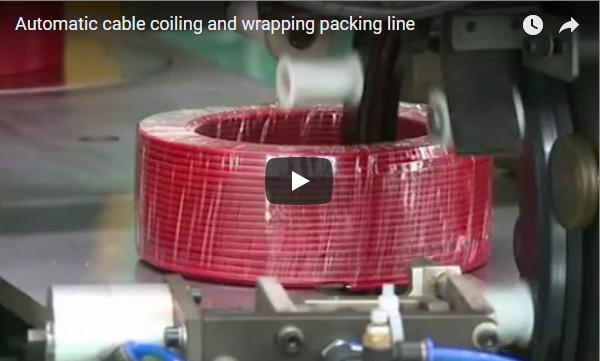
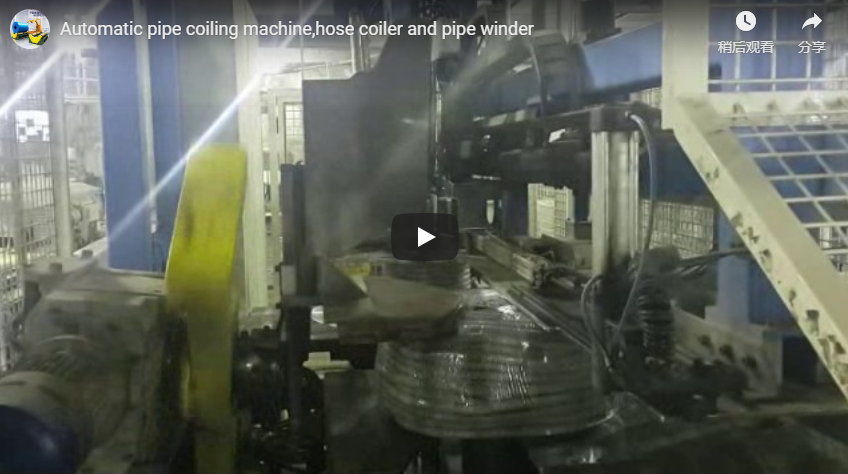
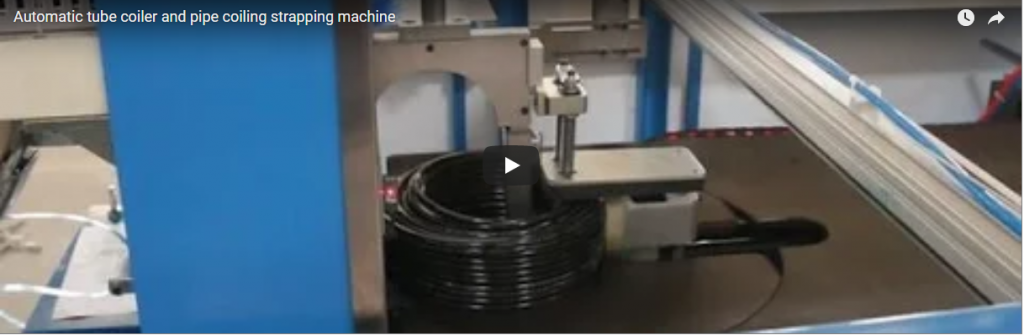
Red cable winds onto a spool between yellow flanges while a guide lays each turn. The coiler, with its pneumatic cylinders and blue frame, takes the finished coil off the spool and ties it. The coil then moves to a sealing station with a red sealing frame, where it is closed in film for shipment.
Table of Contents
- Why automate the end of the cable line
- Machine flow
- FCL-V600 coiler data
- Coil size for a set length
- Selection checklist
- Safety
- Engineering FAQ
- Next step
- Related reading
- Sources
Why automate the end of the cable line
Extrusion runs continuously; hand coiling does not. Operators cut lengths by eye, coils come out in different sizes, and loose coils spring open before they are tied. A measured, machine-wound coil has the same length, ID and height every time, so it fits the same film bag and the same carton, and length claims are not an issue.
Machine flow
- Measure: a meter counter measures the cable as it feeds in.
- Wind: the spool turns between flanges and the guide traverses to lay even layers.
- Cut: at the set length the cable is cut and the end is held.
- Hold and strap: the coil is held in a loop and strapped or tied at several points.
- Transfer: the coil moves to the next station.
- Pack: the coil is sealed in film and shrunk, ready for the carton.
FCL-V600 coiler data
| Item | FHOPE FCL-V600 automatic coiler |
|---|---|
| Coil OD | 400–600 mm |
| Coil height | 40–120, 40–200 or 100–300 mm |
| Coil ID | 200–400 or 250–400 mm |
| Cable OD | 2–16, 8–20 or 15–30 mm |
| Coil length (meter counter) | 20–100 m (other lengths custom) |
| Cutting length | adjustable |
| Air | 6 bar |
Line speed and packing station size are confirmed at quote.
Coil size for a set length
Turns per layer = coil height ÷ cable OD. Length ≈ π × mean diameter × turns per layer × layers. For 6 mm cable in a coil 60 mm high there are 10 turns per layer. With ID 300 mm and 9 layers, OD = 300 + 2 × 9 × 6 = 408 mm and the mean diameter is 0.354 m, so length ≈ 3.14 × 0.354 × 10 × 9 = 100 m. That 100 m coil sits inside the 400–600 mm OD range (example only). The counter sets the exact length; this sizing picks the film bag and carton.
Selection checklist
- Cable OD range and type?
- Coil length or lengths?
- Coil ID and height for your carton or bag?
- Strap, tie or tape?
- Shrink film, bag or carton after coiling?
- Extrusion line speed?
Safety
We design cable coilers to EN ISO 12100:2010 for risk assessment, EN 415-10 for packaging machine safety and EN 60204-1 for electrical equipment. The spool and cutter are guarded with mesh panels and interlocks.
Engineering FAQ
Q: How accurate is the length? A: The meter counter cuts at the set length; tolerance is confirmed at quote.
Q: Can one machine run several cable sizes? A: Yes, within the cable OD range, by changing the guide and recipe.
Q: Strap or tie? A: Either; the binding method is chosen per coil size and market.
Q: Can packing be added later? A: Yes, the coiler hands coils to a separate packing station.
Next step
- Send your cable OD, coil lengths and pack style to info@fhopepack.com.
- We size the coiler, strapping and packing station.
- We reply within 24 hours with a proposal and quotation.
Related reading
- Automatic hose coiling machine FCL-600 (product)
- Cable coil wrapping machine FPCA-200 (product)
- Automatic cable coiling, strapping and shrink packaging machine (video)
- Cable wire coil re-winding and strapping line (video)
Sources
- FHOPE product page: FCL-600 automatic coiler
- EN ISO 12100:2010; EN 415-10; EN 60204-1
- The cable coiling and packing machine shown above
Last reviewed: 2026-10-20