Executive summary
Pipes, extrusions and lumber travel as long bundles that a pallet wrapper cannot touch. This big horizontal stretch wrapping machine runs a ring around the stationary or slowly moving product and applies a 360-degree wrap along its length. Engineered for continuous multi-shift production, it keeps electronically regulated tension along the whole bundle and interlocks layers against slip. Bundle cross-section and throughput are confirmed per project.
Table of Contents
- What this machine wraps
- How a horizontal orbital wrap works
- The ring and the frame
- Film delivery and tension
- The conveyor and load positioning
- Sizing the machine
- Typical configuration
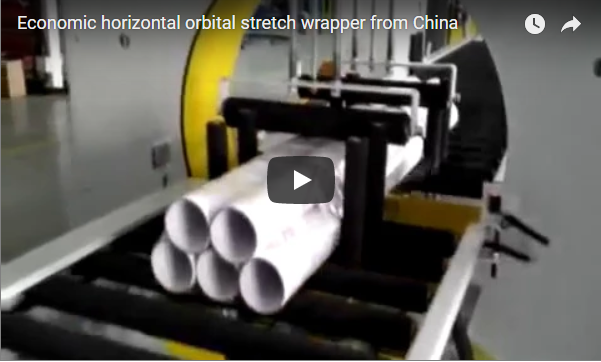
- What the video shows
- Selection checklist
- Operation and safety
- Engineering FAQ
- Next step
- Related reading
- Sources and standards
What this machine wraps
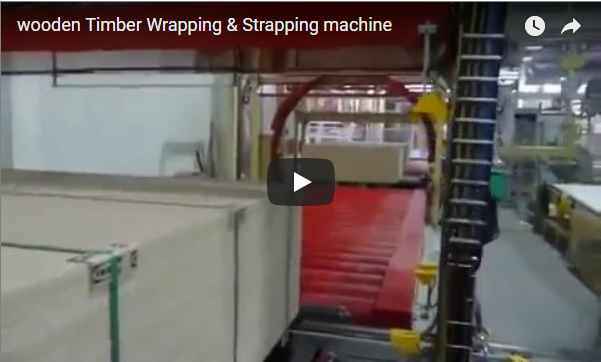
Long, heavy or awkward linear loads are the machine’s territory. Steel pipes, aluminum extrusions, lumber and fabricated assemblies all arrive as bundles that run long in one dimension, which is where a horizontal orbital wrapper does the job. Manual wrapping of these loads is slow and gives uneven tension, and the machine removes both the inconsistency and the physical handling of the wrap around heavy product.
How a horizontal orbital wrap works
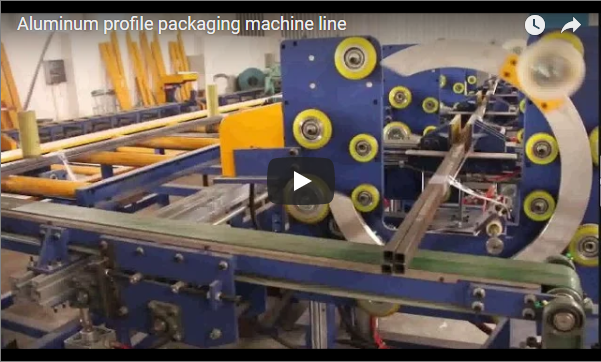
The geometry is built for length. Instead of spinning a pallet, a rotating ring carries the film carriage around the stationary or slowly moving bundle, applying stretch film a full 360 degrees around the product as it advances. The product passes through the middle of the ring, and the film spirals along the bundle as the load advances or the ring travels. Uniform tension holds regardless of how long the bundle is.
The ring and the frame
The ring is the machine. A balanced rotating ring houses the film carriage and turns at variable speed through a precision drive, so acceleration and deceleration stay smooth and the load is not shifted mid-wrap. The frame is welded heavy steel profile built for continuous three-shift duty, with the structure sized to carry dynamic forces at working speed. Drive rollers and bearings are laid out for easy service.
Film delivery and tension
The film carriage runs a powered pre-stretch unit that draws the film out before application. Tension is electronically regulated, held even from the start of the bundle to the end, and set so it does not crush delicate profiles or sit loose on heavy steel. Quick-change spindles cut the time to swap film rolls between bundles, and the pre-stretch setting follows the film grade, confirmed per project.
The conveyor and load positioning
Automation comes from the line side. The bundle is carried on a reinforced roller conveyor for smooth, rigid bundles, or a chain conveyor for cross-skids and heavy profiles, selected per project. The conveyor is synchronized with the ring, and photo-electric sensors detect the load and position it for the start of the wrap. Because the ring and the conveyor share one control sequence, a long line of identical bundles can be wrapped without an operator resetting between them.
Sizing the machine
Ring size is the sizing decision. The ring diameter sets the largest bundle cross-section the machine will accept, so the machine is selected on the biggest pipe diameter or the stack of profiles the line must pass. The drive and frame follow that cross-section and the bundle weight, and the ring size, drive and conveyor are confirmed per project rather than taken from a catalog copy.
Typical configuration
Figures below list functional design boundaries rather than numeric values, and are confirmed per project.
| Parameter | Typical range, confirmed per project |
|---|---|
| Bundle | cross-section and length |
| Ring | diameter per largest bundle |
| Drive | precision with VFD control |
| Conveyor | roller or chain, synchronized |
| Film | pre-stretch per grade |
| Electrical supply | 380 V three phase 50 Hz, or 220 V single phase for light machines, selected per project |
What the video shows
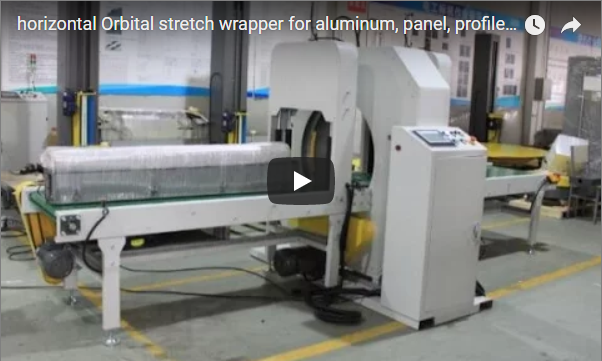
Our footage shows a horizontal orbital wrapper applying a spiral wrap along a long bundle. It is a general demonstration, so bundle size and throughput for your line are confirmed with us per project.
Selection checklist
| Question | Confirm per project |
|---|---|
| Bundle range | cross-section, length, weight |
| Ring size | pass-through diameter |
| Drive | speed and acceleration needs |
| Conveyor | roller or chain, line sync |
| Film plan | grade and pre-stretch |
| Electrical supply | voltage, phase and frequency on site |
Operation and safety
Start the recipe from the panel, load the bundle onto the conveyor and let the ring run. Keep clear of the ring and the conveyor while it operates, with emergency stops at the operator position and guarding around the wrap zone. Routine checks cover the ring drive, bearings, film carriage, conveyor and sensors, per the machine manual.
Engineering FAQ
Q: What loads does a horizontal orbital wrapper handle? A: Long linear bundles such as steel pipes, aluminum extrusions, lumber and fabricated assemblies.
Q: How does it wrap different bundle lengths? A: The ring orbits the bundle along its length, standing or slowly moving, so tension stays uniform regardless of bundle length.
Q: What sets the ring size? A: The ring diameter sets the largest bundle cross-section the machine can pass, selected per project.
Q: How is film tension controlled? A: Tension is regulated electronically and set so it holds heavy steel without crushing delicate profiles.
Q: Does it need a dedicated line? A: No. It can integrate into an upstream pipe or saw line, or run as an offline station with its own infeed and outfeed conveyors, selected per project.
Next step
- Email us at info@fhopepack.com with your bundle sizes, film and throughput.
- We send a horizontal wrapper proposal and a layout drawing within 48 hours.
- We arrange a site survey to confirm bundle range and floor layout.
Related reading
- Automatic horizontal orbital wrapping machine from FHOPE
- Hose coil wrapping machine – orbital coil wrapper
- Robot pallet wrapping machine
- FHOPE packing machinery product lines
Sources and standards
- ISO 12100:2010 Safety of machinery, general principles for design and risk assessment
- EN 415-10:2014 Safety of packaging machines, general requirements
- EN ISO 13849-1:2023 Safety of machinery, safety-related parts of control systems
FHOPE big horizontal stretch wrapping machine demonstration video. Reviewed as a general demonstration; bundle size confirmed per project.
Last reviewed: 2026-10-10