Executive summary A heavy roller conveyor with a turntable carries steel loads along a line and rotates them at a junction, so the load leaves in a new direction without a crane or forklift. Our coil handling modules cover coils of 80–5000 kg, rail transfer cars up to 20 t and stacking arms rated 10 t each. Size the turntable by its swept circle and the rollers by the load per roller. This guide gives the layout and sizing method.
Table of Contents
- How it works
- Handling modules
- Swept circle
- Load per roller
- Controls and interlocks
- Line layout
- Safety
- Selection checklist
- Engineering FAQ
- Next step
- Related reading
- Sources
How a heavy roller conveyor with turntable works
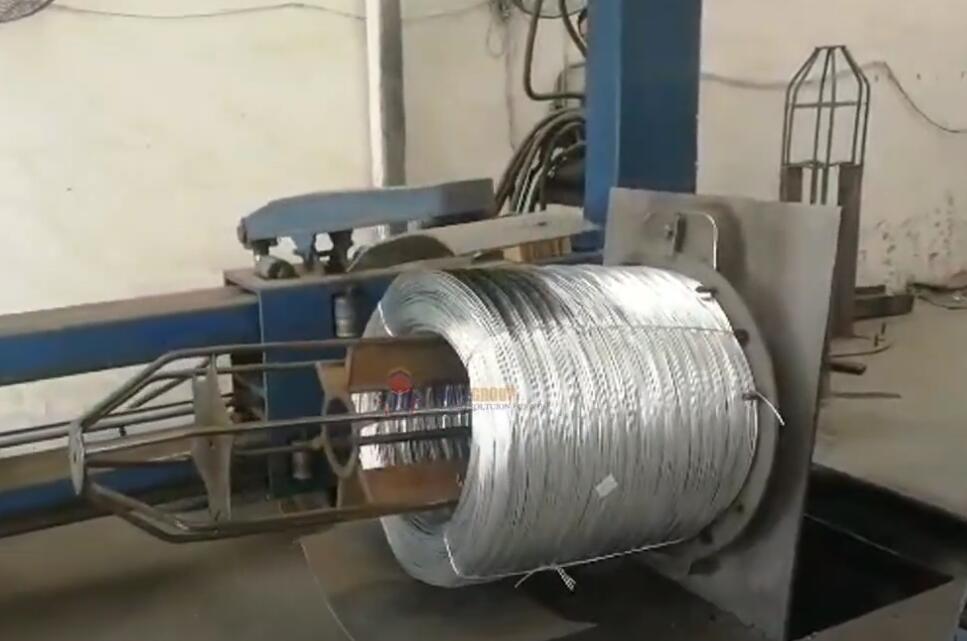
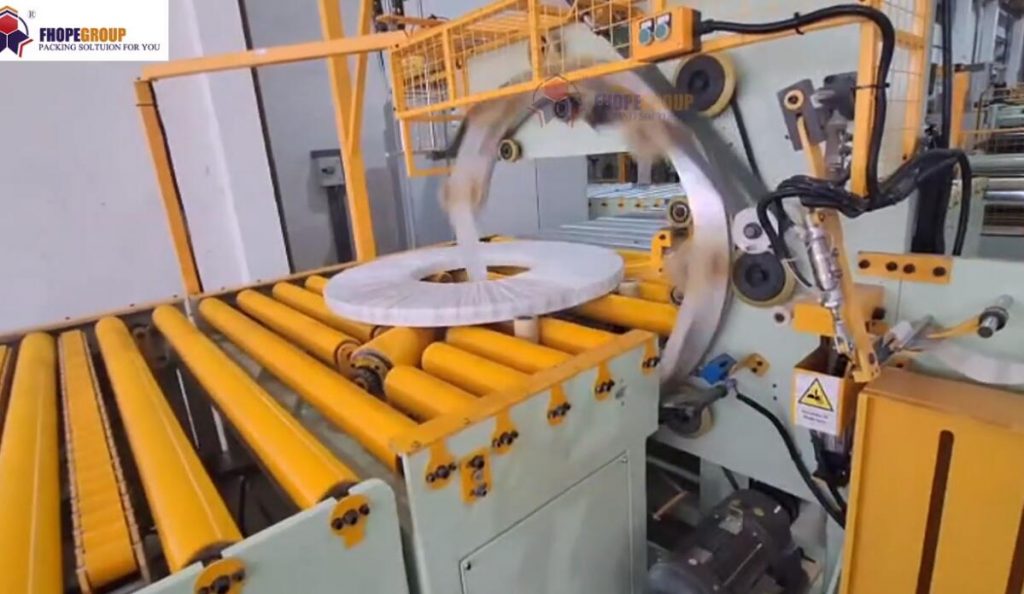
We built the system in this video: straight roller conveyor sections joined to a rotating roller section, run from a cabled control box. The clip shows a no-load rotation run: the deck stands still for the first 4 s, then from 4 s to 16 s turns slowly clockwise under pendant control. Rotation runs through an inverter, so the deck starts and stops softly; under load the same drive turns the deck between the junction positions described below. It works in five steps:
- Transport. Powered rollers carry the load along the straight section to the junction.
- Transfer on. The load rolls onto the roller deck of the turntable, which is aligned and locked with the fixed conveyor.
- Rotate. The turntable turns the deck, typically by 90° or 180°, with inverter speed control for soft start and stop.
- Align and lock. The deck stops in line with the outgoing conveyor and locks in position.
- Transfer off. The deck rollers drive the load onto the next conveyor.
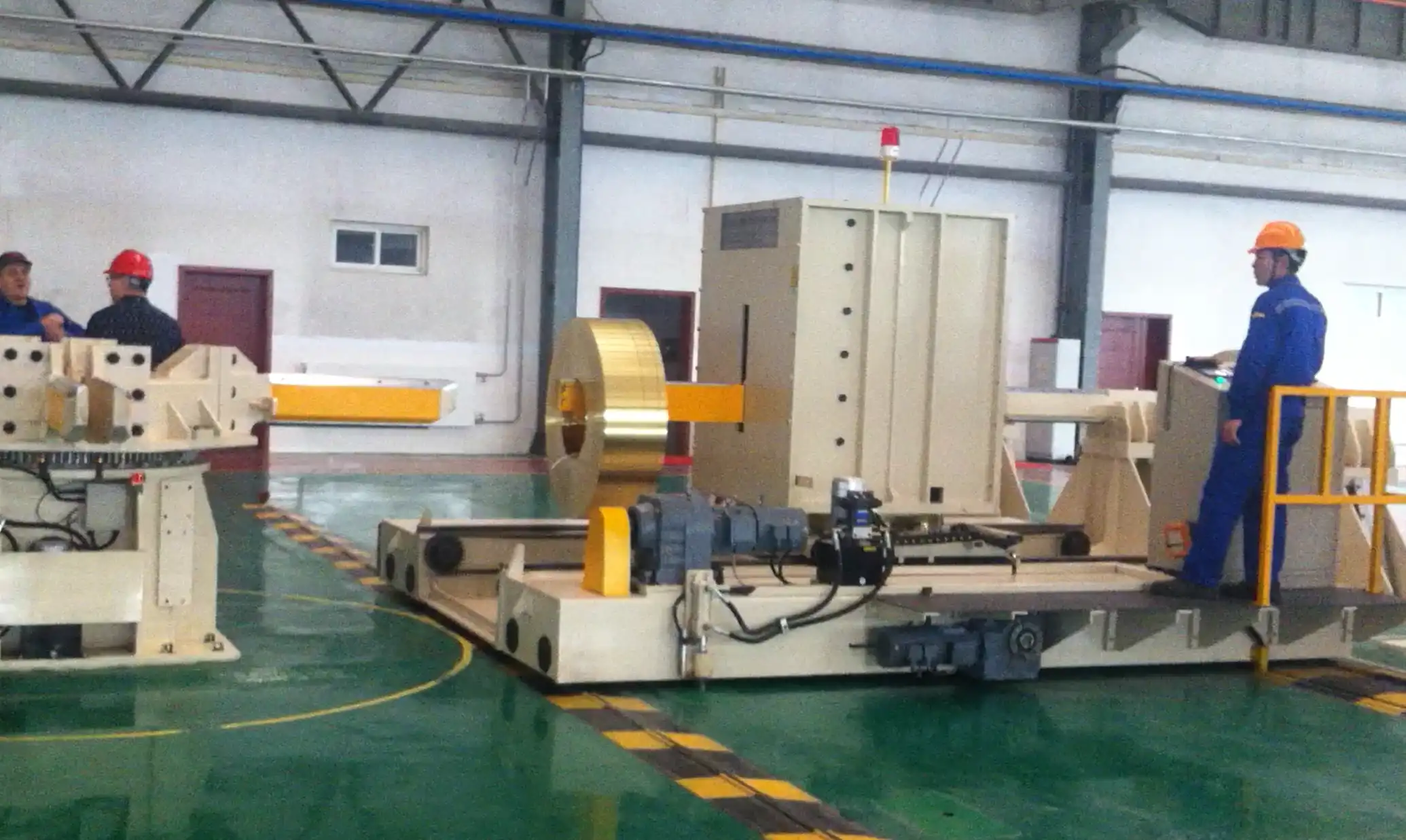
Handling modules around a coil packing line
| Module | Our specification |
|---|---|
| Coil range in slit coil lines | 80–5000 kg, OD 750–1400 mm, ID 508 mm |
| Turntable stacker cross arm | 10 t per arm, 40 t total, automatic rotation |
| Coil transfer car | max load 20 t, 360° turning, rail-guided, semi-automatic |
| Upender with conveyor | 90° tilt in about 50 s, roller tables on the platform |
| Strapping in the same line | PET strapper, 15 s cycle |
Each module replaces a crane lift at a direction change: the turntable or transfer car changes travel direction, and the upender changes the coil axis.
Swept circle: size the turntable clear zone
A rectangular roller deck sweeps a circle equal to its diagonal when it rotates:
- Swept diameter = √(deck length² + deck width²).
- Example: a 3000 × 1500 mm deck sweeps a 3354 mm circle.
- Load overhang: if the load is longer than the deck, use the load length instead, because the load sets the swept circle.
- Clear zone: keep fixed conveyors, columns and walkways outside this circle, and size the clearance with a margin on the layout drawing.
| Deck size | Swept diameter |
|---|---|
| 2000 × 1500 mm | 2500 mm |
| 3000 × 1500 mm | 3354 mm |
| 4000 × 2000 mm | 4472 mm |
Load per roller: check the worst case
A heavy coil or saddle rests on only a few rollers at a time, so check the load per roller, not the total capacity:
- Rule: load per roller = load weight ÷ rollers under the load.
- Example: a 5000 kg coil on a saddle spanning 4 rollers puts 1250 kg on each roller.
- Static figure only: this assumes even contact on every roller and a load at rest. Rolling transfer and uneven saddle contact load single rollers harder, so we size the rollers with a margin on the layout drawing.
- Arm margin: a 5000 kg coil on a 10 t stacking arm uses half the arm rating.
Roller diameter, pitch and bearing size follow from this per-roller load and the shortest saddle or pallet length.
Controls and interlocks
Our heavy handling modules use a manual control box or remote control, with inverters for speed. Key functions:
- Emergency stop and position lock on the transfer car and upender, so the deck cannot move during transfer.
- Automatic location of loading and unloading positions on the transfer car.
- Photoeyes on powered roller tables to detect the load.
- Stop at any angle and two displacement limiters on the upender.
Line layout: where the turntable fits
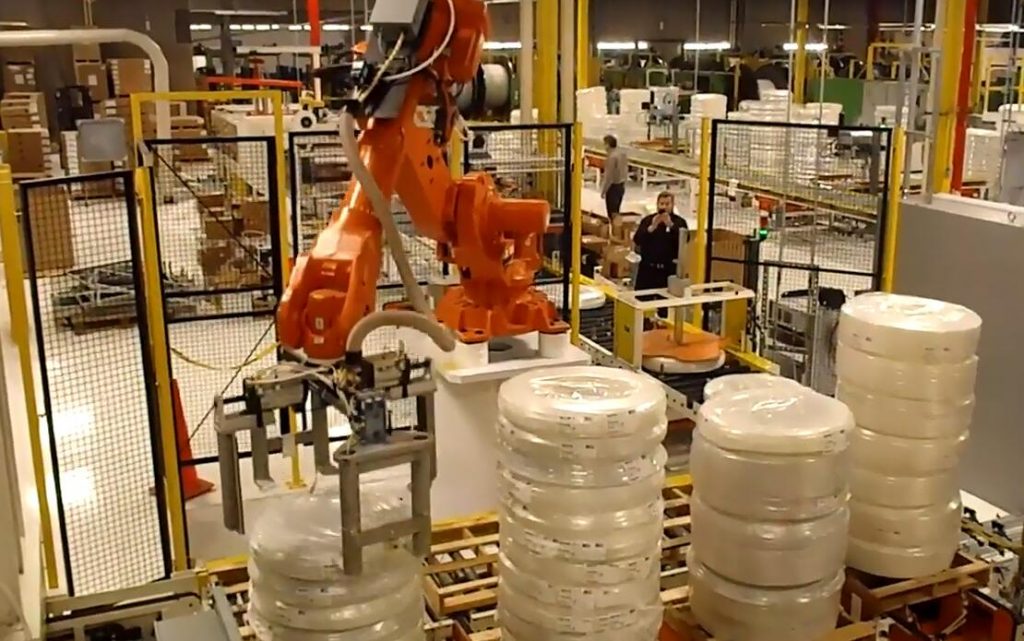
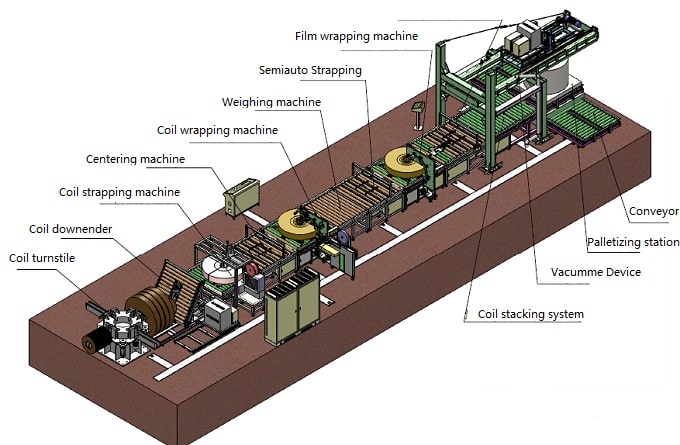
Put the turntable where the line must change direction and floor space rules out a straight run. In our slit coil lines, coils move from the slitter through a coil turntable and downender into strapping, wrapping and stacking. A turntable stacker with four 10 t arms lets one coil stack fill while another is unloaded.
Safety around heavy conveyors and turntables
The swept circle, the roller nips and the transfer gaps are the main hazards. Fence the swept circle, keep the control desk outside the working area, and lock the deck before any load transfer. The applicable standards depend on the destination market. For CE markets, ISO 12100 sets the risk-assessment method and EN 415-10 sets the general requirements for packaging machines.
Selection checklist for a heavy roller conveyor and turntable
- Heaviest load and its footprint on the conveyor (coil on saddle, pallet, bundle).
- Load length and width, to set deck size and swept circle.
- Rotation angles needed: 90°, 180° or other.
- Loads per hour through the junction.
- Manual control box, remote control or automatic line control.
- Floor space around the junction, and supply voltage at site.
Engineering FAQ
Q: How large a clear zone does a turntable need? A: Use the diagonal of the deck or the load, whichever is longer. A 3000 × 1500 mm deck sweeps a 3354 mm circle.
Q: How do I check roller capacity for a heavy coil? A: Divide the load by the rollers under it. A 5000 kg coil on 4 rollers puts 1250 kg on each roller as a static, even-contact figure; size the rollers with a margin on the layout drawing.
Q: When should I use a turntable instead of a transfer car? A: Use a turntable for a direction change at one junction. Use a rail transfer car, rated up to 20 t in our range, to move loads between parallel lines.
Q: How is the turntable kept aligned during transfer? A: A position lock holds the deck in line with the fixed conveyor, and an emergency stop halts the drive. Rotation runs through an inverter for soft start and stop.
Q: Can a turntable also tilt a coil? A: No. A turntable changes direction only. Our upender with conveyor tilts a coil by 90° in about 50 s when the coil axis must change.
Next step
We lay out the handling around your coil line in three steps:
- Submit your layout drawing with weights, footprints, rotation angles and loads per hour to info@fhopepack.com.
- Receive a layout proposal within 48 hours, with deck size, swept circle and roller load check.
- Book a site survey to fit the turntable and conveyors into your floor plan.
Related reading
- Upender and tilter with conveyor
- Steel coil transfer car
- Video: coil upender with turntable and rotary tilter
- Video: slit coil packing lines with turntable
- Steel coil wrapping machine
Sources
- Coil range, cross arm rating, PET strapper cycle: automatic slitting coil packaging line with turntable stacker page
- Transfer car load, turning, rail guidance, controls: coil transfer car page
- Upender tilt time, roller tables, photoeyes, limiters: upender with conveyor page
- Line view: our roller conveyor and turntable video on YouTube
- Standards scope: ISO 12100:2010, EN 415-10:2014
Last reviewed: 2026-10-03