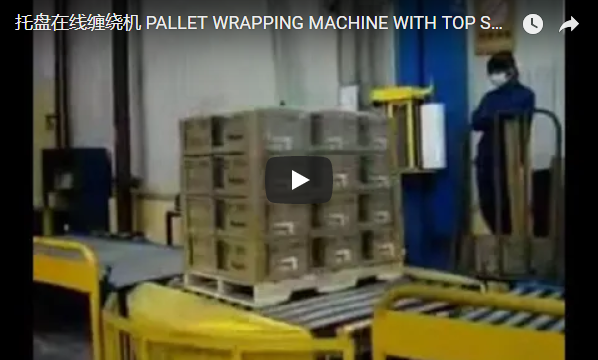
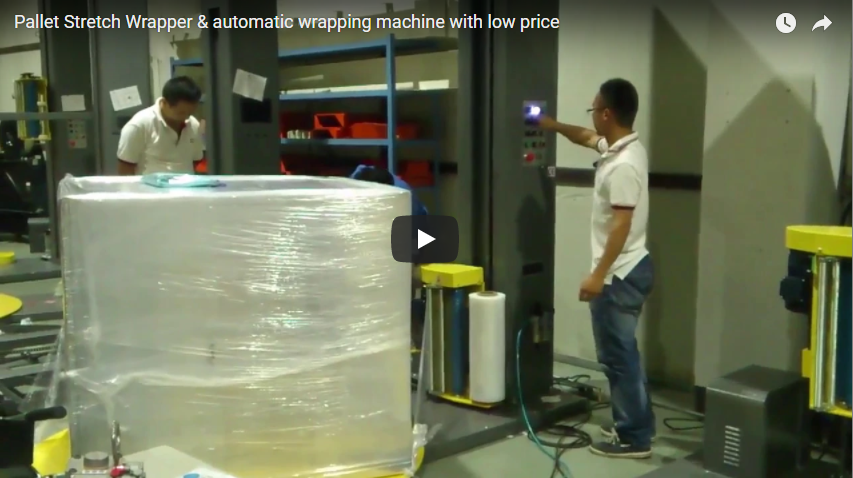
Executive summary Our automatic turntable wrapper takes bottled drink pallets on a roller conveyor and wraps them with no operator. Powered pre-stretch keeps tension constant, which matters for light, unsteady shrink packs. The film overlap comes from two settings: turntable speed and carriage speed. At 12 rpm and 2.9 m/min, the carriage rises about 242 mm per turn, so 500 mm film overlaps by about half.
Table of Contents
- Why bottle pallets are different
- Specifications
- Overlap from rpm and carriage speed
- Wind pattern for bottle packs
- Film handling
- Utilities and safety
- Selection checklist
- Engineering FAQ
- Next step
- Related reading
- Sources
Why bottle pallets are different
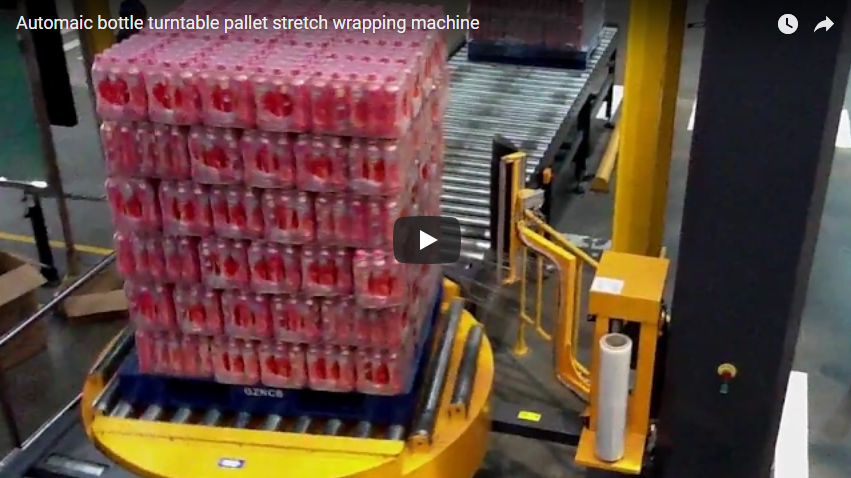
In this installation, our wrapper sits inline with the plant conveyors and handles tall pallets of shrink-wrapped bottle packs. The infeed conveyor moves each pallet onto the roller turntable. After wrapping, the turntable conveyor sends it to the outfeed line.
Bottle packs are light for their size, and each layer sits on round bottle tops. The stack can lean or slide if the film pulls unevenly. So the wrapper has to keep the film tension steady over the whole pallet, and tie the bottom layer to the pallet. The turntable has soft start and stop, so the stack is not jolted when rotation begins or ends.
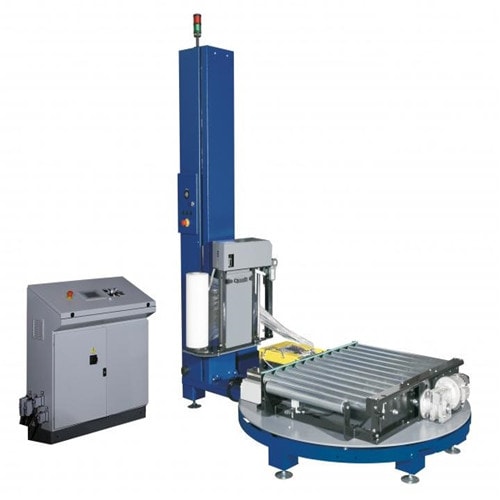
Specifications
| Parameter | Value |
|---|---|
| Output | min. 24 loads per hour |
| Max load weight | 1,800 kg |
| Turntable | 2,200 mm diameter, max. 12 rpm (adjustable), chain-drive roller conveyor |
| Start and stop | soft start and stop |
| Stretch film | LLDPE, 500 mm wide, 0.025 mm thick |
| Pre-stretch | 250% (100–300% optional) |
| Film carriage speed | 2.9 m/min |
| Wrap layers | bottom, middle, top: 0–99 winds each |
| Height detection | photocell sensor |
Overlap from rpm and carriage speed
During the spiral wrap, the turntable turns while the carriage moves up the mast. How far the carriage rises in one turn sets the film overlap. Here is the calculation at full speed:
- Time per turn. At 12 rpm, one turn takes 60 ÷ 12 = 5 s.
- Carriage rise per turn. At 2.9 m/min, the carriage rises about 48 mm/s, so about 242 mm in 5 s.
- Nominal overlap. With 500 mm film, each turn covers about 500 − 242 = 258 mm of the turn below, or about 52%.
If the turntable runs slower while the carriage speed stays at 2.9 m/min, the carriage rises more per turn and the overlap falls. At an illustrative 8 rpm, one turn takes 7.5 s, the carriage rises about 362 mm and the overlap is about 138 mm.
These are planning figures. Pre-stretched film narrows a little before it reaches the load, so we confirm the overlap on a trial pallet. The overlap setting on the control is adjustable to suit your load.
Wind pattern for bottle packs
We set bottom, middle and top winds separately, each from 0 to 99:
- Bottom winds. Extra winds tie the first layer of packs to the pallet, so the stack cannot slide off the deck.
- Middle. The spiral wrap with steady overlap holds the layers together.
- Top winds. Extra winds hold the top layer, which has no weight on it.
Motor-driven pre-stretch rollers deliver the film, and an electronic system measures the speed to keep the tension constant. This lets us wrap light and unsteady pallets that friction-brake systems cannot wrap well. The re-wrap and overwrap functions are also available.
Film handling for unmanned running
- Clamp. Scissors-like gripper bars hold the film tail for the next load.
- Cut. An instant heating wire cuts the film.
- Wipe. A soft brush presses the tail onto the pallet.
Sensors and the PLC program control each step. The operator only changes film rolls and other consumables.
Utilities and safety
| Utility | Requirement |
|---|---|
| Power | AC 380 V, 3 phase, 50 Hz |
| Motors | turntable 0.75 kW, rollers 0.75 kW, carriage 0.37 kW, pre-stretch 0.37 kW |
| Air | 6–8 kgf/cm² supply pressure |
| Controls | PLC, pre-stretch controller, separate buttons and HMI |
Safety includes a red mushroom-head emergency stop and a lockable electrical disconnect. The standards that apply depend on the destination market. For CE markets, ISO 12100 sets the risk-assessment method and EN 415-10 sets general requirements for packaging machines.
Selection checklist for bottle pallets
- Pallet size, stack height and weight.
- Pack type: shrink packs, cases or trays.
- Pallets per hour from the filling line.
- Target overlap and bottom and top winds.
- Infeed and outfeed conveyors, or forklift loading.
- Power supply and compressed air at the wrapper.
Engineering FAQ
Q: How is the film overlap set? A: By the turntable speed and the carriage speed. At 12 rpm and 2.9 m/min, the carriage rises about 242 mm per turn, which gives about 52% overlap with 500 mm film.
Q: Why confirm the overlap on a trial pallet? A: The calculation uses the nominal 500 mm film width. Pre-stretched film narrows a little before it reaches the load, so the real overlap is somewhat lower. A trial pallet shows the actual figure.
Q: How do you stop light bottle packs from shifting? A: With powered pre-stretch at constant tension, and with extra bottom and top winds from the 0–99 range.
Q: How many pallets per hour can it wrap? A: At least 24 loads per hour, or 150 s per pallet.
Q: What is the maximum load? A: 1,800 kg on a 2,200 mm turntable.
Next step
We match the wrapper to your bottling line in three steps:
- Submit your layout drawing with pallet size, pack type and pallets per hour to info@fhopepack.com.
- Receive a proposal within 48 hours, with wrapper, conveyors and wrap settings.
- Book a site survey to fit the wrapper to your end-of-line floor.
Related reading
- Automatic pallet wrapping machine B100
- Video: turntable pallet wrapper for the beverage industry
- Video: pallet wrapping machine with conveyors
- Video: turntable pallet wrapping machine and top sheet covering
- Video: pallet stretch wrapping machine A200
Sources
- Specifications, pre-stretch, film handling, utilities: B100 automatic pallet wrapping machine page
- Wrapper in action: our automatic bottle turntable pallet wrapping video on YouTube
- Standards scope: ISO 12100:2010, EN 415-10:2014
Last reviewed: 2026-10-03