Executive summary A semi-automatic pallet wrapper turns the load and runs the film carriage on its own, while the operator starts the film and finishes the tail by hand. Our A100 does this with an orange turntable and a green mast, here wrapping a pallet of four steel drums. Film use follows from the pallet perimeter and the load height. Both are set per project.
Table of Contents
- A100 turntable wrapper wrapping a pallet of drums
- How semi-automatic wrapping works
- Estimating stretch film per pallet
- Securing steel drums with bottom and top turns
- Controls and safety
- Selection checklist for a semi-automatic pallet wrapper
- Engineering FAQ
- Next step
- Related reading
- Sources
A100 turntable wrapper wrapping a pallet of drums
Four red steel drums stand on a wooden pallet on the orange turntable of our A100. The film carriage sits on the green mast beside it.
The turntable turns and the carriage travels up and down the mast, laying clear film round the drums until the whole load is covered. When the cycle ends, the operator crouches by the pallet and tucks the film tail by hand.
How semi-automatic turntable wrapping works: operator and machine
| Step | Who does it |
|---|---|
| Load the pallet onto the turntable | Forklift driver |
| Tie the film end to the pallet | Operator |
| Turn, wrap up and down the load | Machine |
| Cut and tuck the film tail | Operator |
| Take the pallet off | Forklift driver |
A turntable stretch wrapper like the A100 does the wrapping, which is the part that needs even tension. The operator only handles the start and the end of the film. To take the film cut off the operator too, see our pallet wrapping machine with auto film cutting.
Estimating stretch film per pallet
Stretch film consumption per pallet follows from the pallet perimeter, load height, film overlap and carriage program. Illustrative example for four drums in a 2 × 2 group on a 1,200 × 1,200 mm pallet, 1,000 mm high, with 500 mm film at half overlap:
| Item | Value |
|---|---|
| Pallet perimeter, 4 × 1,200 | 4,800 mm |
| Advance per turn at half overlap | 250 mm |
| Spiral turns per carriage pass, 1,000 ÷ 250 | 4 |
| Top and bottom turns (illustrative) | 4 |
Film use by carriage program
Film use then depends on the carriage program set on the panel. Each pass over the load height lays one layer:
| Carriage program | Layers | Turns | Film laid |
|---|---|---|---|
| Bottom to top only | 1 | 4 + 4 = 8 | about 38 m |
| Up and down | 2 | 8 + 4 = 12 | about 58 m |
| Up, down, up, down | 4 | 16 + 4 = 20 | about 96 m |
Each film figure is turns × 4.8 m. So the same pallet can take 38 m or 96 m of film, depending only on the program. Pick the program from how well the load must hold, not as a fixed rule.
Round drums touch the film only at their outer faces, so extra bottom turns help tie them to the pallet.
Securing steel drums with bottom and top turns
| Point | Why it matters |
|---|---|
| Round shape | Gaps between drums leave film unsupported |
| Heavy load | Drums stay put on the turntable |
| Bottom turns | Lock drums to the pallet so they cannot walk |
| Top turns | Hold the drum rims together |
Set extra turns at the bottom and top for drum loads.
Controls and safety
The turntable and carriage move during the cycle. Keep clear of the turntable while it turns, and step in to cut the film only when the cycle has stopped. For pallet wrapping machines, EN 415-6 adds the specific safety requirements.
The standards that apply depend on the destination market. For CE markets, ISO 12100 sets the risk-assessment method and EN 415-10 sets general requirements for packaging machines.
Selection checklist for a semi-automatic pallet wrapper
- Pallet size and load height.
- Heaviest load.
- Pallets per shift.
- Load type: drums, cartons or bags.
- Turns and overlap wanted.
- Floor space and power supply.
Engineering FAQ
Q: What does semi-automatic mean? A: The machine turns and wraps; the operator starts and finishes the film by hand.
Q: Can it wrap drums? A: Yes. Our video shows four steel drums on a pallet.
Q: How much film per pallet? A: Turns times perimeter, and the turns depend on the carriage program. Our 1,000 mm high example lays about 38 m bottom to top only, about 58 m up and down, and about 96 m up, down, up, down.
Q: Why extra bottom turns on drums? A: They lock the drums to the pallet so they cannot move.
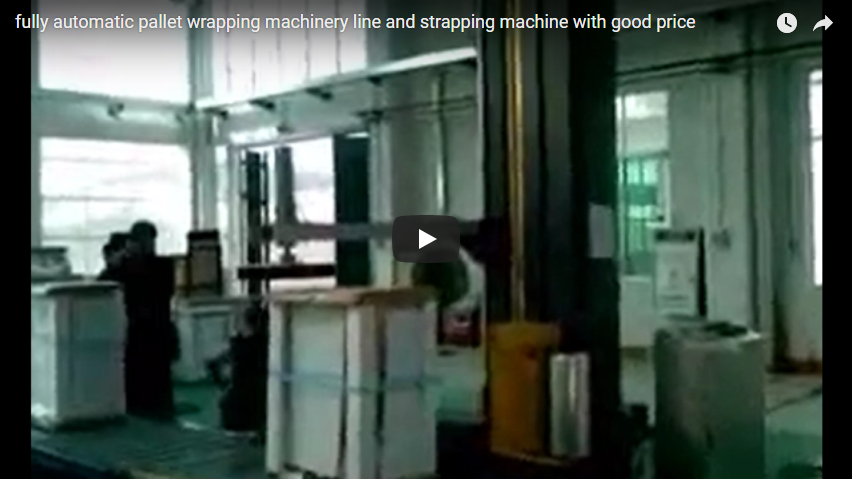
Q: When should I choose a fully automatic wrapper? A: When pallets arrive on conveyors at a steady rate and no operator is free. Our fully automatic pallet wrapping line shows that set-up.
Q: Which safety standards apply to a pallet stretch wrapper? A: EN 415-6 sets the specific requirements for pallet wrapping machines. For CE markets, ISO 12100 sets the risk-assessment method and EN 415-10 the general requirements for packaging machines.
Next step
We plan your pallet wrapper in three steps:
- Submit your layout drawing with pallet sizes and output to info@fhopepack.com.
- Receive a proposal within 48 hours, with the wrap and film plan.
- Book a site survey to check the floor space and power.
Related reading
- Semi-automatic pallet wrapping machines
- Automatic pallet wrapping machines
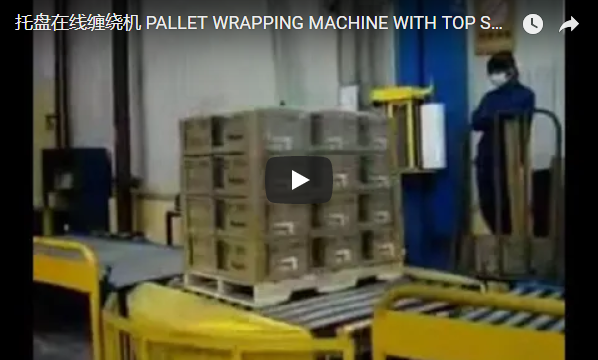
- Video: A200 pallet stretch wrapper with top press, operation and film use
Sources
- Machine content: FHOPE engineering team, 2026-10-04
- Pallet wrapper safety: EN 415-6
- Film example: our worked example, illustrative values
- Machine in action: our video on YouTube
- Standards scope: ISO 12100:2010, EN 415-10:2014
Last reviewed: 2026-10-04