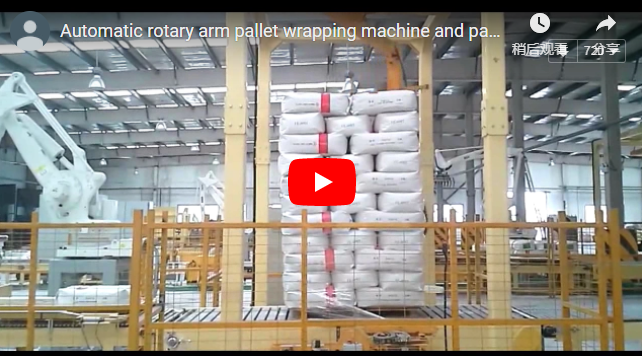
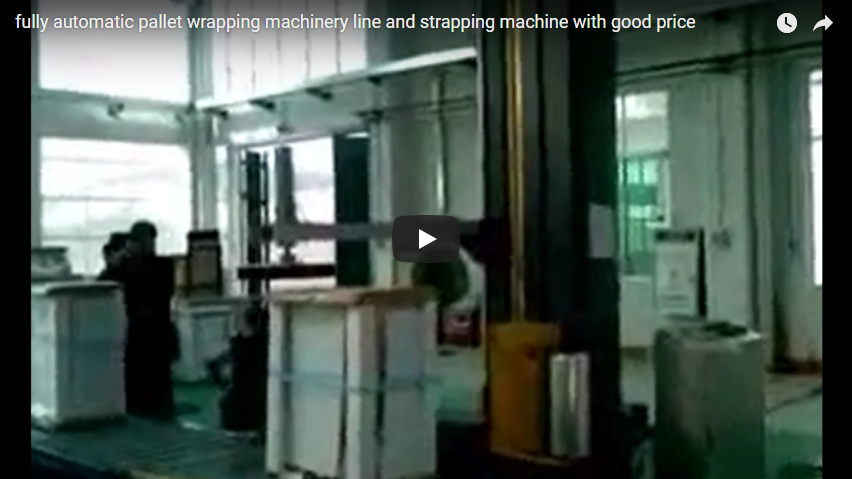
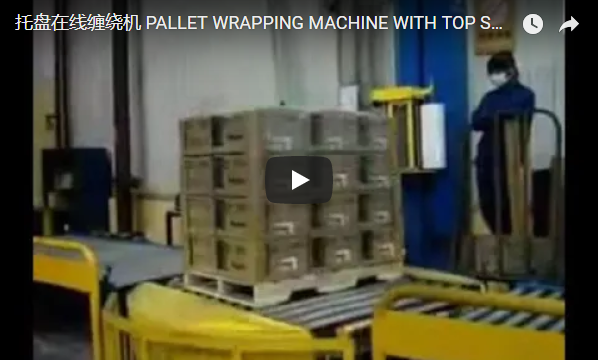
Executive summary The FHOPE-RAS200 rotary arm stretch wrapper integrates into automated packaging lines to deliver five-sided weatherproofing for palletised goods. While the pallet remains completely stationary on the conveyor, the system applies a protective polyethylene (PE) top sheet and secures the load with pre-stretched film. An electro-mechanical scissor top press prevents light or loose cartons from shifting and keeps the top sheet centred until side wrapping seals the edges. Engineered for loads up to 1,200 × 1,200 × 2,000 mm and 2,000 kg, the machine achieves cycle rates of 40–50 pallets per hour. A worked calculation demonstrates how to determine top sheet dimensions and balance cycle times against conveyor line rates.
Table of Contents
- Why Cover the Top as Well as the Sides
- Why the Arm Turns and the Load Does Not
- Covering and Wrapping Sequence on the Line
- What the Scissor Top Press Does
- RAS200 Specifications
- Worked Example: Top Sheet Size and Line Balancing
- Selection Checklist: What to Send Us
- Safety and EN 415-6 Compliance
- Engineering FAQ
- Next Step
- Related Reading
- Sources
Why Cover the Top as Well as the Sides
Standard horizontal stretch wrapping seals only the vertical faces of a pallet. This configuration leaves the top exposed to warehouse dust, roof drips, moisture ingress, and transit condensation. For corrugated cartons stored in humid distribution centres or transported on flatbed vehicles, moisture settling on top softens the upper boxes and causes structural stacking failure.
Integrating an automatic PE top sheet creates a sealed five-sided barrier. As the film carriage ascends, it applies overlapping wraps directly over the down-folded edges of the top sheet. This mechanical seal keeps the pallet protected against environmental exposure during long-term storage and intermodal shipping.
Why the Arm Turns and the Load Does Not
Conventional turntable wrappers spin the entire pallet, subjecting the cargo to centrifugal forces. When wrapping tall stacks, lightweight cartons, or unstable bulk loads, rotational acceleration can cause layer displacement or total load collapse.
The rotary arm design eliminates this failure mode:
- Static Load Stability: The pallet remains motionless on the roller bed while the balanced cantilever arm rotates around it at 3–12 rpm.
- Simplified Conveyor Integration: Infeed, wrapping, and discharge occur along the same conveying axis. The production line does not require turntable indexing drives, load transfer lifts, or auxiliary centering stops.
- Reliable Conveyance: Heavy industrial loads up to 2,000 kg exert purely static downward pressure on the conveyor structure, reducing mechanical wear and eliminating pallet shifting during the wrapping cycle.
Covering and Wrapping Sequence on the Line
- Infeed and scan: the roller conveyor advances the pallet into the wrap zone and the height sensor measures the load.
- Sheet dispensing: an overhead carriage draws PE sheet over the load, cuts it to the programmed length and drapes it over the perimeter.
- Top press: a scissor mechanism lowers a platen onto the centre of the sheet, locking the sheet and the top carton layer.
- Arm wrapping: the arm runs at 3–12 rpm while the carriage travels vertically, laying pre-stretched film across the pallet base, up the load face and over the draped sheet edges.
- Cut and wipe: a pneumatic clamp holds the tail while the cutter trims it and the wipe presses the end against the load.
- Outfeed: the press retracts and the conveyor takes the finished pallet away.
What the Scissor Top Press Does
A loose PE sheet lifts under the air moved by the rotating arm, and without downforce film tension pulls it off centre in the first passes.
- Sheet retention: the platen clamps the sheet flat against the top carton layer, keeping the overhang even on all four sides until the side film locks the edges.
- Stack compression: on tall or light stacks, wrap tension can deform corners; the press applies controlled vertical force against it.
- Pallet lifter (option): a pneumatic lifter raises the pallet clear of the rollers so the bottom wrap can pass under the timber runners.
RAS200 Specifications
The table below details the technical specifications of the FHOPE-RAS200, alongside our RAS100 system for cross-comparison within the rotary arm portfolio.
| Parameter | FHOPE-RAS200 (In-Line System) | RAS100 (Heavy-Duty Standalone) |
|---|---|---|
| Operation Mode | Fully Automatic (In-line) | Fully Automatic / Standalone |
| Control System | PLC + Touchscreen HMI | PLC + Touchscreen HMI |
| Max. Load Dimensions (L × W × H) | 1,200 × 1,200 × 2,000 mm | OD 1,400 mm × W 1,400 mm |
| Max. Load Weight | 2,000 kg | 4,000 kg |
| Throughput Capacity | 40–50 pallets/hour (load-dependent) | 10–30 pallets/hour |
| Rotary Arm Speed | 3–12 rpm (VFD adjustable) | 10–14 rpm (VFD adjustable) |
| Rotary Ring/Arm Diameter | 1,500 mm | Base envelope aligned |
| Film Pre-Stretch | Motorized pre-stretch up to 200% / Mechanical | Power pre-stretch (LLDPE 500 mm, 0.25 mm) |
| Height Detection | Photoelectric sensor | Photoelectric sensor |
| Top Sheet Dispenser | Integrated PE top sheet unit (Standard/Option) | Optional / Modular |
| Top Press Mechanism | Electro-mechanical scissor plate | Optional pneumatic / mechanical |
| Film Cut & Clamp | Automatic pneumatic cut and wipe | Automatic pneumatic cut, clamp, and wipe |
| Compressed Air Requirement | 4–6 kgf/cm² | 4–6 kgf/cm² |
| Conveyor Configuration | Integrated line conveyor pass-through | 1.5 m infeed + 1.5 m outfeed (~12 m/min) |
| Machine Power Supply | 220 V, 50 Hz, 1-Phase, 3.0 kW | 380 V / 220 V, 3-Phase |
| Total Machine Weight | 1,500 kg | Engineered per structural frame |
Note: The FHOPE rotary arm product family includes five models: RAS200, RAS100, R300, R200, and R100, accommodating diverse payload sizes and line speeds.
Worked Example: Top Sheet Size and Line Balancing
The following calculations provide an illustrative engineering example for sizing the PE top sheet and evaluating line cycle times.
1. Top sheet sizing
For a pallet of 1,200 mm (L) × 1,000 mm (W) × 1,500 mm (H) with 200 mm overhang per side:
| Input | Value |
|---|---|
| Sheet length | 1,200 + 2 × 200 = 1,600 mm |
| Sheet width | 1,000 + 2 × 200 = 1,400 mm |
| Sheet area | 1.6 × 1.4 = 2.24 m² |
The 200 mm overhang is caught by the top wraps and bonded against the carton walls.
2. Film Turns and Overlap Kinematics
- Film Roll Width: 500 mm
- Overlap Rate: 50% (vertical carriage travel per arm turn = 250 mm)
- Vertical Travel Distance: 1,500 mm / 250 mm = 6 climbing turns
- Reinforcement Wraps: 3 bottom base winds, 3 top locking winds
| Programme Type | Turn Breakdown (Bottom + Travel + Top + Return) | Total Turns | Wrap Time at 12 rpm |
|---|---|---|---|
| Up-and-Down (Heavy Duty) | 3 base + 6 up + 3 top + 6 down = 18 turns | 18 turns | (18 ÷ 12) × 60 = 90 s |
| Up-Only (High Speed) | 3 base + 6 up + 3 top = 12 turns | 12 turns | (12 ÷ 12) × 60 = 60 s |
3. Line takt and cycle feasibility
A rate of 40 pallets per hour needs a complete station cycle every 90 s (3,600 ÷ 40). The cycle is wrap time plus auxiliary time, where auxiliary covers infeed and outfeed, sheet pulling, cutting and the scissor press — typically 20–30 s.
- Up-and-Down Programme: Wrapping alone requires 90 s. Adding 25 s for auxiliary tasks gives 115 s/pallet (maximum line capacity: ~31 pallets/hour). This programme does not fit a 40 pallets/hour target.
- Up-Only Programme: Wrapping requires 60 s. Adding 25 s for auxiliary movement results in an 85 s cycle time (equivalent to ~42 pallets/hour). This satisfies the 40 pallets/hour target with a 5-second buffer.
4. Film consumption
The pallet perimeter is 2 × (1.2 + 1.0) = 4.4 m, so 12 turns apply 52.8 m of film. At 200% pre-stretch (1 m off the roll becomes 3 m on the load) that draws about 17.6 m from the master roll per pallet. These figures are illustrative and confirmed against your own film and programme.
Selection Checklist: What to Send Us
To receive a formal engineering layout and cycle time validation, provide the following operational parameters:
- Load Geometry: Minimum and maximum pallet dimensions (Length × Width × Height).
- Weight Distribution: Maximum payload weight and load centre-of-gravity details.
- Line Speed: Target pallets per hour from upstream case packers or palletisers.
- Top Sheet Specification: Required edge overhang (mm), film thickness (µm), and film material (PE/VCI).
- Conveyor Baseline: Top-of-roller height, conveying direction, roller pitch, and upstream/downstream safety interlock protocols.
- Site Utilities: On-site electrical supply (e.g., 220 V 1-ph / 380 V 3-ph) and clean compressed air availability (bar / kgf/cm²).
Safety and EN 415-6 Compliance
The FHOPE-RAS200 complies with EN 415-6 (Safety of Packaging Machines: Pallet Wrapping Machines) and is verified via an ISO 12100 risk assessment. Because the arm rotates around an open perimeter, safeguarding the operating zone is mandatory:
- Perimeter Guarding: The entire station envelope must be enclosed with 2.0-metre-high fixed steel mesh fencing to prevent access to the rotating arm and scissor press.
- Conveyor Access Interlocks…let flow from personnel entry.
- Emergency Control Architecture: Dual-channel safety circuits connect all emergency stop pushbuttons, interlocked maintenance doors, and low-pressure trip sensors to the safety PLC module.
Engineering FAQ
Q: Can the sheet length change for mixed loads? A: Yes. Height and length come from the line sensors (or an upstream MES telegram) and the cut length follows the stored recipe.
Q: Does it need an operator full time? A: No, it runs inline automatically; attendance is limited to replacing stretch film and PE sheet rolls, with warnings before run-out.
Q: Can the film wrap the pallet base? A: Yes, with the optional pneumatic pallet lifter that raises the pallet clear of the rollers during the bottom wrap.
Q: Which standards apply? A: EN 415-6 for pallet wrapping machines, with a risk assessment to ISO 12100.
Next Step
- Submit Your Application Data: Send your pallet sizes, stack heights, and target line speeds to info@fhopepack.com.
- 24–48 Hour Engineering Response: Our packaging engineering team will provide a comprehensive project proposal, including sheet sizing and cycle time analysis.
- Layout & System Integration Drawing: We deliver an engineering integration drawing demonstrating the RAS200 layout inside your existing roller conveyor layout.
Related Reading
- Rotary Arm Stretch Wrapper RAS200
- Automatic Rotary Arm Stretch Wrapper RAS100
- Rotary Arm Pallet Wrapping Machine Product Line Overview
- Automatic Rotary Arm Pallet Wrapping Machine with Top Sheet Covering (Video)
- Online Pallet Wrapping Machine for Big Sized Products (Video)
Sources
- RAS200 rotary arm stretch wrapper specifications
- RAS100 automatic rotary arm stretch wrapper
- Machine in action: Online pallet wrapping with top sheet covering
- EN 415-6:2013 Safety of packaging machines, part 6
- ISO 12100:2010 Safety of machinery
Last reviewed: 2026-11-05