Executive summary
A carpet roll needs a closed, tight film cover so its surface stays clean. This machine wraps a roll on a conveyor, seals the film, and passes it through a heat shrinking section so the film tightens against the roll. The machine handles rolls of different colours side by side on one line. Roll size, film grade and line layout are confirmed per project.
Table of Contents
- Why rolls need a sealed shrink cover
- What the machine does
- Seal first, shrink second
- Handling different rolls
- What the footage shows
- Typical configuration
- Selection checklist
- Operation and safety
- Engineering FAQ
- Next step
- Related reading
- Sources and standards
Why rolls need a sealed shrink cover
A carpet or fabric roll has a surface that marks easily, and an open film sheet lets dirt reach the pile between the roll ends. A sealed cover protects the whole roll until it is opened by the customer.
A wrap only helps if it stays in place. Shrinking a sealed film sleeve onto the roll makes the cover fit the surface tightly, with no loose film to catch on shelving. Roll size and film are confirmed per project.
What the machine does
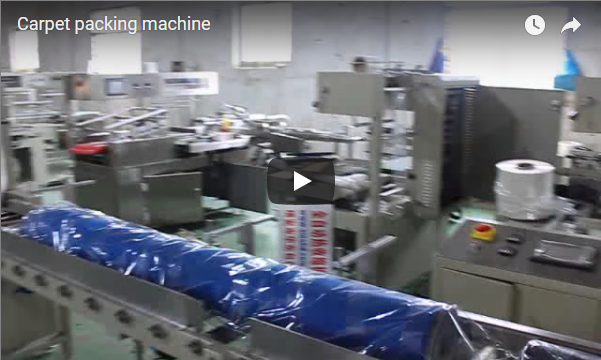
The machine is a carpet roll sealing and shrinking packing machine. A roll travels on a conveyor into the wrapping area, where transparent film is drawn around it. The wrapped roll then moves into a sealing and heat shrinking section so the film closes and tightens onto the roll surface.
The machine links the sealing and shrinking steps on one line, so covered rolls come out at the far end. The wrapping and shrink sections are matched to the roll length. Line layout is confirmed per project.
Seal first, shrink second
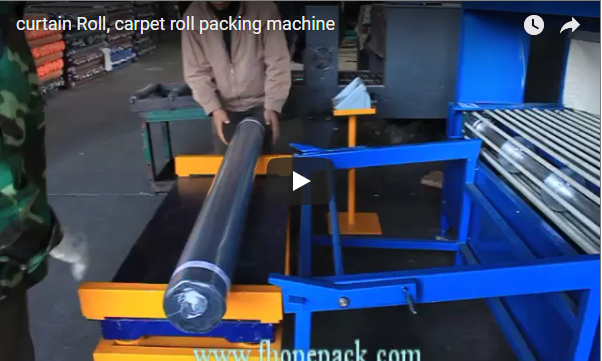
The cover has to be sealed before it shrinks: heat only pulls a closed sleeve tight around the roll. The footage shows the roll passing through the film wrap, the sealing area closing the film, and then a shrinking section where the film begins to tighten and take the shape of the roll.
Because sealing happens before heat, the shrink has a closed film to work on. Seal and shrink settings are confirmed per project.
Handling different rolls
The demonstration lines up several rolls of different colours on the support, showing that the machine does not depend on one roll finish. Rolls of various diameters and lengths can run through the same wrap and shrink cycle with the settings matched to each size.
Roll-to-roll changeover is part of the setup rather than a re-engineer. The roll range handled is confirmed per project.
What the footage shows
Our footage shows a carpet roll sealing and shrinking packing machine wrapping, sealing and heat-shrinking a roll on the conveyor, with several rolls handled on one support. It is a general demonstration, so your roll size, film grade and line layout are confirmed with us per project.
Typical configuration
Figures below list functional design boundaries rather than numeric values, and are confirmed per project.
| Parameter | Typical range, confirmed per project |
|---|---|
| Load | carpet or fabric roll |
| Wrap | transparent film drawn on |
| Seal | film closing section |
| Shrink | heat shrinking section |
| Feed | conveyor through-line |
| Electrical supply | 380 V three phase 50 Hz, or 220 V single phase for light machines, selected per project |
Selection checklist
| Question | Confirm per project |
|---|---|
| Load range | roll diameter, length, weight |
| Film | grade, thickness, width |
| Seal | edge seal method |
| Shrink | heat range, dwell |
| Line | feed and outfeed layout |
| Electrical supply | voltage, phase and frequency on site |
Operation and safety
Start the line from the control and the roll moves through wrap, seal and shrink under power. Keep clear of the film feed, the sealing area and the heat section while the machine runs, with guarding around the moving parts and heat.
Routine checks cover the conveyor, the film feed, the sealer and the heat section, per the machine manual. Confirm the settings against the film grade before each run.
Engineering FAQ
Q: What does this machine do? A: It wraps, seals and heat-shrinks film onto a carpet roll.
Q: Why seal before shrinking? A: Heat only makes a closed film sleeve shrink tight around the roll.
Q: Can it handle different rolls? A: Yes, rolls of different sizes and finishes run on the same line.
Q: Does it work with a conveyor? A: Yes, the roll feeds through under power and comes out covered.
Q: Where is the sealer relative to the shrink? A: The sealing area comes first, so the heat section works on a closed film sleeve when the roll reaches it.
Next step
- Email us at info@fhopepack.com with your roll dimensions.
- We send a sealing and shrinking machine proposal and a layout drawing within 48 hours.
- We arrange a site survey to confirm film grade and line layout.
Related reading
- Carpet roll sealing and shrinking packing machine
- Shrink packaging machine for carpet roll
- Stretch wrapping machines
- FHOPE packing machinery product lines
Sources and standards
- ISO 12100:2010 Safety of machinery, general principles for design and risk assessment
- EN 415-10:2014 Safety of packaging machines, general requirements
- EN ISO 13849-1:2023 Safety of machinery, safety-related parts of control systems
FHOPE carpet roll sealing and shrinking packing machine demonstration video. Reviewed as a general demonstration; roll size, film grade and line layout confirmed per project.
Last reviewed: 2026-10-11