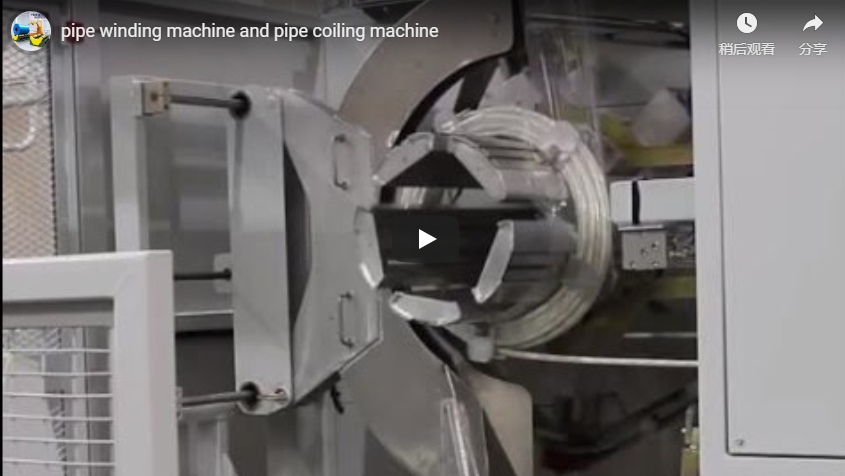
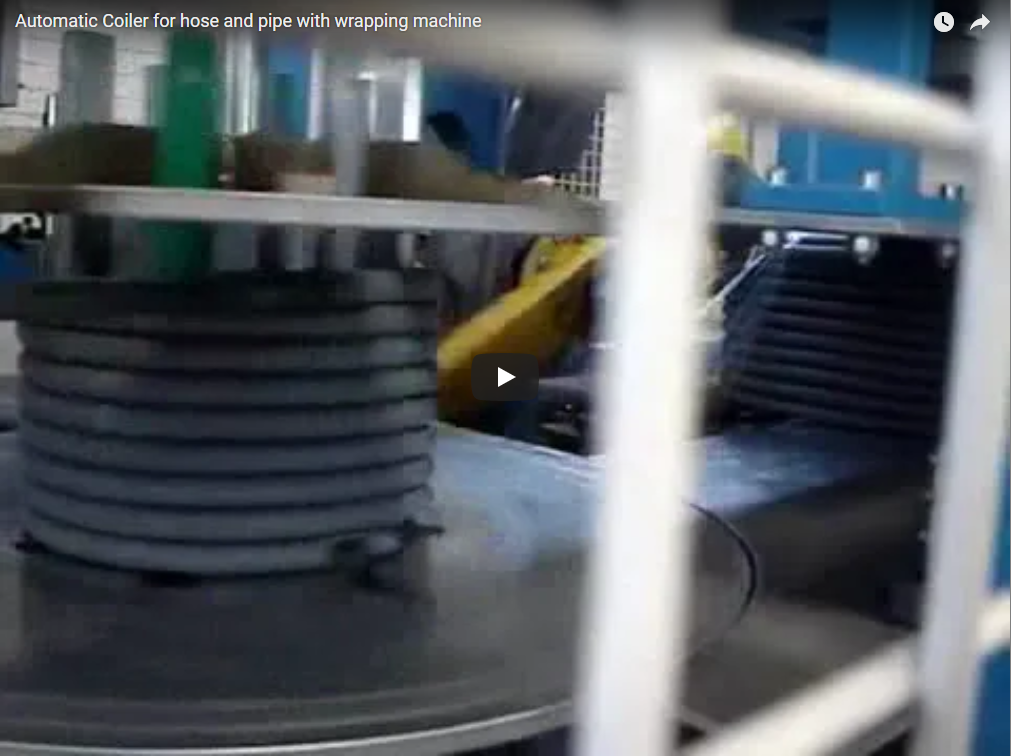
Executive summary This video shows an automatic tube coiler and pipe coiling strapping machine in a real factory setting: a coil is formed on a rotating platform under a vertical press head, black strapping tape is wound into a tight spiral, and the finished coil is pushed out along a conveyor. Later footage shows coiled tube moving on to a heat-shrink wrapping unit. The video demonstrates the process visually only — no cycle-time, capacity, or power data is given.
Why this machine matters for tube and hose producers
If you ship coiled tubing, hose, cable, or flexible strip, you already know the pain of manual coiling: uneven coil tension, loose bands that shift in transit, and operators spending hours winding by hand. The machine in this video addresses exactly that step. It takes a flexible product, forms it into a compact coil under controlled pressure, secures it with strapping material, and pushes the finished coil out for the next stage of packaging.
This article walks through what the footage actually shows, what it does not show, and which questions you should ask before shortlisting a machine like this.
What the video shows: the machine in action, step by step
Based on the footage, a full working cycle looks like this:
| Stage | Approx. time | What happens on screen |
|---|---|---|
| Loading / setup | 0–28 s | A silver cylindrical workpiece sits centered on a yellow rotating platform; a red supply reel on the left feeds black tape toward the working zone; the green indicator light on the control panel is lit. |
| Pressing and rotation | 35–77 s | The vertical press head lowers onto the top of the workpiece; the platform spins; black strapping tape is fed in from the side and wraps tightly around the outer wall in a spiral. |
| Winding completes | 77–84 s | Multiple spiral layers are formed; the press head lifts gradually; the workpiece stops rotating. |
| Discharge | 84–98 s | A pusher mechanism moves the finished black coil off the platform along a rail to the output side, where it rests as a compact spiral. |
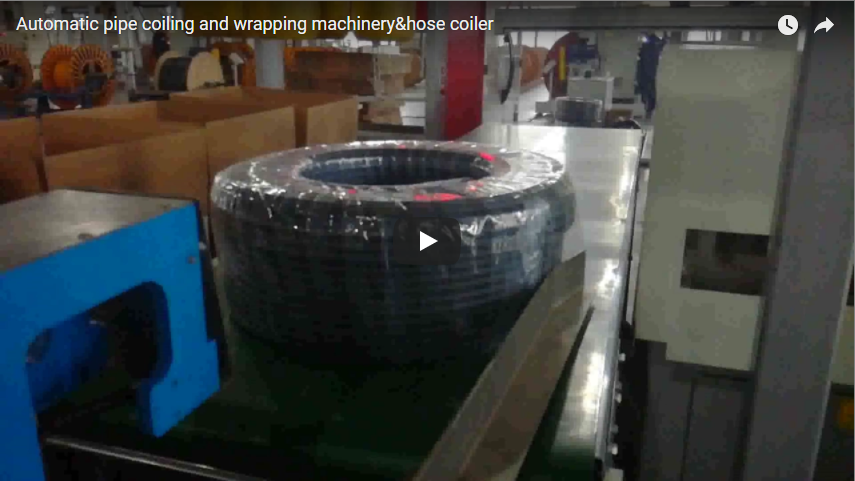
From roughly the 105-second mark, the camera pans across the wider line: a long silver metal tube travels along a rail conveyor, a mechanical arm with a circular clamp grips a coil core and positions it under the press head, and red tubing is seen exiting a white heat-shrink packaging unit with roller output. The coiler is clearly one station in a larger packaging flow — coil, strap, then shrink-wrap — rather than a stand-alone device.
Direct observation notes
- Main frame is a blue painted steel cabinet with white panel sections; some columns and supports are silver-grey metal.
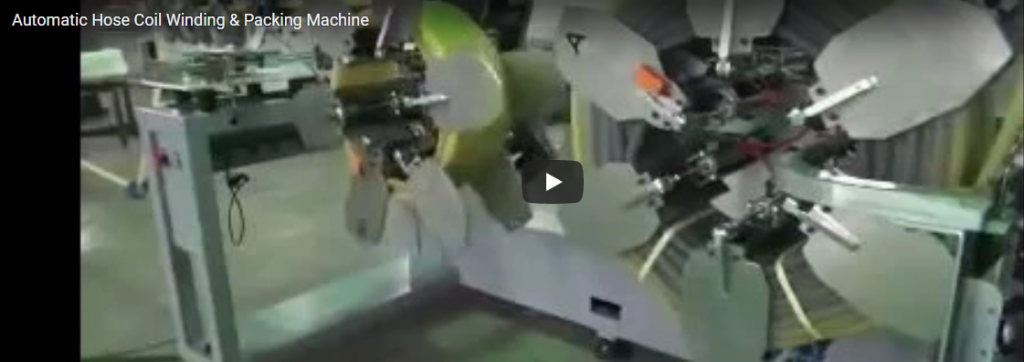
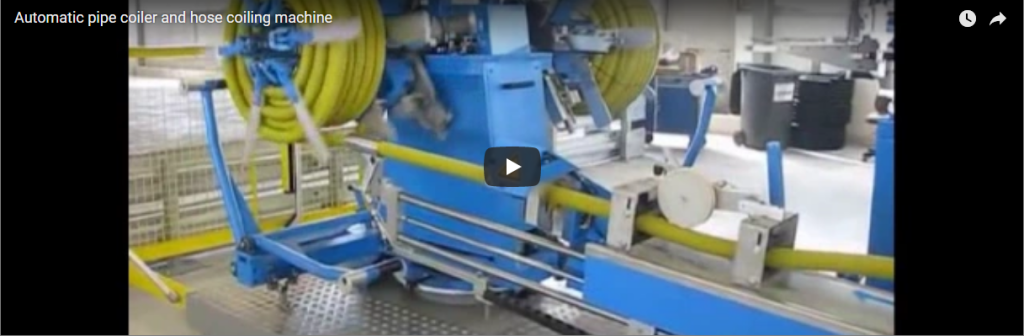
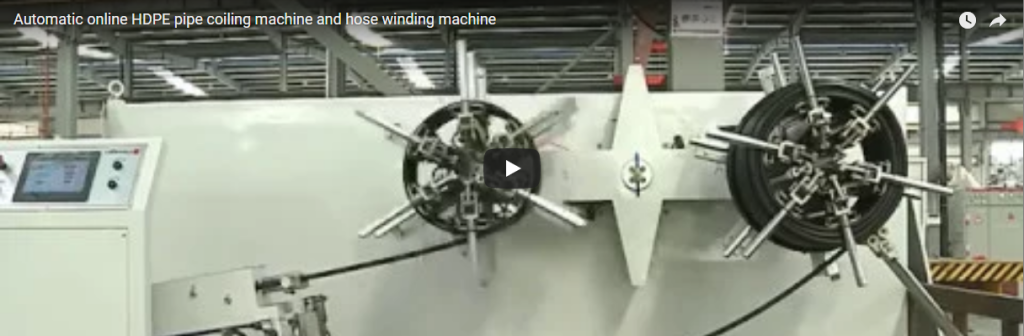
- Left side: a red twin-wheel reel used to supply strapping tape. Center: a vertical pneumatic/hydraulic press head with a silver cylinder body and guide sleeve. Below: a yellow circular rotating platform with locating fixture. Right: a control box with buttons, a knob, indicator lights, and pneumatic lines in red and blue.
- A rail-type conveyor system runs along the front of the machine.
- The control panel carries a rotary knob, two square buttons, indicator lamps (red/green), and a yellow triangular warning label with a hand-crushing pictogram on the column; a red mushroom-head emergency stop button is visible on the panel in later frames (around 140 s).
- Workpiece starts as a silver cylindrical metal part roughly 20–25 cm in diameter; the finished black spiral coil is roughly 25–30 cm outside diameter, about 10–12 cm tall, with approximately 8–12 layers of tape roughly 1–2 cm wide.
- Later footage shows black coiled flexible tube (estimated 15–25 cm coil diameter), straight silver metal tube over 1 m long, and red finished tube exiting the shrink unit.
- The only legible text in the entire video is the watermark
www.fhopepack.com; no nameplates, model numbers, or parameter values are readable.
What the video does not show
The footage is useful, but it stays at the visual level. It does not reveal:
- Rated power, voltage, or air supply requirements
- Actual cycle time or output per hour
- Maximum and minimum coil diameter, tube length, or weight limits
- Whether tooling can be changed for different product sizes, and how long changeover takes
- Control system type (PLC, touch HMI) or integration interfaces
- Safety certifications (CE or others), fencing options, or light-curtain protection
- Maintenance schedule, spare-parts list, or warranty terms
- Noise levels in normal operation
None of these can be confirmed from the video, so treat every one as a verify with the manufacturer item before comparing quotes.
Where this type of machine fits
Judging from the products visible on screen, the likely applications include:
- Flexible hose and rubber tube — coiling and strapping before boxing or shrink-wrapping
- Cable and wire assemblies — bundling coils so they hold shape in transit
- Metal and plastic pipe in coils — securing spiral coils for warehousing and shipping
- Downstream packaging lines — pairing the coiler with heat-shrink wrapping, as shown in the video, or with pallet wrapping for consolidated loads
The core benefit shown is consistency: the coil comes off the platform uniformly wound and tightly strapped, which is hard to sustain with manual winding. The machine also reduces manual handling of heavy, springy coils.
Two honest limitations visible in the footage: loading appears to depend on an operator placing or positioning the workpiece, and the working area is open, with no full perimeter guarding or light curtain observed. If your safety policy requires interlocked guarding, raise this early with the supplier.
Buyer checklist before you request a quote
- Confirm the coil diameter and height range matches your products (largest and smallest).
- Ask for a measured cycle time on a sample of your actual tubing.
- Confirm strapping tape width and type compatibility, and local tape availability.
- Ask whether changeover between product sizes needs extra tooling and how long it takes.
- Request safety options: perimeter guarding, light curtains, interlocked gates, e-stop layout.
- Verify power supply (three-phase/single-phase, voltage, frequency) and compressed-air requirements against your workshop.
- Ask about integration with your existing conveyor or shrink-wrap line, as shown in the video.
- Confirm warranty, spare parts lead time, and commissioning/training support.
FAQ
Does the machine coil and strap in one cycle? Yes — the footage shows the coil being formed on the rotating platform while black strapping tape is wound around it, then the finished coil is pushed out. Details of how many straps per coil are applied are not visible; check with the manufacturer.
Is loading automatic? The video shows operators nearby and workpieces being positioned on the platform, but no fully automatic feeding system is clearly demonstrated. Treat loading as a question to confirm.
Can it handle different tube diameters? The video shows several product types (black coiled tube, silver straight tube, red finished tube) on the line, but does not show size changeover. Verify the compatible diameter range with the manufacturer.
What safety features are included? Visible items include an emergency stop button, warning labels, and indicator lights. No full guarding or light curtains are observed. If your site requires them, confirm availability before purchase.
Does it connect to shrink wrapping? The video shows a heat-shrink packaging unit operating in the same line with coiled tube moving toward it on rollers, indicating line integration is possible. Layout specifics should be confirmed for your facility.
Related reading
- Automatic coiling machine overview
- Automatic strapping machines
- Steel tube strapping machine
- Automatic pallet wrapping machine
Next step
If coiled tube, hose, or cable is slowing down your end-of-line packing, the fastest way forward is to send us your product dimensions and target output. Visit our contact page to request a quote, a cycle-time demonstration, or layout advice for a coiling and strapping line like the one shown here.
Source and method
This article is based solely on the video above. Frames were sampled at regular intervals and analyzed with a vision-language model; the video contains background music only, with no narration or speech to transcribe. All observations are limited to what is visible on screen; figures described as estimates are approximations from the footage, and anything not observable is listed as needing confirmation from the manufacturer.
Published: 2026-09-03