Executive summary A coil’s quality is set the moment the hose leaves the operator’s hands. This guide covers automatic coiling and wrapping for hoses and pipes on one machine: how the product is measured, wound onto a mandrel in even layers, and then wrapped in the same pass. We explain what manual coiling gets wrong and how the machine makes each coil repeatable. Hose sizes and wrap are confirmed per project.
Table of Contents
- What manual coiling gets wrong
- Measured infeed
- Winding and layers
- Cutting at the target
- Wrapping in line
- Coil presentation
- Typical configuration
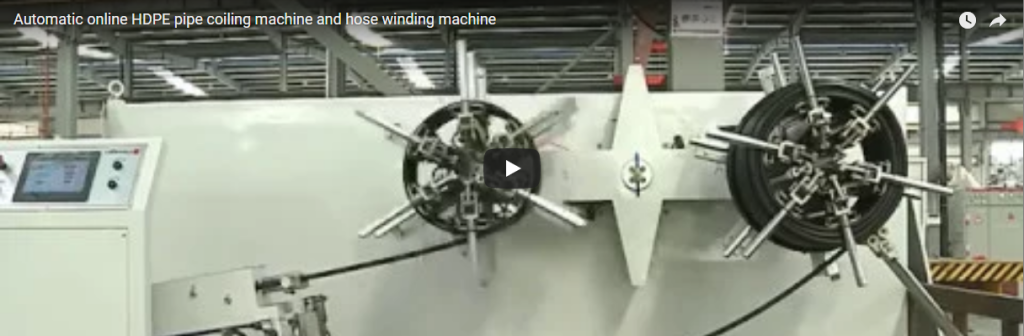
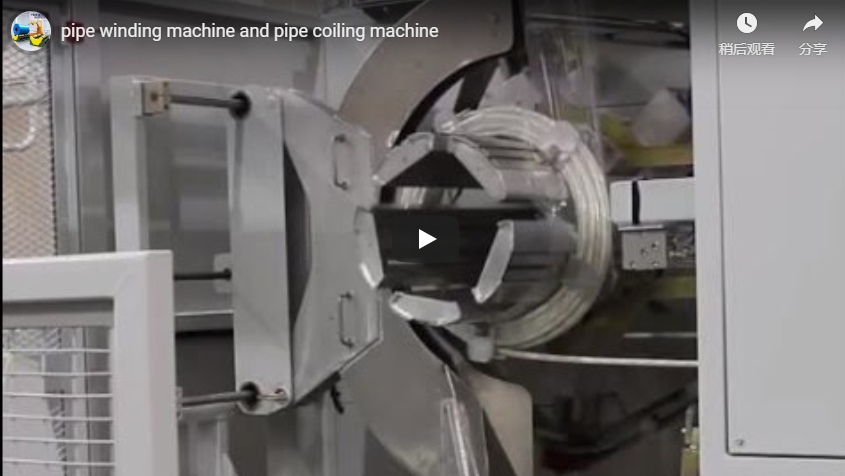
- What the video shows
- Selection checklist
- Controls and safety
- Engineering FAQ
- Next step
- Related reading
- Sources and standards
What manual coiling gets wrong
Manual coiling reads like a list of problems. Coil diameter, tightness and length drift between operators and between shifts. The work is slow and repetitive, and a kink or scuff from a hurried turn ruins the coil before it is even packed.
The machine answers those problems with measurement and repetition, taking the coil’s dimensions off the operator’s hands and putting them on the line.
Measured infeed
The hose or pipe is guided into the machine through rollers and a measuring device tracks the length as it feeds. Because the length is counted on the way in, the machine winds exactly the length the product calls for, not what the operator estimates.
Winding and layers
The product winds onto a rotating head or mandrel that sets the coil’s inner diameter. A traversing guide lays the hose side by side in even layers, controlling the coil’s width as it builds. Neat layers are what keep a finished coil from slumping into a heap on its pallet.
Cutting at the target
When the measured length is wound, the machine cuts the product cleanly. The cut lands at the same point each time, which keeps the coil’s size and weight consistent from one run to the next.
Wrapping in line
On the same machine, the finished coil moves to the wrapping station and receives its protective wrap in the same sequence. Coiling and wrapping share one index, so the coil is not carried between two stands and left waiting.
Coil presentation
A coil that comes out wound, wrapped and complete lands on the outfeed ready for its pallet. Consistent coils stack predictably, which shows up in clean presentation and fewer handling surprises downstream.
Typical configuration
Figures below list functional design boundaries rather than numeric values, and are confirmed per project.
| Parameter | Typical range, confirmed per project |
|---|---|
| Product | hose or pipe diameter and type |
| Measurement | length tracking on the infeed |
| Coiling | head or mandrel with traverse layers |
| Cut | at measured target length |
| Wrap | in-line wrapping of the coil |
| Electrical supply | 380 V three phase 50 Hz, or 220 V single phase for light machines, selected per project to the plant supply |
What the video shows
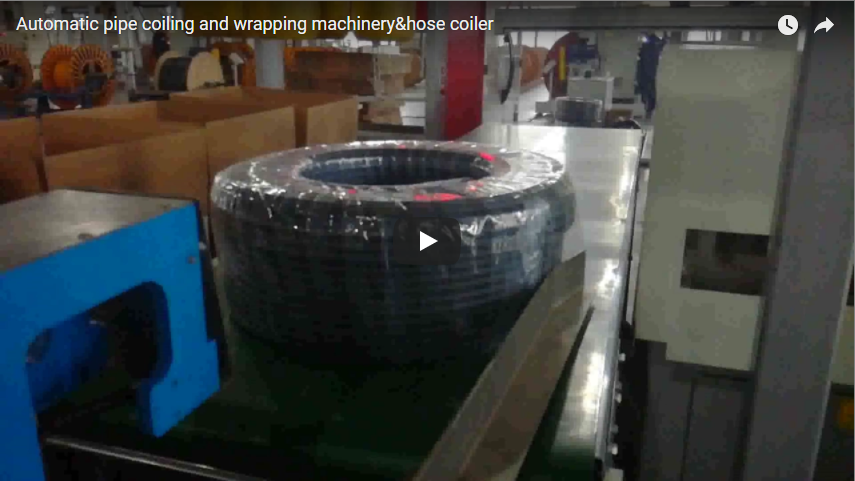
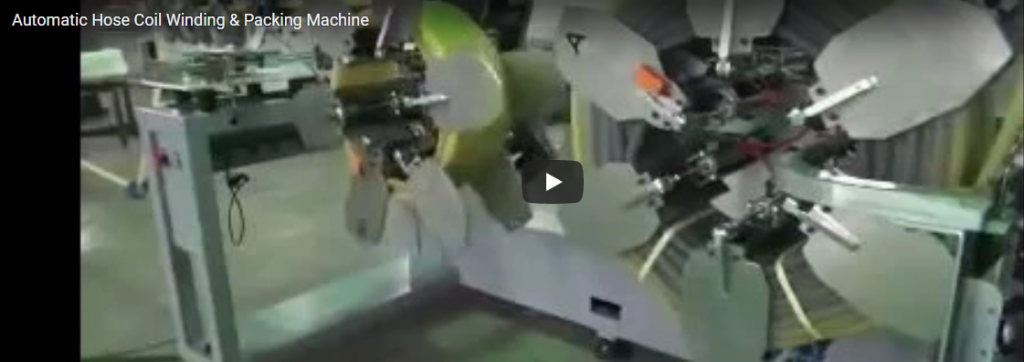
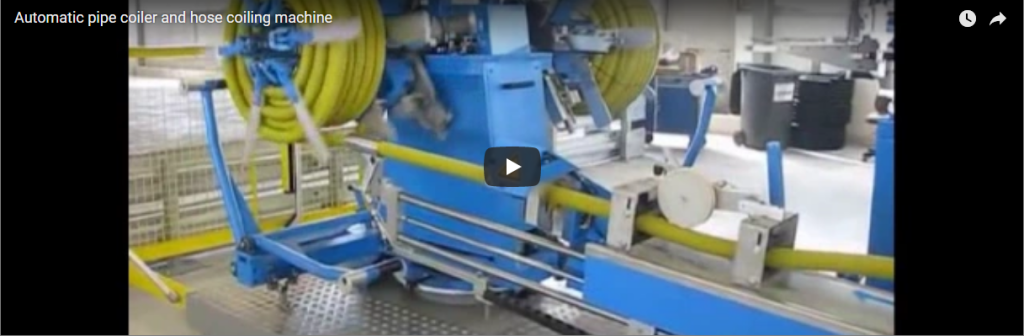
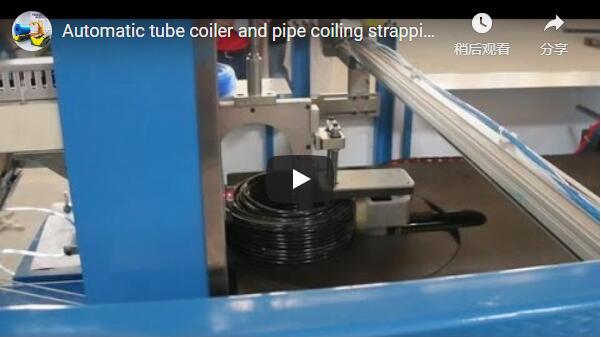
The demonstration confirms single-index transfer from traversing mandrel coiling through the cut-off to the wrap, without manual intermediate handling. Hose size, coil and wrap for your plant are confirmed with us per project.
Selection checklist
| Question | Confirm per project |
|---|---|
| Hose or pipe range | infeed and mandrel envelope |
| Coil dimensions | inner diameter, width, layers |
| Length control | measurement and cut accuracy needed |
| Wrap | film and pattern on the coil |
| Line pace | machine cycle fit |
| Electrical supply | voltage, phase and frequency on site |
Controls and safety
The machine runs from a control panel with an emergency stop at the operator position and guarding around the winding mandrel and wrapping zones. Keep hands clear while the line runs. Routine checks cover the measuring device, mandrel, traverse, cutter and wrap carriage, per the machine manual.
Engineering FAQ
Q: How is coil size controlled? A: The inner diameter is set by the mandrel and the width by the traverse layers, with length measured on the infeed.
Q: What does measurement actually do? A: A measuring device counts the product length on the way in, so the wind and cut land at the same point every run.
Q: Can it wrap as well as coil? A: Yes. The finished coil is wrapped in the same machine sequence on one index.
Q: How consistent are the coils? A: Dimensions come from the machine rather than the operator, so the coil varies with the setup, not with the shift.
Q: What products run through it? A: Flexible hoses, industrial tubing and semi-rigid plastic pipes within the confirmed mandrel and infeed-roller limits, per project.
Next step
- Email us at info@fhopepack.com with your hose sizes, coil targets and volumes.
- We send a coiler-and-wrapper proposal and a layout drawing within 48 hours.
- We arrange a site survey to confirm services and floor space.
Related reading
- Automatic hose coil making machine: technology and best practices
- Automatic wire coiler and strapping machine
- Tube bagging machine
- FHOPE packing machinery product lines
Sources and standards
- ISO 12100:2010 — Safety of machinery. General principles for design, risk assessment and risk reduction
- EN 415-10:2014 — Safety of packaging machines. General requirements
- EN ISO 13849-1:2023 — Safety of machinery. Safety-related parts of control systems
- FHOPE automatic coiler for hose and pipe with wrapping machine demonstration video. Reviewed as a general demonstration; hose size, coil and wrap confirmed per project.
Last reviewed: 2026-10-10