Executive summary A pallet changing cell only pays off if loads reach it and leave it without a forklift. Our push-type cell in this video pushes a carton load on its pallet into the transfer station, then a yellow turntable turns it 90 degrees and lines it up for the next station. Output follows from the push distance, the turn time and the pusher return. We set them per project.
Table of Contents
- What the video shows
- How the push transfer works
- Cycle per load
- Fitting the cell into a line
- Controls and safety
- Selection checklist for a pallet changing cell
- Engineering FAQ
- Next step
- Related reading
- Sources
What the video shows
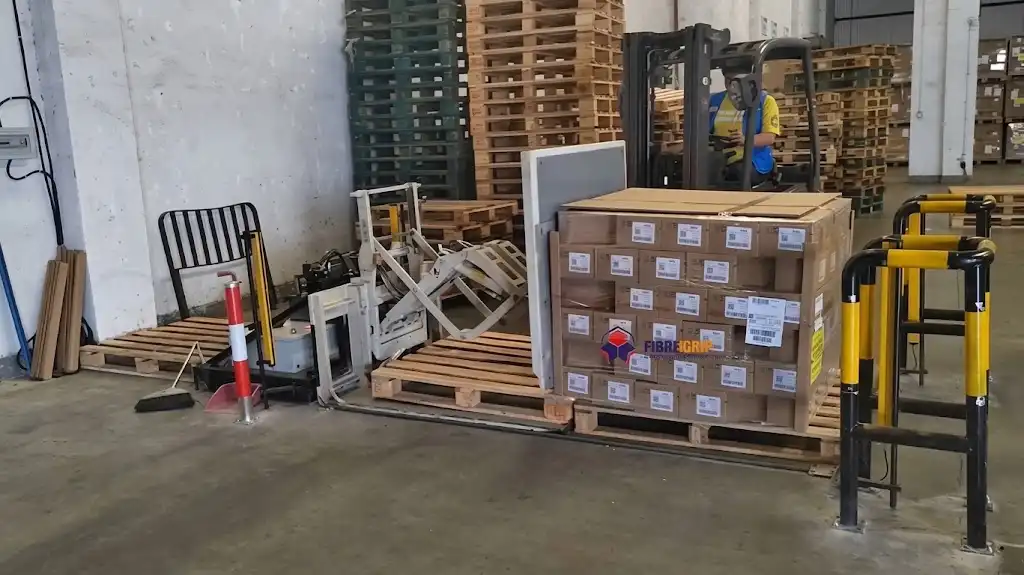
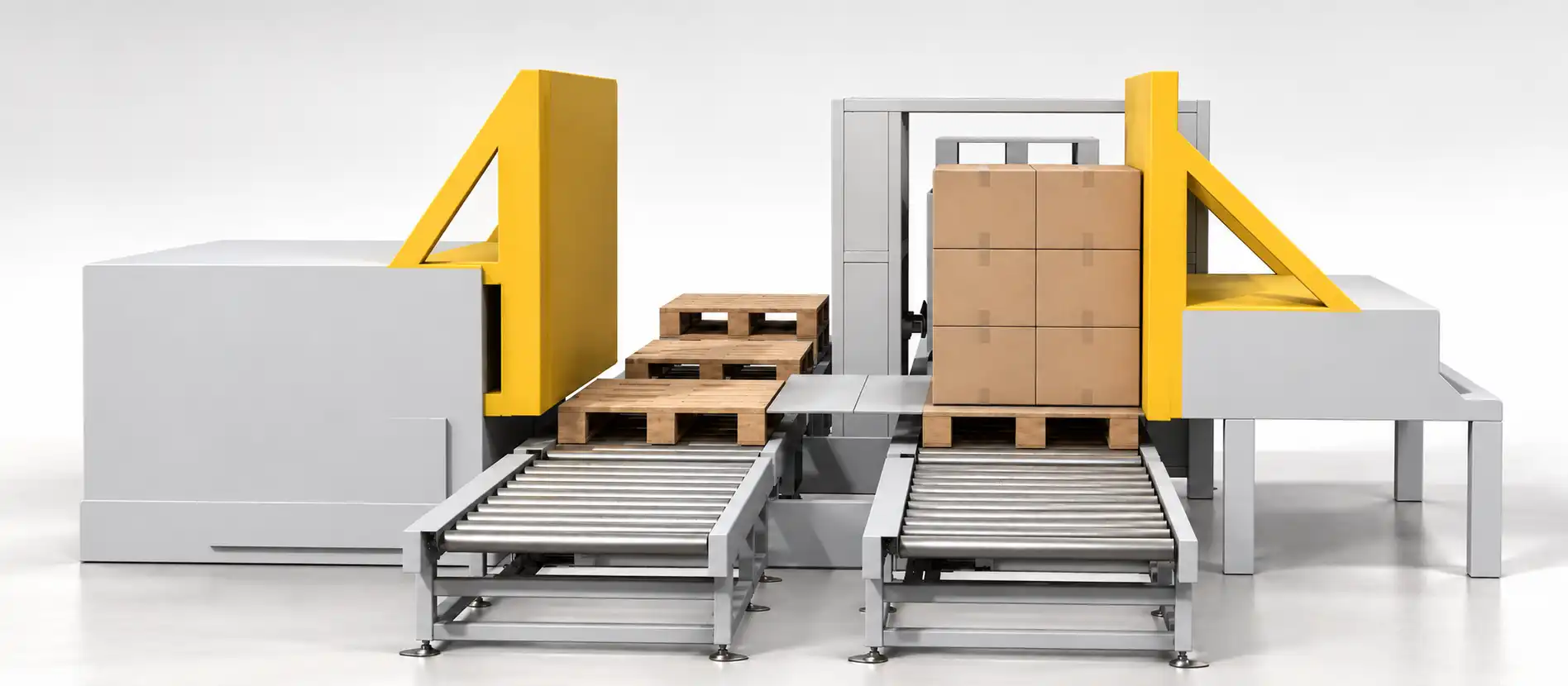
A stack of cartons on a blue pallet waits at the entry unit, a white frame with a yellow mechanism inside. A powered pusher moves the load off, and a motor-driven moving platform carries it along the track into the grey transfer structure. The stack and pallet travel as one unit.
Further down the line the load reaches a yellow turntable, which turns it 90 degrees and lines it up before it moves on along the roller conveyor. No one handles the load and no forklift appears. Yellow and black mesh fencing surrounds the cell, and FHOPE GROUP lettering shows on the machine and in the watermark.
How the push transfer works
| Step | What happens |
|---|---|
| Entry | The loaded pallet waits at the entry unit |
| Push | The pusher moves it onto the moving platform |
| Transfer | The platform carries it into the transfer station |
| Turn | The turntable turns the load 90 degrees |
| Outfeed | The load moves on along the roller conveyor |
Pushing the load as one unit keeps the stack square, so the next station gets it in a known position. The video follows the push transfer and the turn; we lay out the pallet change step at the transfer station to suit your pallets. For a cell built around the swap itself, see our push-type pallet changer.
Cycle per load
Illustrative example:
| Item | Value |
|---|---|
| Push and transfer distance (illustrative) | 3 m |
| Transfer time | Distance ÷ transfer speed |
| Turn time | Set by the turntable |
| Pusher return | Adds to every cycle |
| Cycle per load | Transfer + turn + pusher return |
| Loads per hour | 3,600 ÷ cycle per load in seconds |
| Line output needed (illustrative) | 60 loads per hour |
| Longest allowed cycle, 3,600 ÷ 60 | 60 s |
The pallet change step at the transfer station adds its own time, and the slowest station in your line sets the real rate, so we size the cell to match it.
Fitting the cell into a line
| Question | Why it matters |
|---|---|
| Pallet size and type | Sets the pusher and platform width |
| Load height and weight | Sets the push force and turntable |
| Turn direction | Sets which side the load leaves |
| Upstream and downstream stations | Sets the conveyor heights |
Send us your line layout, and we place the entry, transfer and turning stations to suit it, ahead of stations such as an auto pallet strapping machine.
Controls and safety
The pusher, the moving platform and the turntable all move loads under power. Keep people outside the mesh fence while the cell runs, and enter only with it stopped and isolated.
The standards that apply depend on the destination market. For CE markets, ISO 12100 sets the risk-assessment method and EN 415-10 sets general requirements for packaging machines.
Selection checklist for a pallet changing cell
- Pallet sizes and types in and out.
- Load height and weight.
- Loads per hour.
- Turn needed between stations.
- Conveyor heights up and down the line.
- Floor space and fencing.
Engineering FAQ
Q: Does a person move the load? A: No. The pusher, platform and turntable move it, with no hand handling.
Q: Why turn the load 90 degrees? A: So it leaves in the direction the next station needs.
Q: How many loads per hour? A: 3,600 divided by the cycle per load in seconds, where the cycle includes push, transfer, turn and the pusher return; your slowest station sets the real rate.
Q: Are forklifts needed inside the cell? A: No. Loads are pushed, transferred and turned on conveyors, with no forklift inside the cell.
Q: What should I send for a quote? A: Pallet sizes, load weight and height, output per hour and your line layout.
Next step
We plan your pallet changing cell in three steps:
- Submit your layout drawing with pallet sizes, loads and output to info@fhopepack.com.
- Receive a proposal within 48 hours, with the push and turn plan.
- Book a site survey to check the line layout and fencing.
Related reading
- Pallet inverter
- Video: V-shape pallet changer
- Video: dual-clamp 180° pallet changer for glass bottle loads
Sources
- Cell content: FHOPE engineering team, 2026-10-04
- Cycle example: our worked example; the 3 m distance is an illustrative layout value
- Machine in action: our video on YouTube
- Standards scope: ISO 12100:2010, EN 415-10:2014
Last reviewed: 2026-10-04