Executive summary
An automatic steel wire coil strapping and rewinding machine processes bulk wire from master coils or pay-off reels, rewinding it into smaller coils of precise length, cutting the wire, and strapping each finished bundle through the coil eye. Utilizing a servo-driven expanding coiling head, high-accuracy encoder metering (accurate to the centimeter), and automated eye-through strapping with 8–10 mm PP strap, the line delivers consistent coil geometry and packaging integrity. Designed for production throughputs up to 45 coils per hour, this system optimizes material handling and cycle times. Below is an engineering overview, machine module breakdown, and time-budget worked example for line capacity evaluation.
Table of Contents
- Why wire is rewound into smaller coils
- The rewinding line
- Machine modules
- Strapping data
- Worked example: a 45 coil/h time budget
- Selection checklist
- Safety: EN 415-10 and ISO 12100
- Engineering FAQ
- Next step
- Related reading
- Sources
Why wire is rewound into smaller coils
Wire drawing mills and hot-dip galvanizing plants typically produce massive master coils or heavy pay-off spools weighing several tons. End-user applications, hardware distributors, and construction sites require smaller, lightweight wire coils of standardized lengths that can be handled manually and commercialized per linear meter. Manual rewinding is labor-intensive, subject to length errors, and yields loose, uneven coils susceptible to uncoiling during transport.
An integrated automatic wire rewinding and strapping line eliminates manual intervention by automating the entire sequence: precise length measurement, high-tension uniform coiling, automatic cutting, and secure eye-through strapping in a single continuous cycle.
The rewinding line
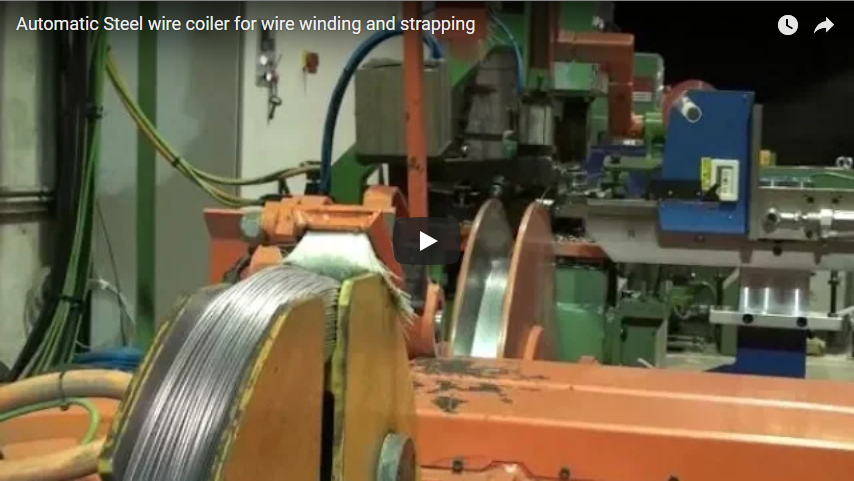
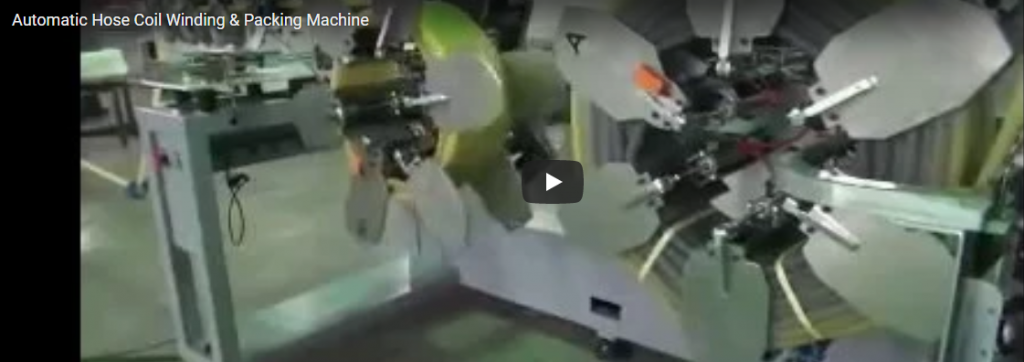
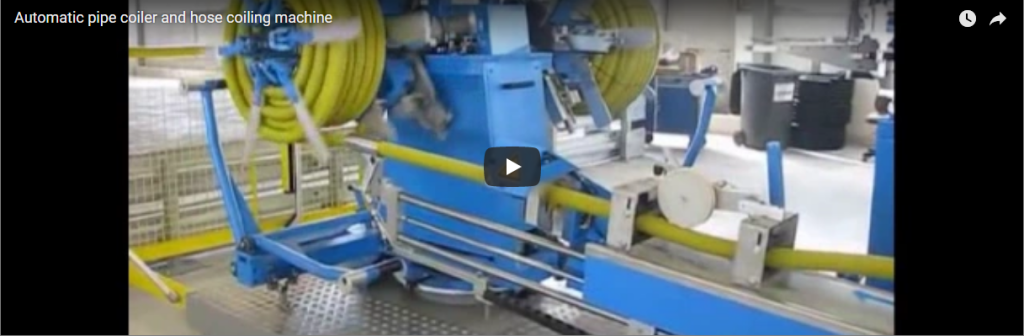
In a typical line layout, wire pays off from a master coil or pay-off reel at the rear of the machine and runs forward through a linear wire straightener, tension dancer, and precision meter counter. At the winding station, the wire is wrapped around a large segmented coiling head mounted on a heavy-duty horizontal spindle; the mandrel expands automatically during winding to maintain structural rigidity and collapses upon completion for rapid coil ejection. Twin-spindle rotary turrets or indexed dual-head configurations allow continuous processing: while one head completes strapping and coil offloading, the second head initiates winding for the subsequent coil cycle.
Machine modules
- Meter counter. Features dual-wheel encoder metering accurate to ±1 cm. The upper measuring wheel is constructed from high-strength aluminum alloy with a plasma-sprayed ceramic coating for high wear resistance, while the lower pinch wheel is polyurethane-covered to protect galvanized or bright wire surfaces. A mechanical one-way clutch bearing prevents wire backlash upon cutting.
- Coiling head. A servo-driven expanding segmented mandrel mounted horizontally. It automatically expands during winding to ensure exact inner diameter (ID) dimensions and collapses upon cycle completion. Variable-frequency servo drive control maintains constant linear speed and precise wire layer alignment.
- Holder. A servo-driven transfer holder clamps the finished coil bundle across its outer diameter and translates it horizontally to the eye-through strapping station while maintaining bundle compression.
- Cutter. Heavy-duty hydraulic or pneumatic shear blade made from SKD11 tool steel, vacuum heat-treated to 58–62 HRC. It delivers a clean, perpendicular cut immediately upon receiving the target length signal from the PLC.
- Control. Integrated Siemens/Mitsubishi PLC with a multi-touch screen HMI. Operators set winding speed, coil length, acceleration ramps, and strapping patterns. Parameter adjustments can be entered during machine operation; new values take effect seamlessly on the subsequent coil cycle.
- Strapping. Automated eye-through strapping head inserting 8–10 mm Polypropylene (PP) strap through the coil center at 2–4 program-selected positions. Equipped with dynamic strap tensioning (100–1,500 N), automatic strap feeding, and an active strap dispenser accumulator with speed-sensing guide wheels.
Strapping data
| Item | Value / Specification |
|---|---|
| Strap material | Polypropylene (PP), 8–10 mm width, 0.8 mm thickness |
| Joint type | Thermal friction (vibration) weld |
| Joint position | Front outer circumference of the wire coil |
| Joint efficiency | Approx. 75–80% of native strap breaking strength |
| Strap places | 2, 3, or 4 radial ties through the coil eye |
| Strap supply unit | Pay-off dispenser with motorized accumulator and dynamic speed encoder |
Worked example: a 45 coil/h time budget
Illustrative coil specification: 1,000 m of 5.0 mm carbon steel wire, wound to 600 mm Outer Diameter (OD), 400 mm Inner Diameter (ID), and 200 mm coil width, secured with 4 eye-through PP straps.
| Step | Calculation | Result |
|---|---|---|
| Total cycle time budget at 45 coils/h | 3,600 s ÷ 45 | 80.0 s / coil |
| Coil steel mass | 7,850 kg/m³ × (π / 4) × (0.005 m)² × 1,000 m | ≈ 154.1 kg |
| Strap length per tie (around cross-section) | 2 × (200 mm + 100 mm wall thickness) | 0.6 m / tie |
| Total strap consumption per coil (4 ties) | 4 × 0.6 m + feed/weld overlap | ≈ 2.5 m |
| Joint holding force threshold | 0.75 to 0.80 × Strap Breaking Load (F_b) | 75–80% of F_b |
| Active winding duration | t_w = Wire Length (L) ÷ Winding Speed (v_wind) | Line speed dependent |
| Available indexing & strapping time | 80.0 s − t_w | Must cover index + 4 ties |
Engineering Analysis: At a line throughput target of 45 coils per hour, the total available cycle budget per coil is exactly 80 seconds. In a single-head system, active winding (t_w = L ÷ v_wind), head indexing, wire cutting, coil transfer, and 4 sequential strapping ties (approx. 4.5–5.0 s per tie cycle) must all fit within 80 seconds.
For high-speed continuous lines, a dual-head alternating coiling system is utilized: Head A performs high-speed winding while Head B undergoes coil transfer, 4-point strapping, and offloading. This parallel architecture decouples winding time from strapping cycle time, easily fulfilling the 45 coil/h requirement with substantial safety margins. Strap selection is calculated based on effective joint strength (75–80% efficiency) rather than raw strap tensile strength alone.
Selection checklist
Before issuing a formal technical quotation, we evaluate the feeding pay-off parameters and required finished coil specifications:
- Wire diameter (mm), tensile grade, and surface condition (galvanized, copper-coated, or bare).
- Supply source: pay-off reel type, stem pack, or master coil weight (kg).
- Finished coil target: length (m) or mass (kg), required OD, ID, and width.
- Desired production capacity: coils per hour and line linear speed (m/min).
- Strap requirements: 2, 3, or 4 eye-through ties.
- Downstream integration: stretch film wrapping, automatic compacting, or robotic stacking.
Safety: EN 415-10 and ISO 12100
Equipment is engineered in full compliance with European Machinery Directive standards, specifically EN 415-10 (Safety of packaging machines) and risk-assessed under ISO 12100:2010. Primary hazard zones include the rotating coiling head, moving wire path, shear cutting blade, and automatic strapping head.
Perimeter physical fencing and safety light curtains protect operational areas. Emergency stop controls are hardwired mushroom-head pushbuttons on control stations, designed to EN ISO 13850 (Category 0/1 stop circuit); the touchscreen HMI functions strictly for status monitoring and fault reset logic. Complete CE compliance documentation and risk assessment dossiers accompany each delivered system.
Engineering FAQ
Q: How accurate is the automatic coil length metering system? A: The encoder system achieves an accuracy within ±1 cm per 1,000 m run, utilizing ceramic-coated anti-slip measuring wheels and real-time PLC high-speed counter modules.
Q: Can coil size and wire length be modified while the line is running? A: Yes. Operators can input new length and diameter parameters on the HMI screen while running; the PLC queues these values to take effect automatically on the subsequent coil cycle.
Q: How does the number of strap ties affect total line output? A: Each additional strap tie adds approximately 4.5 to 5.0 seconds (covering head indexing, feeding, and friction welding). Where production throughput is critical (45+ coils/h), dual-head mandrels or 2-strap configurations are recommended.
Q: How many strap ties can be applied per coil? A: Typically 2 to 4 eye-through positions, configured via the HMI program. Strap tension is independently adjustable (100–1,500 N) to match different wire grades.
Q: Which safety standards govern machine design? A: EN 415-10 applies to overall machine safety and packaging mechanisms, with ISO 12100 used for comprehensive risk assessment and hazard mitigation.
Next step
- Send wire size, supply reel, and target coil specifications to info@fhopepack.com.
- We determine the optimum horizontal or vertical coiling and strapping configuration.
- We deliver a customized 3D line layout and formal quotation within 24 hours.
Related reading
- Automatic steel wire coiling and strapping machine (product)
- Full automatic steel wire rope coiler for winding and strapping
- Automatic steel wire coiler for winding and strapping
- Steel wire coil rewinding and automatic packing
- Automatic steel wire coil packing machine (product)
Sources
- FHOPE Product Specification: Automatic Steel Wire Coiling and Strapping Machine
- FHOPE Engineering Notes on Coiling Mandrels, Line Speeds, and Strapping Options
- Operational Steel Wire Rewinding and Packaging Line Case Studies
- Worked Example Parameters: Steel Density 7,850 kg/m³
- Harmonized Standards: EN 415-10:2014, ISO 12100:2010, EN ISO 13850:2015
Last reviewed: 2026-10-18