> **Executive summary**
>
> A full-automatic steel wire rope coiler winds rope or wire into coils of a set length, cuts it and straps each coil, with no one handling the coil. Ours winds at 200–800 m/min. With two coiling heads, one winds while the other is strapped and emptied, for up to 40 coils per hour. A worked example checks whether a 500 m coil leaves enough time to strap.
Table of Contents
- What the coiler does
- Tension and the wire accumulator
- One head or two
- Coiler data
- Worked example: can two heads keep up?
- Selection checklist
- Safety: EN 415-10 and ISO 12100
- Engineering FAQ
- Next step
- Related reading
- Sources
What the coiler does
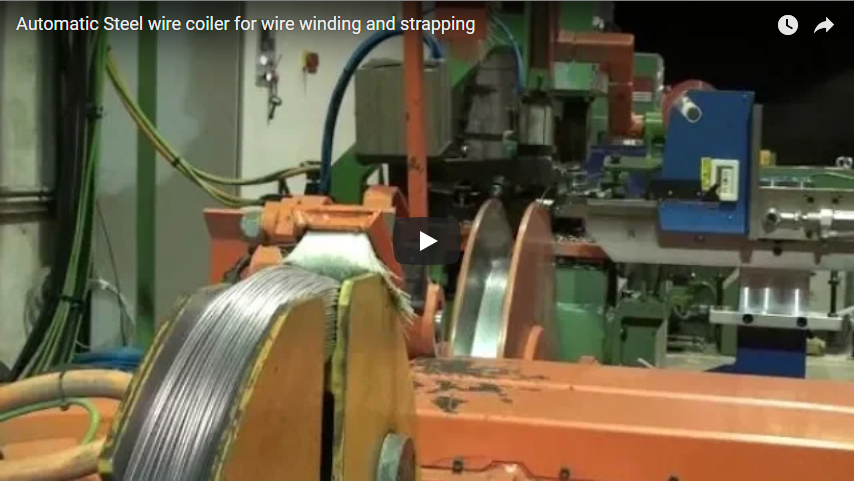
The rope enters through a length counter: a pair of encoder wheels, the lower one covered in PU so the rope is not marked. The counter measures to the centimetre and tells the coiler when to slow and when to cut. The rope then goes to a coiling head that lies flat, eye up, where a servo-driven traverse lays each turn so the coil builds square and even.
When the set length is reached, the head stops at the cutting position and the cutter cuts the rope. The head opens, and the finished coil is strapped through the eye. Strapped coils come out under the blue machine frame, ready to stack.
The operator sets everything from a touch screen: reel length, coil width, speed and alarms. Reel length and speed can be changed while the machine runs. A new rope diameter is called up from the specifications stored in the PLC.
Tension and the wire accumulator
Between the production line and the coiler sits a vertical wire accumulator. It stores 5–20 m of rope and keeps the tension steady, set from a 24 V DC control cabinet with a tension meter. A synchronising device matches the take-up speed to the line, so the rope is not overstretched or broken. Limit switches guard both ends of the accumulator travel, and the machine stops at once if the rope breaks.
One head or two
With one coiling head, the line must wait while each coil is cut, strapped and taken off. With two heads, the rope switches to the second head as the first coil is cut. The first coil is then strapped and emptied while the second winds, so the line keeps running. That is why our coiler is rated at 20 coils per hour with one head and 40 with two.
Coiler data
| Item | Value |
| :--- | :--- |
| Winding speed | 200–800 m/min |
| Output | 20 coils/h one head; 40 coils/h two heads |
| Wire / rope diameter | built to order |
| Length count | to 0.01 m, with slow-down before the set length |
| Accumulator | vertical, 5–20 m, tension control on 24 V DC |
| Machine centre height | 1,000 mm |
| Supply | 380/440 V, 60 Hz |
| Strapping | through the eye, 2–4 places |
| Strap | PP, 8–10 mm wide, 0.8 mm thick |
| Strap joint | friction (vibration) weld, about 75–80% of strap breaking load |
Worked example: can two heads keep up?
Illustrative job: 500 m coils of steel wire rope at a line speed of 300 m/min, strapped in 4 places. Our experience on coiling lines is that 4 straps per coil take about 60 s.
| Check | Calculation | Result |
| :--- | :--- | :--- |
| Winding time per coil | 500 ÷ 300 × 60 | 100 s |
| Coils per hour, two heads | 3,600 ÷ 100 | 36 (under the 40/h rating) |
| Time for the idle head | equal to the winding time | 100 s |
| Strapping, 4 places | about 60 s | 60 s |
| Left for cutting, unloading and head change | 100 − 60 | 40 s |
| Accumulator buffer at 300 m/min | 20 ÷ 300 × 60 | 4 s |
**Result.** At 300 m/min a 500 m coil winds in 100 s. The idle head has 100 s to strap and empty its coil, so 60 s of strapping leaves 40 s for the rest. The line keeps its speed at 36 coils per hour. Halve the coil length to 250 m and the winding time drops to 50 s, less than the strapping time, so the line would have to slow.
Selection checklist
1. Rope or wire diameter and construction.
2. Coil length, OD, ID and width.
3. Line speed in m/min.
4. One or two coiling heads.
5. Straps per coil and strap type.
6. Weighing, labelling and stacking after strapping.
Safety: EN 415-10 and ISO 12100
We design the coiler to EN 415-10 and assess its risks to ISO 12100. The main hazards are the moving rope, the turning coiling head and the cutter. Yellow guard rails close off the head area, guard interlocks are set from the risk assessment, the accumulator has limit switches and anti-collision springs, and an emergency stop is on the panel.
Engineering FAQ
Q: How accurate is the coil length?
A: The counter reads to 0.01 m, and the coiler slows before the set length.
Q: Can I change size while it runs?
A: Reel length and speed, yes. For a new rope diameter, the stored specification is read from the PLC.
Q: What if the rope breaks?
A: The machine stops at once. Limit switches at both ends of the accumulator travel also stop it if the tension carriage runs too far.
Q: Which standard applies?
A: EN 415-10 for the machine, and ISO 12100 for the risk assessment.
Next step
1. **Send rope size, coil length and line speed** to info@fhopepack.com.
2. **We check** the head timing and the strapping.
3. **We reply within 24 hours** with a proposal and quotation.
Related reading
- [Automatic wire coiler (product)](https://www.fhopepack.com/Wire-coil-wrapping-machine/automatic-wire-coiler.html)
- [Automatic steel wire winding and strapping machine (product)](https://www.fhopepack.com/Wire-coil-wrapping-machine/Automatic-steel-wire.html)
- [Automatic steel wire coil strapping and rewinding machine](https://www.fhopepack.com/videos/automatic-steel-wire-coil-strapping-and-rewinding-machine/)
- [Automatic steel wire coiler for wire winding and strapping](https://www.fhopepack.com/videos/automatic-steel-wire-coiler-for-wire-winding-and-strapping/)
- [Wire and cable rewinding strapping machine, 24-hour running](https://www.fhopepack.com/videos/wire-cable-rewinding-strapping-machine-real-24-hour-continuous-running/)
Sources
- FHOPE product pages: automatic wire coiler; automatic steel wire winding and strapping machine
- FHOPE project notes on coiling and strapping time
- Our wire rope coiler shown above
- Worked example: illustrative figures
- Standards: EN 415-10; ISO 12100:2010
Last reviewed: 2026-10-19