Executive summary An automatic steel wire coiling machine winds wire from the drawing line onto a coiling head, cuts it at the set length and releases a tight coil for strapping. Our clip, about 72 s long, shows an orange segmented coiling head winding silver wire, opening, and closing again for the next coil. Our line runs at 200 to 800 m per minute and delivers about 40 coils per hour with two heads.
Table of Contents
- What the clip shows, in order
- Cycle on the clip
- How the coiling line works
- Line data
- Takt check
- Selection checklist for a steel wire coiling machine
- Controls and safety
- Engineering FAQ
- Next step
- Related reading
- Sources
What the clip shows, in order
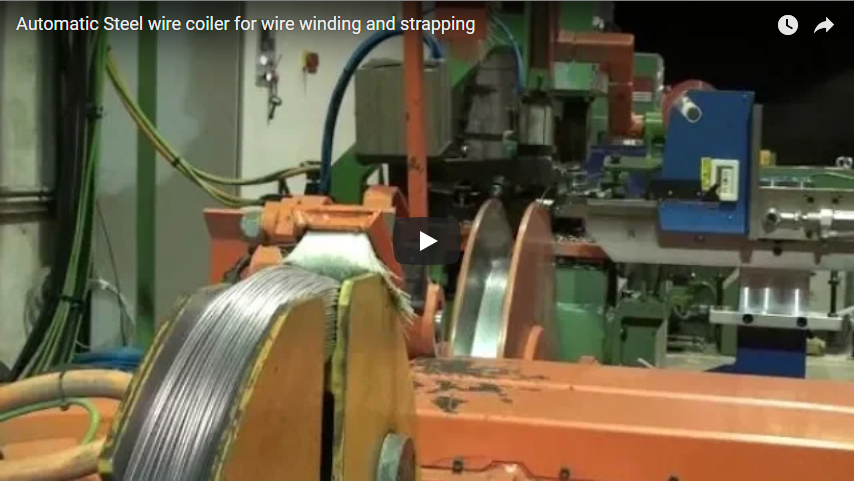
The machine has an orange coiling head made of curved segments on the left, an orange swinging unit on the right and a green base frame. A control cabinet on a green column carries a small screen, buttons and a red, yellow and green lamp row. No person is in the frames.
- 0 to about 9 s. Close up, the head turns and silver wire builds up in tight layers on it.
- About 12 s. The wire coil is almost full, and the layers on the head pack closer.
- About 15 to 42 s. A wider view shows the whole machine. The segments of the coiling head move outward between about 15 and 30 s and stay open until about 42 s.
- About 45 to 51 s. The head is open, a part-formed coil sits in the middle, and the right-hand unit is at rest.
- About 54 to 60 s. The right-hand unit swings in and holds the coil, while the head begins to close.
- About 63 to 69 s. The head is closed and turning, and the coil diameter grows.
- About 72 s. The right-hand unit lets go and moves back to its start position.
Cycle on the clip
| Step on the clip | Time window | Duration |
|---|---|---|
| Winding, close up | 0 to about 12 s | about 12 s |
| Head segments open | about 15 to 30 s | about 15 s |
| Head held open | about 30 to 42 s | about 12 s |
| Head open, part-formed coil in the middle | about 45 to 51 s | about 6 s |
| Right-hand unit in, head closes | about 54 to 63 s | about 9 s |
| Winding again | about 63 to 69 s | about 6 s |
| Right-hand unit back | about 72 s | — |
The times come from frames 3 s apart. The clip runs through one opening and closing of the head, so it shows the change from one coil to the next rather than a full timed coil.
How the coiling line works
Our steel wire coiling line has four parts. A vertical tension wire accumulator holds 5 to 20 m of wire and keeps the tension steady. The coiling machine winds the wire on one of two heads. An automatic strapping machine straps the coil through its ID with PP strap. An unloading device takes the strapped coil off the head.
On the coiling machine a length counter measures the wire to the centimetre. A servo traverse lays the wire in a regular coil shape. At the set length the head stops, the portal cutter cuts the wire and the head opens to release the coil. With two heads, one winds while the other is unloaded, so the wire never stops.
| Unit | What it does |
|---|---|
| Tension wire accumulator | Stores 5 to 20 m of wire, sets the coiling tension |
| Coiling heads, two | Wind the wire, open to release the coil |
| Length counter and servo traverse | Exact length and regular coil shape |
| Portal cutter | Cuts the wire at the set length |
| Strapping machine | PP strap through the ID, 3 to 6 places |
| Unloading device | Takes the strapped coil off the head |
Line data
| Steel wire coiling and strapping line | Specification |
|---|---|
| Wire diameter | Customised |
| Line speed | 200 to 800 m per minute |
| Output | 40 coils per hour with two heads, 20 per hour with one |
| Centre height | 1,000 mm from the floor |
| Supply | 380 or 440 V, 60 Hz |
| Accumulator length | 5 to 20 m |
| Strap | PP, 10 mm wide, 0.8 mm thick, friction weld |
| Strap places | 3 to 6 |
| Joint efficiency | about 75% to 80% of the strap breaking load |
Takt check
At 40 coils per hour the takt is 3,600 ÷ 40 = 90 s per coil. At 20 coils per hour with one head it is 180 s.
The wire speed sets the coil length per cycle. At 600 m per minute, an illustrative 900 m coil takes 900 ÷ 600 × 60 = 90 s to wind, which matches the two-head takt. Each head then has a full coil time to be strapped and unloaded before it winds again. With one head, the strap and unload time adds to the wind time, which is why the output halves.
Selection checklist for a steel wire coiling machine
- Wire diameter and the drawing line speed.
- Coil length or weight, ID, OD and width.
- One or two coiling heads, for 20 or 40 coils per hour.
- Strap places and strap type.
- Unloading: to a trolley, a conveyor or a hook line.
Controls and safety
The coiling head turns fast, and its segments and the right-hand unit open and close with force. On the clip nobody stands near the machine while it runs, which is the arrangement we keep. The wire under tension can whip if it breaks, so the accumulator stops the machine on a wire break, and limit switches guard its travel.
A hand at the head or between the segments while they can move is the move to design out. Stop, isolate and lock out the machine before anyone threads new wire, clears a tangle or works on the head, the cutter or the strapping machine. The operation panel carries the touch screen, a speed button and an emergency stop switch.
The standards that apply depend on the destination market. For CE markets, ISO 12100 sets the risk-assessment method and EN 415-10 covers general requirements for packaging machines, which fixes guarding and the stop arrangement.
Engineering FAQ
Q: How fast does the steel wire coiling line run? A: At 200 to 800 m per minute, with about 40 coils per hour on two heads or 20 per hour on one.
Q: How is the coil strapped? A: With PP strap, 10 mm wide and 0.8 mm thick, through the coil ID in 3 to 6 places.
Q: What happens if the wire breaks? A: The accumulator stops the machine at the same moment, and limit switches at both ends guard its travel.
Next step
We size a steel wire coiling line in three steps:
- Submit your layout drawing with the wire diameter, line speed, coil size and output target, to info@fhopepack.com.
- Receive a proposal within 48 hours, with the head count, the strapping layout and the takt check.
- Book a site survey so we confirm the drawing line exit, the floor space and the unloading route.
Related reading
- Automatic steel wire coiling and strapping machine
- Horizontal steel wire winding and strapping machine
- Wire coil packing machines
- Wire rod coil compacting press
Sources
- Line data and units: automatic steel wire coiling and strapping machine product page
- Clip timing: frame timings taken from our clip, 3 s between frames
- Machine in action: our video on YouTube
- Standards scope: ISO 12100:2010, EN 415-10:2014
Last reviewed: 2026-10-05