Overview
A steel wire coil rewinding and packing line turns wire from the take-up machines into a finished, film-wrapped coil on one conveyor flow. It is written for wire mill engineers and production managers planning such a line: it follows the stages in the clip, explains why rewinding and wrapping run in one line, and lists the data to confirm before purchase.
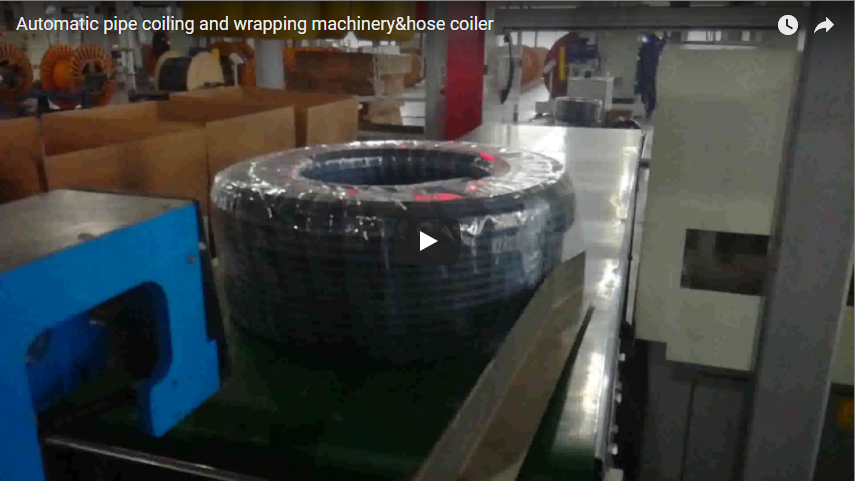
The video below shows the line wrapping a finished steel wire coil:
What the Line Does
The clip follows steel wire from the take-up machines to a wrapped coil in one line. The stages run in sequence:
| Stage | What happens |
|---|---|
| Take-up | A row of take-up machines with overhead wire guides feeds wire into the line |
| Rewinding | A rotating laying head drops the wire in rings into a cage below, forming the coil |
| Control | Grey cabinets with touch-screen panels sit beside each rewinding station |
| Transfer | The finished coil leaves the station and moves along a roller conveyor |
| Wrapping | The coil lies flat on rollers between upright guide rollers while the wrapping station applies film |
| Result | The wrapped coil leaves the line ready for storage or shipping |
Why Rewinding and Wrapping Run in One Line
The value of a combined line is that the coil is not handled a second time: the coil goes from the rewinding cage to the wrapper on conveyors, the upright guide rollers hold it in place while the wrapping station works, and each rewinding station feeds the same wrapper so the line is sized to the combined coil rate.
FPW-AU300 Wrapping Data
The wrapping station is an automatic steel wire coil packing machine of the FPW-AU300 family. The manufacturer’s published data for the wrapper:
| Item | Published value |
|---|---|
| Coil weight | 300–1,500 kg |
| Coil width | 100–300 mm |
| Coil OD | 500–1,200 mm |
| Coil ID | 300–900 mm |
| OD minus ID | Under 500 mm |
| Roller speed | 2–4 m/min |
| Ring speed | 0–90 r/min |
| Overlap | 10–90% |
| Wrap material | Stretch film or paper, 120 mm wide, 50 mm core |
| Power | About 3.8 kW, 380 V 50 Hz 3-phase |
Rewinding stations are built to the wire size and coil weight of each line, so their data are set per project.
Coil sizes, film width and overlap are confirmed per project rather than read from the footage; strapping or labelling after wrapping are separate downstream stations, added per project.
Turns per Coil: A Worked Example
Film consumption and wrap time follow the coil diameter, the film width and the overlap you run. As an illustrative example with 120 mm film at 50% overlap, each turn advances 120 × 0.5 = 60 mm round the coil. A coil of 1,000 mm OD and 600 mm ID has a mean diameter of 800 mm, so its centre line is about π × 800 ≈ 2,513 mm round. That needs about 2,513 ÷ 60 ≈ 42 ring turns for one full cover. Roller speed and ring speed are set together to hold this pitch; confirm the actual overlap and turns per coil for your film and coil range in the proposal.
Selection Checklist
- Wire diameter and grade.
- Coil weight, OD, ID and width.
- Number of rewinding stations feeding the wrapper.
- Film or paper, and overlap.
- Coils per hour and target cycle time, with buffer capacity between the rewinding stations and the wrapper.
Safety
Keep clear of the laying head and the cage while the wire runs, guard the wrapping ring and stop it before reaching in, and lock out the conveyor before clearing a coil. For CE-market deliveries, ISO 12100 is referenced as the risk-assessment method and EN 415-10 as the general reference for packaging-machinery safety; guarding and interlocks are fixed in the site risk assessment.
FAQ
Q: What does this line do in one flow?
A: It rewinds steel wire into a coil and wraps it in film on one conveyor line, so the coil is not handled between the two steps.
Q: What coil sizes does the wrapper take?
A: The FPW-AU300 family covers 300–1,500 kg coils, 500–1,200 mm OD and 100–300 mm width as published; confirm the range for your wire size.
Q: How much film does each coil use?
A: It follows coil diameter, film width and overlap; the worked example shows the estimate, and the final setting is confirmed per project.
Q: Can the line also strap or label the coils?
A: Yes. Strapping, weighing and labelling are separate downstream stations that can be added to the same line per project.
Next Step
Send the wire diameter and grade, coil weight and dimension range, number of rewinding stations, and coils per hour to info@fhopepack.com, so the FPW-AU300 wrapper and line stations are sized on the layout drawing.
Related Resources
- Automatic Wire Coil Rewinding and Tying Machine – A rewinding and tying line for coils that need a tie before wrapping.
- Steel Wire Coil Wrapping Machine and Packing Machine – The FPW-500/FPW-600 wrapping family for larger steel wire coils.
- Automatic Steel Wire Coil Rewinding and Compacting Line – A rewinding line with a compacting stage before strapping.