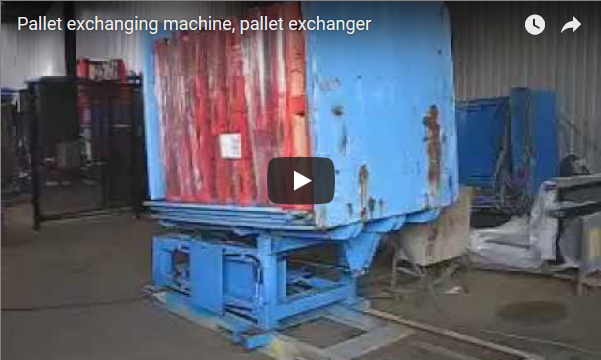
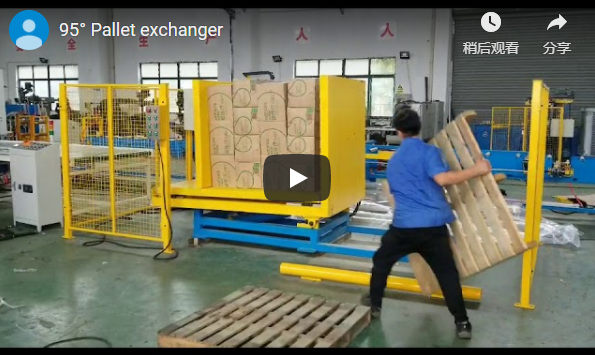
Executive summary An automatic M-type pallet wrapper is a stretch wrapping machine whose turntable has cut-outs so a pallet jack enters and unloads without a ramp. The cycles are started by an RF remote, film is applied with pre-stretch, and the film is cut and clamped automatically. Representative engineering data from the live source covers a 2500 kg rated load, 2400 mm wrap height and a 45 to 65 second cycle for a 1.6 m load.
Table of Contents
- What an M-type wrapper does
- Film cutting and clamping system
- Remote control operation
- Powered pre-stretch system
- PLC and HMI wrap parameters
- Turntable design and maintenance
- Technical specifications
- M-type vs standard turntable vs rotary arm
- Machine selection checklist
- Engineering FAQ
- Related reading
- Sources and standards
What an M-type wrapper does
An M-type pallet wrapper is an automated stretch wrapping machine whose turntable has two opposing cut-outs aligned with standard pallet fork spacing. The cut-outs line up with the forks of a pallet jack, about 160 to 180 mm fork width and 680 to 720 mm between forks for EUR pallets. On the representative unit they are 220 mm wide at 850 mm center-to-center.
The gaps let a pallet jack drive straight in and out, so the machine needs no loading ramp, as on an M-type pallet wrapping machine.
The M-type geometry directly concerns the turntable. Cut-outs in the deck match the fork spacing, about 160 to 180 mm fork width and 680 to 720 mm between forks for EUR pallets, and this removes the ramp from the loading path.
The unit shown in the video above runs the core cycle: the operator drives in with a pallet jack, starts the wrap from the remote, and the machine applies film with pre-stretch around the load. When the pattern completes, the film is cut and clamped against the load, and the operator drives the wrapped pallet out. For a 1.6 m tall load, the stated total cycle time is 45 to 65 seconds depending on the wrap pattern.
Film cutting and clamping system
The cut and clamp mechanism is pneumatic, the same function as on an automatic pallet stretch wrapping machine with film cutter. A solenoid valve drives the blade with a 12 to 18 ms response. A mechanical clamp secures the film tail with 80 to 120 N holding force and leaves about 150 to 200 mm of tail against the load.
That tail matters for transit. A secured film tail prevents unraveling when loads are shifted during shipping, which is a common claim cause on less-than-truckload freight.
A known failure mode is cold storage operation below 5 degrees C, where condensation in the pneumatic lines slows the blade. The stated fix is a coalescing filter with auto-drain fitted at the machine inlet.
Remote control operation
The machine runs on an industrial-grade RF remote in the 433 MHz or 2.4 GHz ISM band, with a stated 15 to 30 m line-of-sight range and under 50 ms command latency. The handset is rated IP65 for dust and water resistance, and the radio band and PLC platform are specified per project against range, site rules and line integration needs.
The remote talks to the machine’s safety PLC on a monitored channel. If the signal is lost for over 500 ms during a cycle, the machine performs a controlled stop. It decelerates the turntable at 2.5 rad/s² and halts the film carriage until reconnection or manual reset.
This design lets the forklift operator start and watch the cycle from the cab instead of walking to a wall-mounted panel several meters away.
Powered pre-stretch system
The pre-stretch assembly uses two rollers with independent VFD control and reaches a 150 to 300 percent stretch ratio electronically. The typical operating point, and the factory default, is 250 percent for 20-micron machine-grade LLDPE.
Pre-stretch saves film by lengthening it before it meets the load, so each pallet takes less film at the same containment. The exact consumption depends on load height, overlap and wrap counts, and is confirmed per project.
The brake band on the pre-stretch rollers is a wearing part. Its stated service interval is 6,000 to 8,000 cycles; when it wears unevenly, film tension oscillates and creates visible waves in the wrap. Inspect it every 500 operating hours and replace it when remaining thickness falls to 0.8 mm from a new 2.5 mm.
PLC and HMI wrap parameters
The control set is a Siemens S7-1200 PLC with a 7 inch HMI touch screen, with an optional upgrade to S7-1500. The HMI stores preset recipes so product families change over without re-entering settings.
The parameters that drive load stability are simple to track. Top wraps add 2 to 4 passes to stop top-layer shifting, and bottom wraps add 2 to 3 passes to anchor the film to the deck. Pre-stretch runs high for stable loads and lower where puncture resistance matters more.
| Parameter | Typical range |
|---|---|
| Top wraps | 2 to 4 |
| Bottom wraps | 2 to 3 |
| Carriage speed | 1.5 to 5.5 m/min |
| Turntable speed | 3 to 15 RPM |
| Pre-stretch ratio | 150 to 300 percent |
The parameter table states the allowable working range; the specification table lists the representative unit’s settings, so the two overlap on purpose.
Turntable design and maintenance
The turntable is fabricated from Q355B structural steel with a 12 mm deck and rectangular frame tubing. The cut-outs reduce torsional rigidity compared with a solid deck, stated at 15 to 18 percent lower in finite element analysis. Loads above 2000 kg with significant overhang use the reinforced option with a thicker deck.
Two maintenance points govern turntable life. After 10,000 to 12,000 cycles, inspect the cut-out corners for hairline cracks with dye penetrant testing and grind out and refill any crack before it grows. The rotation runs on four tapered roller bearings, typically SKF 30208 or equivalent, lubricated every 500 hours with NLGI grade 2 lithium grease.
Technical specifications
The table below reflects the representative model in the machine class shown in the video, based on the published engineering data for the FH-M2500.
| Parameter | Value |
|---|---|
| Max load weight | 2500 kg (turntable rated; frame rated to 3200 kg) |
| Max load height | 2400 mm, optional mast to 2800 mm |
| Turntable diameter | 1650 mm |
| M-type cut-outs | 220 mm wide, 850 mm center-to-center |
| Turntable speed | 4 to 12 RPM (parameter range 3 to 15 RPM) |
| Carriage speed | 2.0 to 4.5 m/min dual-speed |
| Pre-stretch | 150 to 300 percent, typical 250 percent |
| Film | machine-grade LLDPE, 20 to 23 micron, 500 mm wide |
| Film roll OD | 250 mm max, 76 mm core |
| Control | Siemens S7-1200, optional S7-1500 |
| HMI | 7 inch touch screen, 800 x 480 |
| Power | 380 V 50 Hz 3-phase, optional 220 V 60 Hz |
| Air | 0.5 MPa, 80 L/min at 6 bar |
| Safety | emergency stop, bumpers, photo-eye curtain |
M-type vs standard turntable vs rotary arm
The three wrapper classes differ in floor space, load rating and access. M-type suits mixed forklift and pallet-jack facilities; a standard turntable handles the heaviest loads but needs a ramp; a rotary arm suits tall or overhead-constrained loads.
| Criterion | M-type turntable | Standard turntable | Rotary arm |
|---|---|---|---|
| Floor space | 3.2 x 3.2 m | 4.5 x 4.5 m incl. ramp | 3.0 x 3.0 m |
| Max load weight | 2500 kg | 3000 kg | 2000 kg |
| Pallet jack access | direct, no ramp | ramp required | direct, no ramp |
| Forklift access | side-loading | side-loading | top-loading |
| Best for | mixed fleet, tight space | high-weight loads | very tall loads |
Machine selection checklist
Work through these points before requesting a quote, and confirm the rest per project.
| Item | What to confirm per project |
|---|---|
| Loading | pallet jack, forklift or both |
| Load weight | within 2500 kg and below deck limits |
| Load height | within mast range |
| Floor space | available station footprint |
| Throughput | pallets per shift and cycle target |
| Environment | cold storage, washdown or dry |
| Power and air | voltage, frequency and air supply |
| Film | gauge, width and roll OD |
Engineering FAQ
Q: Does the wrapper need a loading ramp? A: No. The M-type cut-outs align with pallet fork spacing, so a pallet jack drives straight in and out without a ramp.
Q: How does the machine handle cold storage? A: Below 5 degrees C, condensation can slow the pneumatic cutting blade; fit a coalescing filter with an automatic drain at the air inlet.
Q: What turntable maintenance is required? A: Inspect the cut-out corners with dye penetrant testing every 10,000 to 12,000 cycles, and lubricate the four tapered roller bearings with NLGI grade 2 grease every 500 hours.
Q: What happens if the remote signal is lost? A: The safety PLC detects the loss within 500 ms and makes a controlled stop, decelerating the turntable at 2.5 rad/s² and halting the film carriage until reconnection.
Q: How is the cycle started? A: The operator starts and monitors the cycle from an RF remote with a stated 15 to 30 m range, under 50 ms latency.
Q: How does the film get cut? A: A pneumatic blade cuts the film and a mechanical clamp holds the tail with 80 to 120 N, leaving a clean 150 to 200 mm tail against the load.
Q: What is the cycle time? A: About 45 to 65 seconds for a 1.6 m tall load, depending on the wrap pattern.
Q: What film does it need? A: Machine-grade LLDPE, 20 to 23 micron and 500 mm wide, sized to the load and pre-stretch target per project.
Next step
- Email us at info@fhopepack.com with your pallet sizes, weights and loading method.
- We send a layout drawing and an M-type proposal within 48 hours.
- We arrange a site survey to confirm floor space, power, air and access.
Related reading
- Rotate arm stretch wrapping machine, pallet wrapping machine
- Cold storage pallet Inverter
- Automatic pallet wrapping and strapping system at one station
- Pallet inverter manufacturer
- FHOPE packaging machinery product lines
Sources and standards
- ISO 12100:2010 — Safety of machinery. General principles for design, risk assessment and risk reduction
- EN 415-10:2014 — Safety of packaging machines. General requirements
- EN ISO 13849-1:2023 — Safety of machinery. Safety-related parts of control systems
- IEC 60204-1 — Electrical equipment of machines
- IEC 61508 — Functional safety of electrical/electronic/programmable electronic safety-related systems
- FHOPE automatic M-type pallet wrapper demonstration video, YouTube.
Last reviewed: 2026-10-09