> **Executive summary**
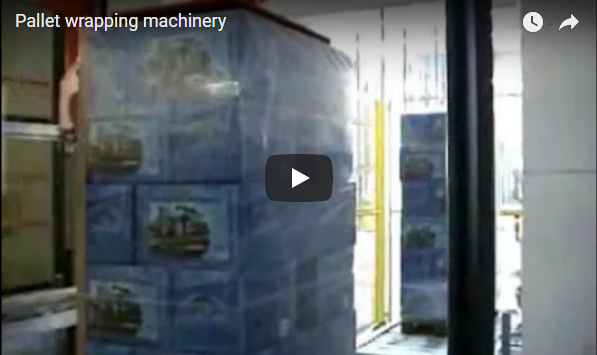
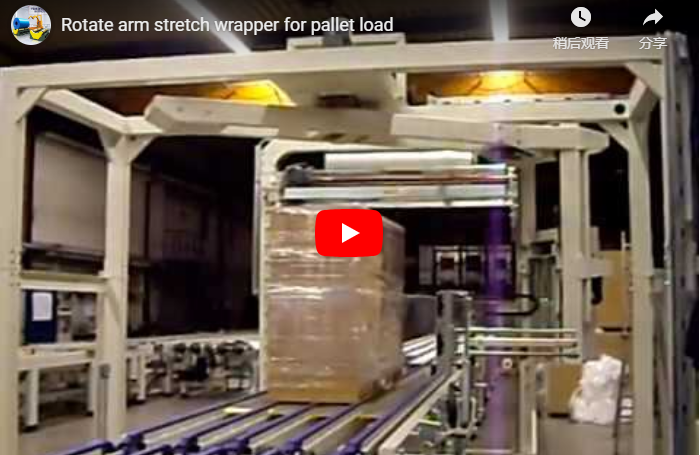
> Our RAS100 rotate arm, or rotary arm, stretch wrapping machine wraps pallets automatically in the conveyor line. The load stays still while the arm turns the film round it, so light or unstable stacks such as empty plastic bottles are not spun. A stabilizer plate holds the top, and the machine clamps, cuts and wipes the film by itself. A worked example times one cycle and checks it against our rated output.
Table of Contents
- Light, unstable loads should not spin
- The automatic rotary arm cycle
- Film clamp, cut and wipe
- RAS100 specifications
- Worked example: a pallet of empty plastic bottles
- Selection checklist: what to send us
- Safety and EN 415-6
- Engineering FAQ
- Next step
- Related reading
- Sources
Light, unstable loads should not spin
Empty plastic bottles, light cartons and tall mixed stacks have little weight to hold them in place. On a turntable they are spun with the pallet, and the top layers can shift outward before the film secures them.
On our rotary arm wrapper the pallet stays still on the conveyor. Only the arm and film carriage move. Nothing pushes the stack sideways except the film itself, and its force is set by a separate motor.
The automatic rotary arm cycle
1. **Infeed.** The conveyor carries the pallet under the arm and stops it in the wrapping station.
2. **Hold.** The stabilizer plate comes down onto the top of the load.
3. **Wrap.** An arm grips the film end on the load. The rotary arm starts, and the carriage climbs steadily so the film spirals up the stack.
4. **Finish.** Depending on the program, the wrap continues on the way down. The sealing arm then seals the film end and cuts it.
5. **Outfeed.** The stabilizer plate lifts, and the conveyor moves the pallet to the next station.
The program sets extra wraps at the foot, middle and top of the stack, anywhere from 0 to 99 turns each.
Film clamp, cut and wipe
The automatic film clamp and cut unit handles the film end without an operator. Scissor-like gripper bars clamp the film, an instant heating wire cuts it, and a soft brush wipes the tail flat onto the load. The clamp then holds the new film end, ready for the next pallet.
An optional top cover device lays a sheet over the pallet before wrapping. The film then binds its edges into the wrap, for dust and rain cover.
RAS100 specifications
| Item | RAS100 |
| :--- | :--- |
| Working mode | automatic, in conveyor line |
| Output | 10–30 pallets per hour |
| Rotary arm speed | 10–14 r/min, inverter controlled |
| Largest load footprint | 1,400 × 1,400 mm |
| Stretch film | LLDPE, 500 mm wide, 76 mm core, 15 kg roll |
| Film tension | set by its own motor |
| Extra wraps | 0–99 at foot, middle and top |
| Film handling | pneumatic clamp, hot-wire cut, brush wipe |
| Load height sensing | photo-eye |
| Protection | anti-collision loop on the carriage |
Load height and carriage speed are matched to your pallets when we quote.
Worked example: a pallet of empty plastic bottles
Say a bottle maker ships empty plastic bottles stacked 1,800 mm tall on 1,200 × 1,000 mm pallets, an illustrative case. The footprint sits inside the 1,400 × 1,400 mm limit.
**Climb.** With 500 mm film and 50% overlap, the carriage climbs 250 mm per turn. Going up only, that is 1,800 ÷ 250 = 7.2 turns. With 3 reinforcing turns at the bottom and 3 at the top, the wrap is 13.2 turns.
**Wrap time.** At 12 r/min the arm makes 13.2 turns in 13.2 ÷ 12 × 60 = 66 s. At 14 r/min that drops to 57 s. To climb 250 mm per turn at 12 r/min, the carriage must travel 250 × 12 = 3,000 mm/min.
**Against the rating.** At our top rating of 30 pallets an hour, each cycle has 3,600 ÷ 30 = 120 s. After 66 s of wrapping, 54 s remain for infeed, the stabilizer plate, film cut and outfeed.
**Up and down.** Light, tall stacks usually get a second pass on the way down. That adds 7.2 turns, so 20.4 turns take 20.4 ÷ 12 × 60 = 102 s at 12 r/min. The 120 s budget then leaves 18 s for handling, so plan nearer 25 pallets an hour.
**Film.** The stack's perimeter is 2 × (1,200 + 1,000) = 4,400 mm, so the up-only wrap lays about 58 m of film on the load. That is applied length; the film drawn off the roll is shorter, by the stretch the carriage puts in. For light bottles, keep the tension low so the stack is held, not squeezed.
Selection checklist: what to send us
1. Pallet footprint and stack height.
2. What the stack is made of, and how easily it shifts.
3. Target output per hour and per shift.
4. Line conveyor height and flow direction.
5. Top sheet cover: yes or no.
6. Site voltage and compressed air.
Safety and EN 415-6
The RAS100 follows EN 415-6, the safety standard for pallet wrapping machines, and every line layout is risk-assessed to ISO 12100. People must be kept clear of the sweeping arm, the moving carriage and the descending stabilizer plate. Guard rails enclose the station around the conveyor, and a white anti-collision loop on the carriage halts the cycle on contact.
Engineering FAQ
Q: When is a rotary arm better than a turntable?
A: For light, tall or unstable loads that should not spin, and for heavy loads that a turntable would have to carry.
Q: Does an operator need to cut the film?
A: No. The RAS100 clamps, cuts and wipes the film automatically.
Q: Can it add a top sheet?
A: Yes, with the optional top cover device.
Q: Which safety standards apply?
A: In CE markets, EN 415-6 covers pallet wrapping machines and ISO 12100 the risk assessment.
Next step
1. **Send us your pallet sizes, stack types and hourly output** at **info@fhopepack.com**.
2. **Expect our proposal within 24 hours**, covering the RAS100, conveyors and film program.
3. **Review our line drawing**, which marks the conveyor run, guard rails and arm circle.
Related reading
- [Automatic rotary arm stretch wrapper RAS100](https://www.fhopepack.com/Rotary-arm-wrapping-machine/Rotary-stretch-wrapper-RAS100.html)
- [FHOPE-R100 rotary arm pallet wrapper with film cutter](https://www.fhopepack.com/videos/fhope-r100-rotary-arm-pallet-wrapper-with-film-cutter/)
- [Height pallet packing machine with top press device](https://www.fhopepack.com/videos/height-pallet-packing-machine-with-top-press-device/)
- [R100 rotary arm pallet wrapping machine](https://www.fhopepack.com/videos/r100-rotary-arm-pallet-wrapping-machine/)
Sources
- Specifications: FHOPE automatic rotary arm stretch wrapper RAS100 product page
- Video: [RAS100 rotary arm wrapper, YouTube](https://www.youtube.com/watch?v=22rB97DRgM8)
- Cycle budget and film length: calculated by us from illustrative bottle-pallet figures
- Standards: ISO 12100:2010 risk assessment; EN 415-6 for pallet wrappers
Last reviewed: 2026-10-17