Executive summary A cold storage pallet inverter, also called a frozen product pallet changer, rotates a palletized load 180 degrees so the pallet can be exchanged without unloading the product. Typical machines handle 1000 to 2000 kg, accept standard pallet sizes such as 1200 x 800 mm, and run continuously down to -25 or -30 degrees C. This guide covers the design for low-temperature use, the operating cycle, the specification range and the safety points.
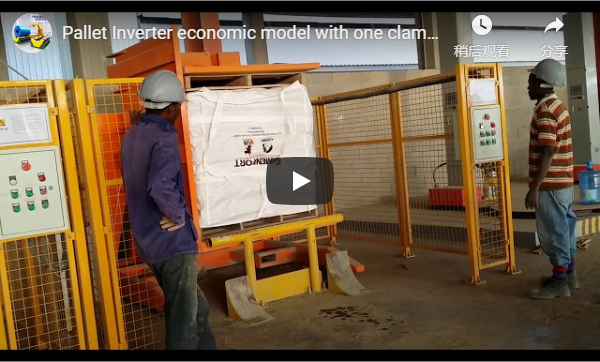
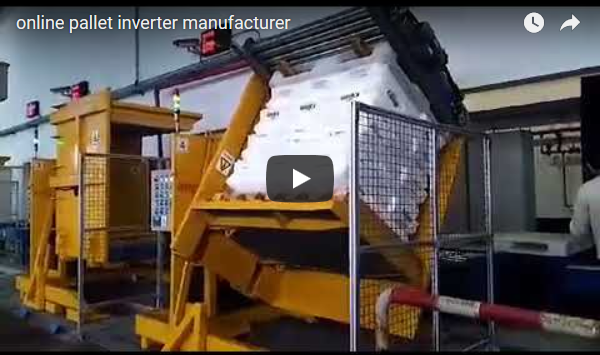
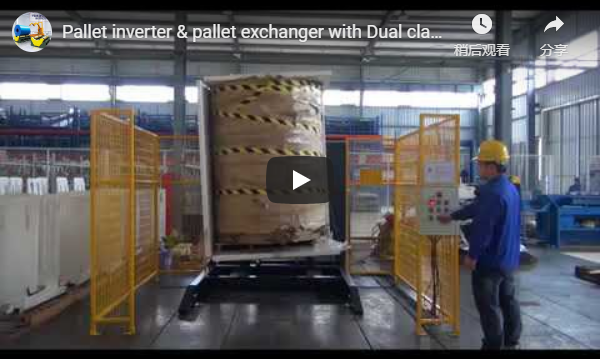
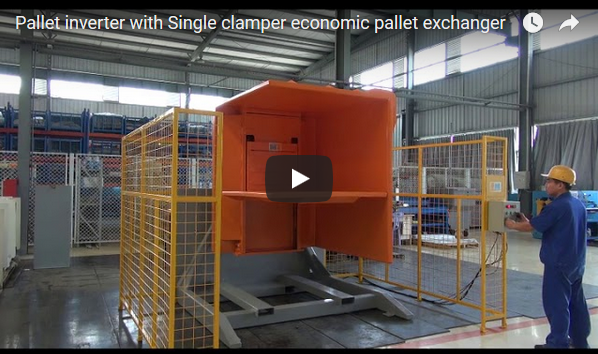
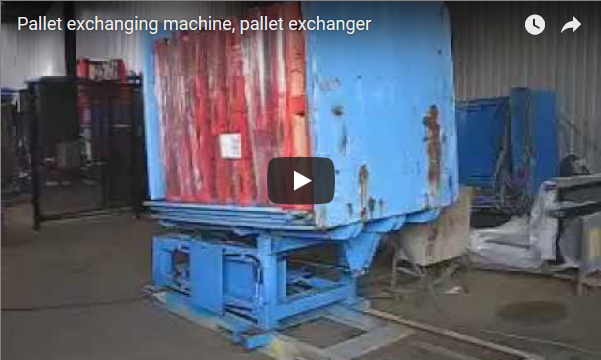
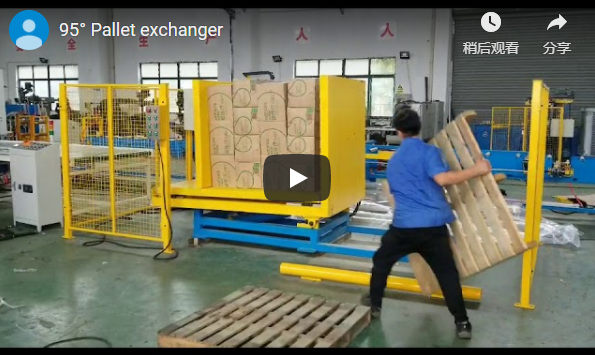
Watch the machine complete a clamping and inversion cycle on the demonstration video above.
Table of Contents
- What the inverter does
- Cold storage handling challenges
- Design and structure
- Key components
- Operating cycle
- Typical specification range
- Machine selection checklist
- Safety and cold chain
- Maintenance essentials
- Engineering FAQ
- Next step
- Related reading
What the inverter does
A cold storage pallet inverter exchanges the pallet under a frozen or refrigerated load without unloading the product. The machine clamps the load between two plates, lifts it, rotates it 180 degrees, lowers it onto a new pallet and releases. That single cycle replaces manual re-palletizing in a freezer, where staff work in bulky gear and every minute outside temperature control matters.
The machine does the heavy lifting and turning, the same role as a heavy-duty 180-degree pallet changer machine, so the operator only positions loads with a forklift and starts the cycle from the panel.
Cold storage handling challenges
Freezer environments down to -30 degrees C break equipment that works fine in a dry warehouse. Standard metals and plastics get brittle, conventional lubricants thicken or freeze, and condensation and ice build up on components as the temperature changes.
A dedicated cold storage inverter is built against those conditions. Low-temperature steel alloys carry the frame, hydraulic systems use low-temperature fluids, electrical enclosures seal to IP65 or higher, and cold-resistant wiring and sensors keep the cycle reliable through the shift.
Design and structure
The frame uses low-temperature tolerant steel with structural reinforcement, because loads can arrive ice-bound or uneven. Cladding is often stainless steel, galvanized steel or powder-coated low-temperature carbon steel, so corrosion from temperature cycling and moisture stays off the structure. The cladding and plate lining are confirmed per project against the store’s humidity, washdown and food-exposure profile.
Key operating components are insulated or heated where needed to keep motion consistent. The result is a machine that holds its cycle time and its safety functions when the warehouse runs cold.
Key components
The clamping system uses dual plates that secure the load from top and bottom before rotation, as on a dual-clamp 180-degree pallet changer. Pressure is adjustable, so light or delicate packaging is not crushed, and the plate surfaces are lined with non-slip, low-temperature material.
The rotation mechanism is hydraulic or electric, driven by the load and lift requirement per project, turning a controlled 180-degree inversion on heavy-duty bearings sized for high torque at low temperature. A lifting frame raises the clamped load, performs the inversion and lowers it gently. Control is PLC-based with an HMI for cycle start, monitoring and parameter changes, and the safety set includes emergency stops, interlocks, guarding, light curtains, pressure sensors and lockout or tagout provisions rated for cold operation.
Operating cycle
The cycle is the same sequence every run. A forklift or pallet truck positions the palletized load on the loading platform or inside the clamping zone.
The operator starts the cycle, the dual clamping plates engage the top and bottom of the load, and the machine lifts the clamped load and rotates it 180 degrees in a controlled motion. The inverted load is lowered, the plates retract, and the old pallet lifts off. A target pallet such as a shipping pallet, plastic pallet or slip sheet goes on top, and a second inversion returns the product to its original orientation on the new pallet.
Typical specification range
The values below are the published typical configuration of this machine class. Confirm the exact numbers against your frozen pallet mix per project.
| Item | Specification |
|---|---|
| Load capacity | 1000 to 2000 kg (2200 to 4400 lbs) |
| Pallet sizes | 1200 x 800 mm, 1200 x 1000 mm and similar standard sizes |
| Operating temperature | continuous operation down to -25 or -30 degrees C |
| Rotation | 180 degrees |
| Cycle time | about 60 to 120 seconds, excluding load and unload |
| Power | 400 V 3-phase 50 Hz, or 480 V 3-phase 60 Hz |
| Control | PLC with HMI panel |
| Frame materials | stainless, galvanized or low-temperature carbon steel |
| Sealing | electrical enclosures IP65 or higher |
The adjustable clamping range handles wood, plastic and CHEP pallets, so the line switches pallet types without separate tooling. The inverter can also join a handling system, integrating with automated conveyor lines or automated guided vehicles for a fully automated pallet-handling loop.
Machine selection checklist
Work through these points before you ask for a quote, and we confirm the rest against your frozen pallet mix per project.
| Item | What to confirm per project |
|---|---|
| Load | heaviest pallet weight and height |
| Pallet | sizes, wood, plastic or CHEP |
| Temperature | store temperature and exposure profile |
| Cycle | inversions per shift and target time |
| Actuation | hydraulic or electric rotation |
| Integration | conveyor or AGV flow |
| Power | voltage and frequency on site |
Safety and cold chain
Two concerns run together in a freezer: operator safety and temperature control. The machine removes manual lifting and turning of heavy, slippery frozen loads, and the safety set of guarding, light curtains, pressure sensors and emergency stops is designed to keep working at low temperature.
Product stays clamped and contained during handling, so packages are not dropped or pinched between cycles. Because the machine minimizes the open handling time, the load spends less time outside the controlled temperature, which protects the cold chain through re-palletizing.
Maintenance essentials
Cold operation changes the maintenance priorities. Hydraulic fluid must be the low-temperature type, seals have to stay flexible, and electrical connections need regular checks for condensation damage.
Run the scheduled checks on the clamping plate lining, the rotation bearings and the control cabinet seals. Keep an eye on the HMI for cycle faults, and follow the manual for seal inspection intervals so ice build-up does not drift into the cycle.
Engineering FAQ
Q: What weight can the inverter take? A: The published typical range is 1000 to 2000 kg, with the exact rating confirmed against your heaviest frozen pallet per project.
Q: Which pallet sizes fit? A: Standard sizes such as 1200 x 800 mm and 1200 x 1000 mm fit through the adjustable clamping range, including wood, plastic and CHEP pallets.
Q: How does the machine work in extreme cold? A: It uses low-temperature steel, low-temperature hydraulic fluid, cold-resistant wiring and sensors, and sealed IP65 or higher electrical enclosures, rated for continuous operation down to about -25 or -30 degrees C.
Q: How long does one cycle take? A: A complete 180-degree inversion cycle takes about 60 to 120 seconds, excluding load and unload time.
Q: What power does it need? A: Typically 400 V 3-phase 50 Hz or 480 V 3-phase 60 Hz, depending on the regional supply.
Q: Does the inverter damage delicate frozen packaging while clamping? A: The clamping system applies adjustable pressure with non-slip, low-temperature plate linings, clamping top and bottom without crushing loads.
Q: Can it exchange onto slip sheets directly? A: Yes. Once the load is inverted and the original pallet is lifted off, a shipping pallet, plastic pallet or slip sheet is positioned before the final inversion.
Q: What protects the electrical system from condensation? A: Enclosures are sealed to IP65 or higher, with cold-resistant wiring and sensors to resist ice and condensation build-up.
Q: Can it work with automated handling? A: Yes. The inverter integrates with conveyor lines or automated guided vehicles for a fully automated pallet-handling loop.
Next step
- Email us at info@fhopepack.com with your frozen pallet weights, sizes and cycle target.
- We send a layout drawing and an inverter proposal within 48 hours.
- We arrange a site survey to confirm the freezer temperature, clearances and power supply.
Related reading
- Pallet inverter manufacturer
- Rotate arm stretch wrapping machine, pallet wrapping machine
- Automatic M-Type pallet wrapper with film cutting, clamping and remote control
- Automatic pallet wrapping and strapping system at one station
- FHOPE packaging machinery product lines
Sources and standards
- ISO 12100:2010 — Safety of machinery. General principles for design, risk assessment and risk reduction
- EN 415-10:2014 — Safety of packaging machines. General requirements
- EN ISO 13849-1:2023 — Safety of machinery. Safety-related parts of control systems
- FHOPE cold storage pallet inverter demonstration, YouTube.
Last reviewed: 2026-10-09