> **Executive summary**
>
> An aluminum rod material wrapper is a horizontal orbital stretch wrapper. The rod lies still on rollers and passes through a ring; the ring carries the film roll round the rod and lays a spiral of film along its length. On our E300 the product can be 50–300 mm across and 15–100 kg, so for solid aluminum rod the weight, not the diameter, is usually the first limit to check.
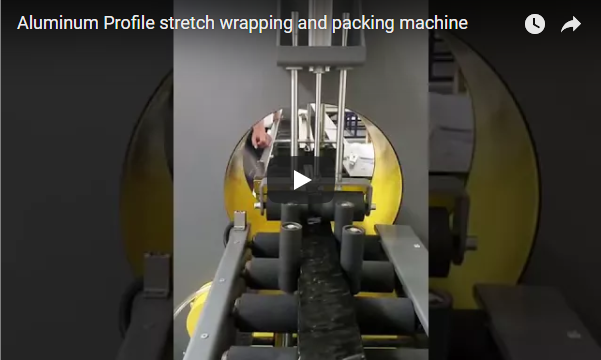
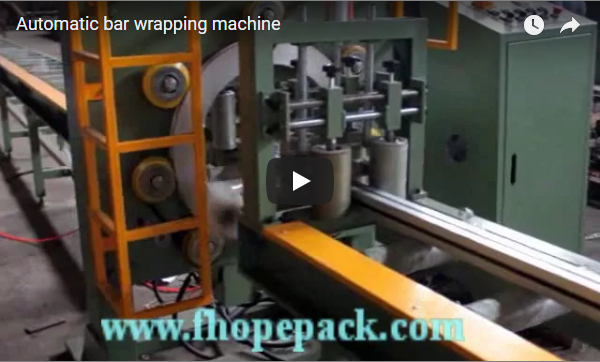
On this wrapper a long round rod already sleeved in clear film lies on support rollers through a yellow ring mounted on a green frame. The operator fixes the film end on the rod by hand, then the ring spins round the stationary rod and keeps laying film on. A yellow guard frame stands beside the ring, and a small side station carries red and black clamping handles.
Table of Contents
- Why aluminum rod is film wrapped
- How the orbital wrapper works
- E300 and E400 orbital wrapper specifications
- Weight check for solid rod
- Worked example: 3,000 mm rod
- Selection checklist
- Safety: EN 415-10 and ISO 12100
- Engineering FAQ
- Next step
- Related reading
- Sources
Why aluminum rod is film wrapped
Aluminum is soft. A drawn or machined rod marks easily when it rubs on another rod, on a fork or on a rack, and damp air leaves stains on a bright surface. A tight spiral of stretch film keeps dust and moisture off and takes the rubbing during handling and transport. Because the rod is wrapped over its full length, the protection is the same at both ends and in the middle.
How the orbital wrapper works
The rod does not turn. It lies on the infeed conveyor and moves through the ring. The ring, driven by a double rub-wheel drive (friction wheels against the ring), turns round the rod and pulls film off the roll it carries. Each turn of the ring lays one wrap; the forward movement of the conveyor during that turn sets how far the next wrap moves along.
- **Ring speed** is set by an inverter, and the friction between the drive wheels and the ring can be adjusted.
- **Conveyor speed** is set by a second inverter, so the overlap is adjusted by the ratio of conveyor speed to ring speed.
- **The conveyor protects the surface** of the product as it carries it in and out.
- **Modes**: automatic or semiautomatic wrapping. A film tail treating device and longer conveyors are options. Where the film should be clamped and cut without the operator, our S300 orbital wrapper has automatic clamping and cutting; the time saved per rod is confirmed at quote.
E300 and E400 orbital wrapper specifications
| Item | E300 | E400 |
| :--- | :--- | :--- |
| Product OD | 50–300 mm | 100–400 mm |
| Product length | over 1,000 mm | over 1,200 mm |
| Product weight | 15–100 kg | 15–100 kg |
| Conveyor speed | 6–12 m/min | 6–12 m/min |
| Ring speed | 20–90 r/min | 20–90 r/min |
| Infeed / outfeed conveyor | 2,000 mm each, motor driven | confirmed at quote |
| Film | 100–200 mm wide, 50 mm core | confirmed at quote |
| Power | about 2.5 kW, 380 V 60 Hz (other supplies confirmed at quote) | confirmed at quote |
On the E300 the 50 mm lower limit applies to stiff products. A rod is stiff, so small diameters are fine; a soft or flexible product needs about 100 mm.
Weight check for solid rod
Solid aluminum is about 2,700 kg/m³. Rod mass grows with the square of the diameter, so a modest increase in diameter can take a rod out of the 15–100 kg range even when it fits the ring easily. For a heavier rod the conveyor and roller loading must be confirmed at quote.
Worked example: 3,000 mm rod
Take an aluminum rod of Ø120 mm and 3,000 mm length, wrapped with 150 mm film at 50% overlap.
| Step | Calculation | Result |
| :--- | :--- | :--- |
| Volume | π × 0.06² × 3 | 0.0339 m³ |
| Mass | 0.0339 × 2,700 | about 92 kg (inside 15–100 kg) |
| Same rod at Ø150 mm | π × 0.075² × 3 × 2,700 | about 143 kg (heavy build, confirmed at quote) |
| Advance per ring turn | 150 × (1 − 50%) | 75 mm |
| Turns over the rod | 3,000 ÷ 75 | 40 |
| Fastest conveyor at this overlap | 90 r/min × 75 mm | 6,750 mm/min = 6.75 m/min |
| Wrap time | 3 ÷ 6.75 | 0.44 min, about 27 s |
| Film per turn | √(0.377² + 0.075²), with π × 0.12 = 0.377 m | 0.384 m |
| Film laid (before pre-stretch) | 40 × 0.384 | about 15.4 m |
**Result.** The Ø120 mm rod fits the E300 by size and weight and wraps in about 27 s. Running the conveyor at 12 m/min with this film and overlap would need 12,000 ÷ 75 = 160 r/min, above the 90 r/min ring maximum, so at 50% overlap the ring speed, not the conveyor, limits throughput.
Selection checklist
1. Rod diameter, length and alloy.
2. Rod weight per piece, single rods or bundles.
3. Surface finish and how many film layers are needed.
4. Film width and core size.
5. Rods per hour, and whether the wrapper links to a line.
6. Manual or automatic film start and cut.
Safety: EN 415-10 and ISO 12100
The wrapper is built to EN 415-10, the safety requirements for packaging machines, with the risk assessment to ISO 12100:2010. The rotating ring is the main hazard, so the ring area is guarded and the operator fixes the film end only while the ring is stopped. Guarding and CE documents are agreed per project.
Engineering FAQ
Q: Does the rod rotate during wrapping?
A: No. The rod lies on the conveyor and the ring turns round it.
Q: What is the smallest rod the E300 takes?
A: 50 mm across for a stiff product such as a rod.
Q: How is overlap changed?
A: By changing conveyor speed against ring speed; both have their own inverter.
Q: Can it wrap rod bundles?
A: Yes, if the bundle fits the ring and weight range. Bundle size is confirmed at quote.
Next step
1. **Send your rod diameter, length and weight** to info@fhopepack.com.
2. **We check** ring size, weight range and output.
3. **We reply within 24 hours** with a proposal and quotation.
Related reading
- [E300 horizontal stretch wrapper (product)](https://www.fhopepack.com/Automatic-horizontal-stretch-wrapper/E300-horizontal-stretch-wrapper.html)
- [Horizontal orbital wrapping machine for rod and bar (product)](https://www.fhopepack.com/Customize-orbital-wrapper/Rod_wrapping_machine.html)
- [Automatic bar wrapping machine](https://www.fhopepack.com/videos/automatic-bar-wrapping-machine/)
- [Rod orbital wrapper and bar wrapping machine](https://www.fhopepack.com/videos/rod-orbital-wrapper-and-bar-wrapping-machine/)
Sources
- FHOPE product pages: E300 and E400 horizontal stretch wrappers
- EN 415-10; ISO 12100:2010
- Our orbital rod wrapper shown above
Last reviewed: 2026-10-19