Executive summary
A load gets a different pallet without being turned fully upside down. This 90-degree pallet changing machine, also called a pallet inverter or load tipper, clamps the load, tilts it onto its side, swaps the pallet underneath and tilts it back upright. This guide covers our clamping cycle and safety architecture. Our engineering team confirms load capacity and pallet geometry per project.
Table of Contents
- What the machine does
- Who it is for
- The pallet changing cycle
- Clamping and tilting
- Under the new pallet
- Controls and safety
- Typical configuration
- What the video shows
- Selection checklist
- Operation and safety
- Engineering FAQ
- Next step
- Related reading
- Sources and standards
What the machine does
A pallet changing machine exchanges the pallet under a load without manual restacking. Where a traditional inverter turns a load a full 180 degrees, the 90-degree model takes a gentler route. The load is clamped and tilted onto its side, the pallet underneath is replaced, and the load is returned upright on the new pallet. The exchange happens without the load being fully inverted, which matters for loads that should not be turned over.
Who it is for
The machine earns its place where loads are sensitive to full inversion. Products that shift, spill or suffer when upside down, or awkward and heavy loads that are dangerous to re-stack by hand, are the natural fit. The 90-degree tilt keeps the load on its edge rather than turning it over, which is why these machines carry everything from bagged goods to drums to sheeted materials onto a fresh pallet.
The pallet changing cycle
The cycle runs in a fixed order. The load is placed on the platform, by forklift or conveyor. Side clamps engage and hold it firmly. The machine tilts the clamped load 90 degrees onto its side, the old pallet is removed at floor level, and a new pallet is positioned. The load is then tilted back upright onto the new pallet, the clamps release, and it is ready for removal.
Clamping and tilting
Secure handling comes from the clamping and tilting system. Adjustable side pressure plates, hydraulically or pneumatically operated, adapt to different load widths and keep the load from shifting through the tilt, with the actuation selected per project for the load range and environment. The tilt itself is driven by hydraulic cylinders or electric motors through a gearbox, giving controlled movement rather than a free swing. The arrangement is heavy-duty, built for daily industrial duty.
Under the new pallet
What goes underneath depends on where the load is headed. A hygienic plastic or clean shipping pallet for dispatch, or a slip sheet where the goal is a low-profile load, all fit the same cycle. Because the bottom support changes while the load stays clamped, the product never leaves the machine during the exchange.
Controls and safety
Controls range from simple push-button operation to a PLC for conveyor-fed automated lines. Safety is built in rather than added. Fencing or light curtains guard the tilting area, emergency stops sit at the operator positions, and pressure relief valves protect the hydraulic circuit. Interlocking guards keep the machine from running with a door open. Cameras and sensors hold the load still until clamps are confirmed engaged, per project.
Typical configuration
Figures below list functional design boundaries rather than numeric values, and are confirmed per project.
| Parameter | Typical range, confirmed per project |
|---|---|
| Load | footprint, height and weight |
| Tilt | fixed 90 degrees |
| Clamp | hydraulic or pneumatic side plates |
| Drive | hydraulic or electric, actuation per project |
| Pallet | pool size and type handled |
| Control | push-button to PLC |
| Electrical supply | 380 V three phase 50 Hz, or 220 V single phase for light machines, selected per project |
What the video shows
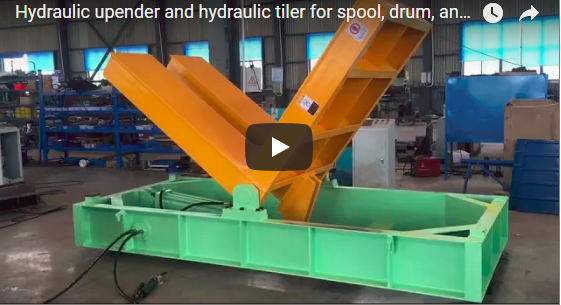
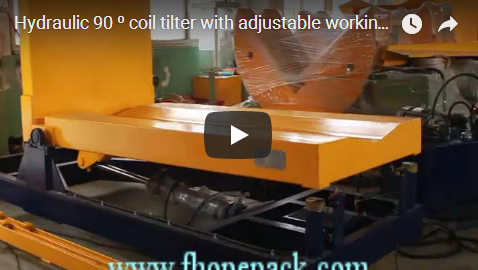
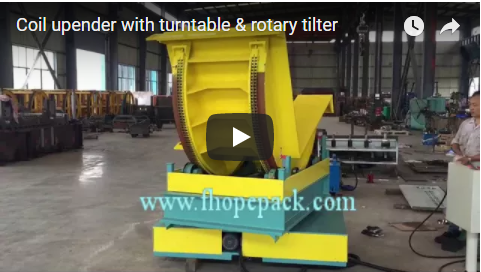
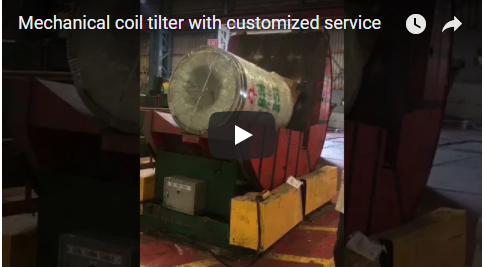
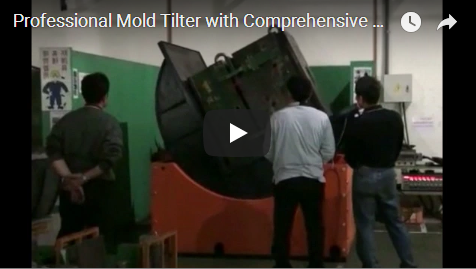
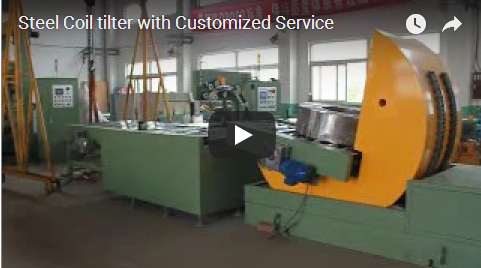
Our footage shows a 90-degree pallet changing machine running the clamp, tilt, exchange and return cycle. It is a general demonstration, so load, pallet and cycle for your plant are confirmed with us per project.
Selection checklist
| Question | Confirm per project |
|---|---|
| Load range | footprint, height, weight |
| Sensitive loads | how the load survives a tilt |
| Pallet pool | sizes and types to handle |
| Tilt style | 90 degrees versus full inversion |
| Line fit | forklift or conveyor feed |
| Electrical supply | voltage, phase and frequency on site |
Operation and safety
Loads are placed within the marked platform area with the clamps set for the load width, and the cycle is started from the panel. Keep clear of the tilting zone while a cycle runs. Routine checks cover the clamps, tilt drive, hydraulic circuit, guards and emergency stops, per the machine manual.
Engineering FAQ
Q: What does a 90-degree pallet changer do? A: It clamps a load, tilts it onto its side, swaps the pallet underneath and returns it upright, without a full inversion.
Q: When is 90 degrees better than 180? A: When the load is sensitive to being turned upside down, such as shifting, spilling or awkward loads.
Q: How is the load held during the tilt? A: Adjustable hydraulic or pneumatic side plates clamp it firmly before the tilt starts.
Q: What pallets can go underneath? A: While the load stays clamped on its side, the bottom pallet is swapped at floor level for plastic, wood or shipping pallets, or slip sheets.
Q: Is it safe around people? A: Yes. Fencing or light curtains, emergency stops, pressure relief valves and interlocking guards protect the tilting zone.
Next step
- Email us at info@fhopepack.com with your load range, pallet pool and cycle needs.
- We send a pallet changer proposal and a layout drawing within 48 hours.
- We arrange a site survey to confirm services and floor space.
Related reading
- FHOPE online pallet inverter: operation and applications
- Automatic pallet strapping machine
- Pallet stretch wrapping: technology and best practices
- FHOPE packing machinery product lines
Sources and standards
- ISO 12100:2010 Safety of machinery, general principles for design and risk assessment
- EN 415-10:2014 Safety of packaging machines, general requirements
- EN ISO 13849-1:2023 Safety of machinery, safety-related parts of control systems
FHOPE 90-degree pallet changing machine demonstration video. Reviewed as a general demonstration; load, pallet and cycle confirmed per project.
Last reviewed: 2026-10-10