Executive summary Narrow slit coils are easy to damage at the edges, so a line that moves them on rollers between stations cuts manual handling. Our line in this video carries ring-shaped slit coils on roller conveyors through pressing and wrapping stations and out to the end of the line. Slit coil weight follows from the coil dimensions and steel density, and it sets the conveyor and handling rating.
Table of Contents
- What the video shows
- How coils move through the line
- Slit coil weight from the dimensions
- Controls and safety
- Selection checklist for a slit coil handling and wrapping line
- Engineering FAQ
- Next step
- Related reading
- Sources
What the video shows
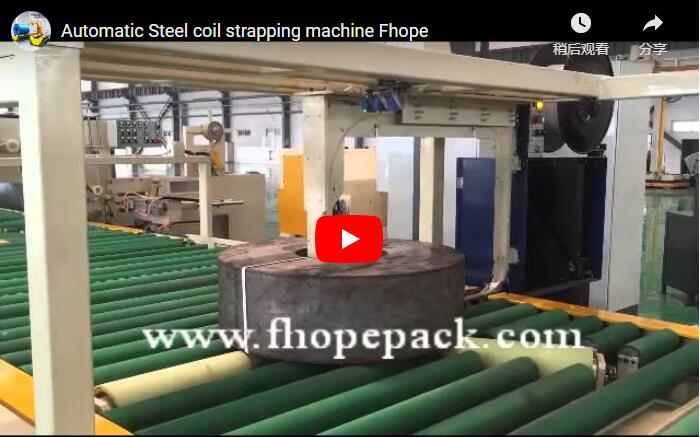
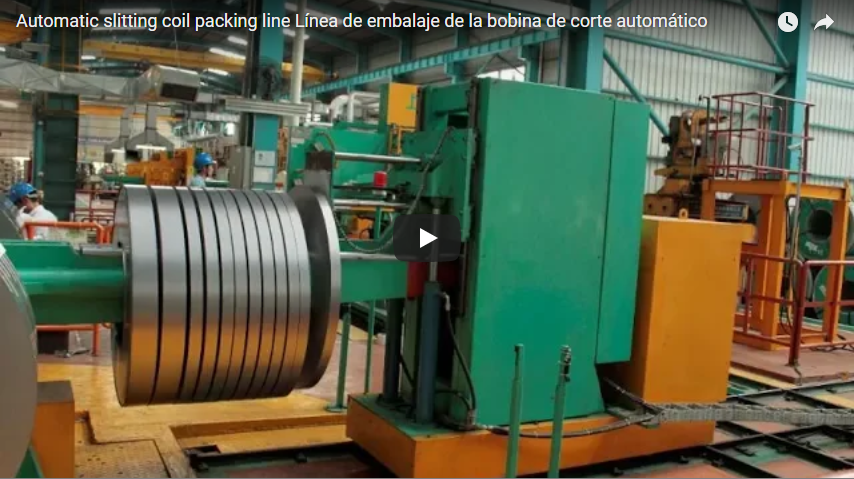
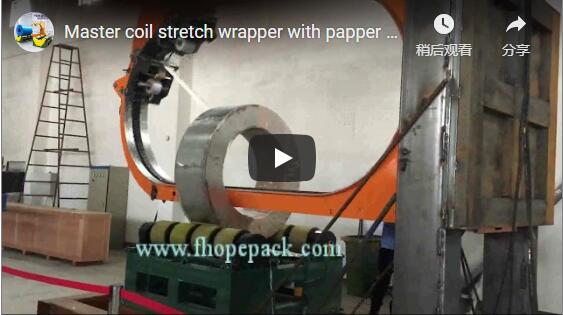
Ring-shaped slit coils ride on the infeed roller conveyors to the machine stations. At the stations a hold-down arm presses the coil and wrapping is applied.
Finished coils then move on along the conveyor towards the end of the line, where they are collected. A white control panel with buttons and green and red lights is on the blue machine, and a yellow warning triangle is on a column of the green machine. FHOPE markings are on the machines.
How coils move through the line
Times are read from the video timestamps.
| Step | What happens | Video time |
|---|---|---|
| Feed | Coils arrive on the roller conveyor | about 0–18 s |
| Press and wrap | The arm presses the coil and wrapping is applied | about 21–27 s |
| Out | Finished coils move on and are collected | about 30–42 s |
Each coil stays on rollers from station to station, so its edges are not dragged or lifted by hand.
Slit coil weight from the dimensions
Illustrative example:
| Item | Value |
|---|---|
| Outer diameter (illustrative) | 1,000 mm |
| Inner diameter (illustrative) | 508 mm |
| Width (illustrative) | 150 mm |
| Steel volume, π ÷ 4 × (1.0² − 0.508²) × 0.15 | about 0.087 m³ |
| Weight at 7,850 kg/m³ | about 686 kg |
Narrower slits weigh less per coil but come in larger numbers, so coils per hour matters as much as weight.
Controls and safety
Coils move on powered rollers and the arm presses down with force at the stations. Keep people out of the stations and off the conveyors while the line runs, and enter only with the line stopped and isolated.
The standards that apply depend on the destination market. For CE markets, ISO 12100 sets the risk-assessment method and EN 415-10 sets general requirements for packaging machines.
Selection checklist for a slit coil handling and wrapping line
- Coil outer and inner diameter and slit width range.
- Heaviest coil.
- Wrapping material and coverage.
- Whether coils are strapped or stacked at the end.
- Coils per shift.
- Line layout and floor space.
Engineering FAQ
Q: What does the line do? A: It carries slit coils on rollers through pressing and wrapping stations to the end of the line.
Q: How heavy is a slit coil? A: Steel volume times density: about 0.087 m³ × 7,850 kg/m³ gives about 686 kg in our example.
Q: Why keep coils on rollers? A: Rollers move the coil between stations without dragging or lifting its edges by hand.
Q: Where are the controls? A: A white control panel with buttons and green and red lights is on the blue machine.
Q: Can the line take my slit widths? A: Send the width range and coil diameters and we lay out the stations to suit.
Next step
We plan your slit coil handling and wrapping line in three steps:
- Submit your layout drawing with coil diameters, slit widths and weights to info@fhopepack.com.
- Receive a proposal within 48 hours, with wrapping and end-of-line steps.
- Book a site survey to check coils per shift and floor space.
Related reading
- Automatic coil packing line
- Video: slit steel coil packaging system
- Video: automated slit coil packing line for service center
Sources
- Line content: FHOPE engineering team, 2026-10-04
- Steel density: standard value for carbon steel, 7,850 kg/m³
- Weight example: our worked example, illustrative values
- Machine in action: our video on YouTube
- Standards scope: ISO 12100:2010, EN 415-10:2014
Last reviewed: 2026-10-04