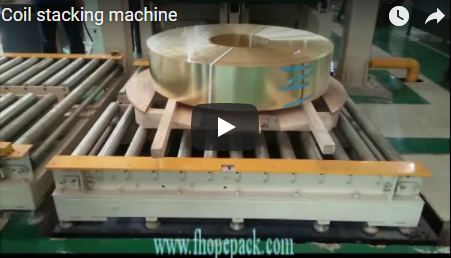
Executive summary Before a steel coil is wrapped or strapped, it has to be set down at the packing station in the right place and the right way up. This short clip shows our light green and yellow coil packing station on the shop floor, then one steel coil set in place on its wooden pallet at the machine. Whether a standalone station or a full line suits you depends on how many coils you pack and how they reach the station.
Table of Contents
- What the video shows
- What a coil packing station has to do
- Standalone station or full line
- Estimating coil weight for the station
- Controls and safety
- Selection checklist for a coil packing station
- Engineering FAQ
- Next step
- Related reading
- Sources
What the video shows
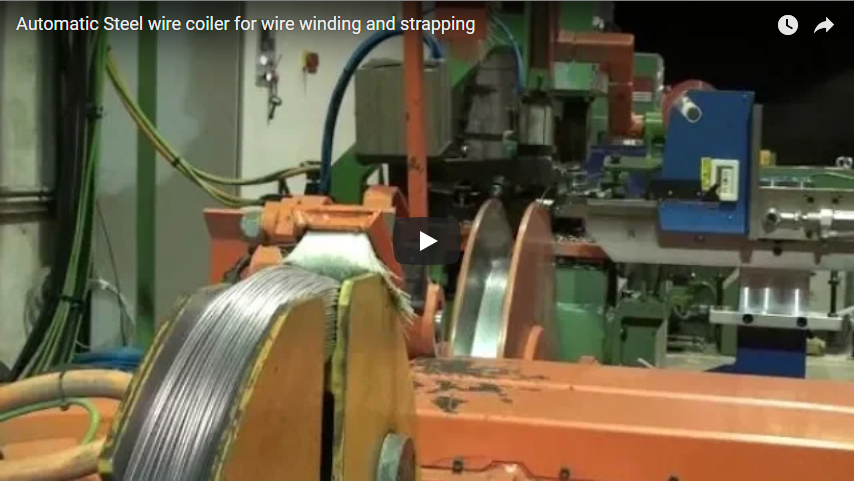
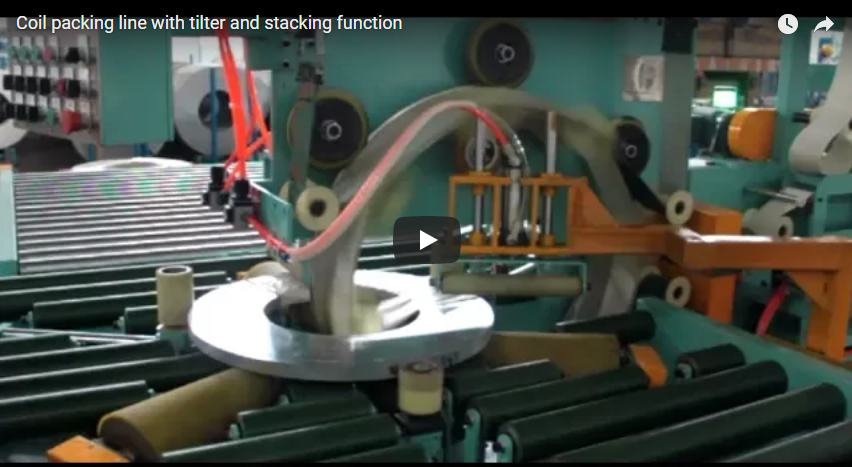
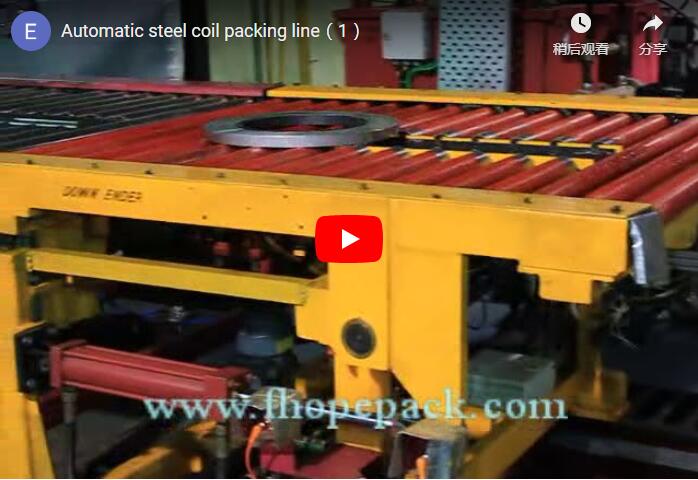
The clip opens on our coil packing station in the workshop: a light green and yellow machine with a conveyor platform and an overhead frame carrying the film roll. Our team is working round it, and the FHOPE packing machine badge is on the frame.
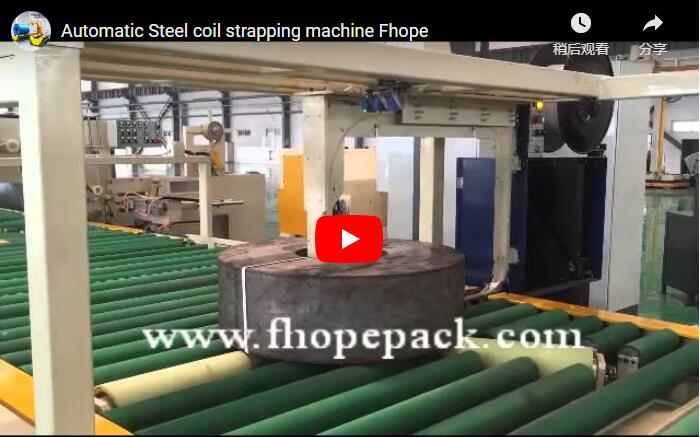
In the last seconds one steel coil sits on a wooden pallet at the machine platform, held beside the yellow arm fixture. The coil is in place and waiting. The clip ends there, before the packing cycle starts.
What a coil packing station has to do
| Task | Why it matters |
|---|---|
| Receive the coil | The coil arrives by crane, forklift or conveyor |
| Locate it | The coil must sit on the station’s centre line |
| Hold it | The fixture keeps it steady while film or strap goes on |
| Pack it | Film, paper or strap is applied |
| Release it | The packed coil leaves for storage or shipping |
Getting the coil in the right place first saves time on every later step. An off-centre coil wraps unevenly and can catch the film carriage.
Standalone station or full line
| Point | Standalone station | Full packing line |
|---|---|---|
| Coil supply | Placed by crane or forklift | Fed by conveyor or car |
| Labour | An operator loads each coil | Coils move between stations automatically |
| Floor space | Small | Long layout with transfers |
| Output | Suits lower volumes | Suits steady high volumes |
| Upgrade path | Can be linked into a line later | Built as one system |
Count the coils you pack per shift and how they arrive. A few coils a shift by crane often suit a standalone station; steady flow from a slitter or mill suits a line.
Estimating coil weight for the station
The station, its fixture and the crane or forklift that loads it are all sized for the heaviest coil. Illustrative example for a steel coil with 1,200 mm outside diameter, 508 mm inside diameter and 400 mm width:
| Item | Value |
|---|---|
| Ring area, π ÷ 4 × (1.2² − 0.508²) | about 0.93 m² |
| Coil volume, 0.93 × 0.4 | about 0.37 m³ |
| Steel density | 7,850 kg/m³ |
| Coil weight, 0.37 × 7,850 | about 2,900 kg |
Add the pallet to the coil weight when the coil arrives on a pallet, as in our video.
Controls and safety
Coils are heavy and can roll. Keep people clear while a coil is being set on the station, and stop the machine before anyone reaches into the wrap area.
The standards that apply depend on the destination market. For CE markets, ISO 12100 sets the risk-assessment method and EN 415-10 sets general requirements for packaging machines.
Selection checklist for a coil packing station
- Coil outside and inside diameter, width and weight.
- Coils per shift.
- How coils arrive: crane, forklift, conveyor or car.
- Eye vertical or horizontal.
- Film, paper or strap, and in what order.
- Whether a full line may be added later.
Engineering FAQ
Q: What does the video show? A: Our coil packing station on the shop floor, then a steel coil set in place on its pallet at the machine.
Q: Standalone station or full line? A: A standalone station suits lower volumes placed by crane; a line suits steady coil flow from a mill or slitter.
Q: Can a standalone station join a line later? A: Yes, when the station is planned with conveyors or transfer cars in mind.
Q: How heavy is the coil the station must take? A: Ring area times width times steel density. Our 1,200 mm OD example weighs about 2,900 kg.
Q: Why does coil position matter? A: An off-centre coil wraps unevenly and can catch the film carriage.
Next step
We plan your coil packing station in three steps:
- Submit your layout drawing with coil sizes and output to info@fhopepack.com.
- Receive a proposal within 48 hours, with the station or line layout.
- Book a site survey to check the coil supply and floor space.
Related reading
- Automatic coil packing line
- Video: coil wrapping machine with movable trolley
- Steel coil strapping machines
Sources
- Machine content: FHOPE engineering team, 2026-10-04
- Coil weight example: our worked example, illustrative values
- Machine in action: our video on YouTube
- Standards scope: ISO 12100:2010, EN 415-10:2014
Last reviewed: 2026-10-04