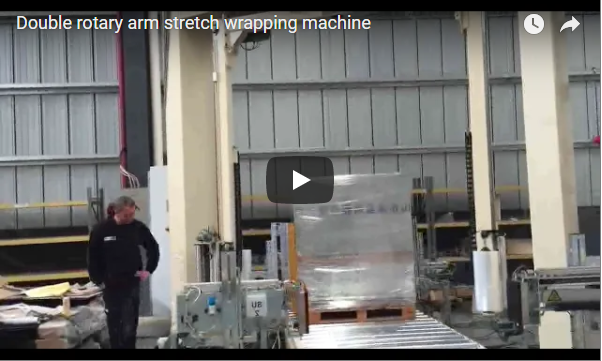
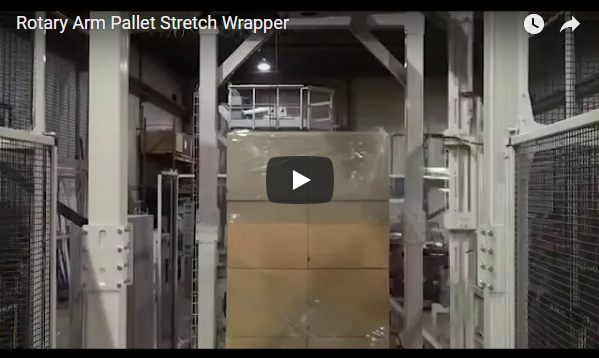
Executive summary At the end of a bag line, a robot builds the pallet and a wrapper locks it with stretch film before it goes to the warehouse. Our rotary arm pallet wrapper does the wrapping: the pallet stays still on the conveyor while the arm circles it inside a yellow mesh guard. Wrapper output must keep up with the palletizer, so the wrap cycle is set per project to match it.
Table of Contents
- From robot palletizer to rotary arm wrapper
- How the rotary arm wrapper works
- Matching wrapper and palletizer
- Estimating film per pallet by carriage program
- Controls and safety
- Selection checklist for a rotary arm pallet wrapper
- Engineering FAQ
- Next step
- Related reading
- Sources
From robot palletizer to rotary arm wrapper
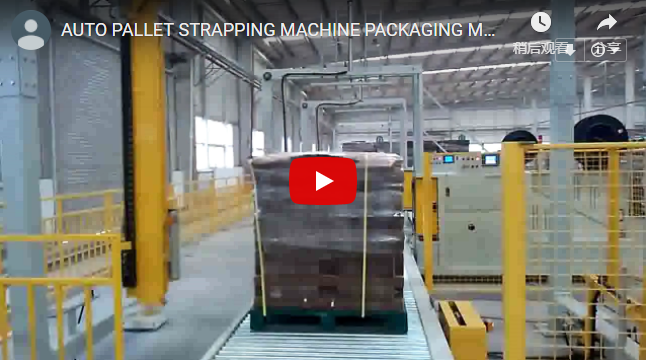
A white robot arm picks white bags from a conveyor and stacks them on a pallet. The finished stack moves on the yellow conveyor into our rotary arm wrapper, a yellow gantry inside a yellow mesh guard.
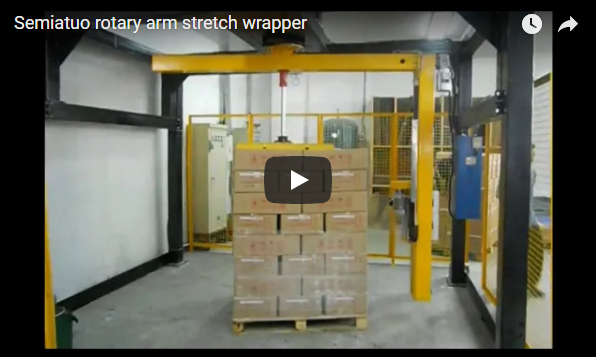
The arm circles the still pallet and winds stretch film around the load from bottom to top. The wrapped pallet then leaves the guard on the outfeed conveyor, and a warning stripe marks a post of the guard.
How the rotary arm wrapper works
| Step | What happens |
|---|---|
| Infeed | The palletized stack arrives on the conveyor |
| Stop and centre | The pallet stops under the arm |
| Wrap | The arm circles the pallet while the carriage travels up and down |
| Cut and seal | The film is cut and the tail held on the load |
| Outfeed | The wrapped pallet leaves on the conveyor |
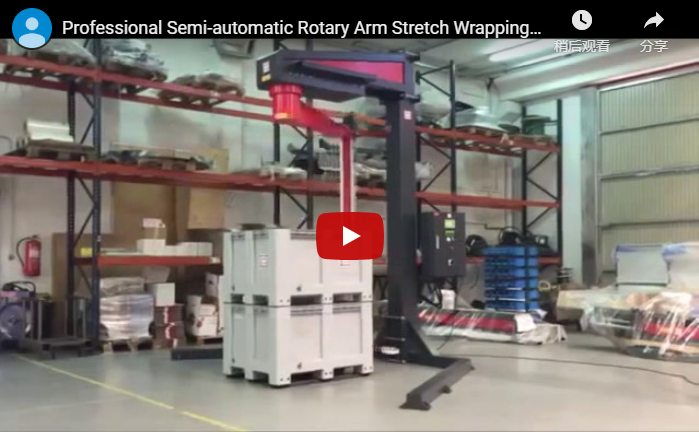
The pallet does not turn, so tall or loose bag stacks are not thrown off balance. That suits light, high pallets from a robot palletizer.
Matching wrapper and palletizer
Illustrative example with a palletizer building one pallet every 4 minutes:
| Item | Value |
|---|---|
| Palletizer cycle (illustrative) | 240 s per pallet |
| Wrapper time per pallet | Wrap cycle + transfer in and out |
| Condition | Wrapper time per pallet below 240 s |
The wrapper should finish well inside the palletizer cycle, so pallets never queue. Our fully automatic pallet wrapping line shows the same conveyor-fed layout. Count turns and transfer time when you plan the line.
Estimating film per pallet by carriage program
Illustrative example for a 1,200 × 1,000 mm pallet stacked 1,500 mm high, with 500 mm film at half overlap:
| Item | Value |
|---|---|
| Pallet perimeter, 2 × (1,200 + 1,000) | 4,400 mm |
| Advance per turn at half overlap | 250 mm |
| Spiral turns, 1,500 ÷ 250 | 6 |
| Top and bottom turns (illustrative) | 4 |
| Film laid, 10 × 4.4 m | about 44 m |
This is one carriage pass, or one layer. Film use depends on the carriage program: an up and down program lays two layers and up, down, up, down lays four, with the spiral turns rising to match. We set the program per load. The figures are film laid on the load; pre-stretch means the roll pays out less than this length.
Bag loads often get extra bottom turns to tie the stack to the pallet.
Controls and safety
A yellow mesh guard surrounds the wrapper, with a warning stripe on a post. The arm circles at speed. Stop the line before anyone enters the guard. For pallet wrapping machines, EN 415-6 adds the specific safety requirements.
The standards that apply depend on the destination market. For CE markets, ISO 12100 sets the risk-assessment method and EN 415-10 sets general requirements for packaging machines.
Selection checklist for a rotary arm pallet wrapper
- Pallet size and load height.
- Pallets per hour from the palletizer.
- Load type: bags, cartons or drums.
- Turns, overlap and top sheet needs (see our arm stretch wrapper with top sheet dispenser).
- Conveyor layout in and out.
- Guarding and floor space.
Engineering FAQ
Q: Why a rotary arm instead of a turntable? A: The pallet stays still, so tall or light stacks are not thrown off balance.
Q: Can it keep up with a robot palletizer? A: Yes, when the wrap cycle and transfer time are set inside the palletizer cycle.
Q: How much film per pallet? A: Turns times perimeter, and the turns depend on the carriage program. Our 1,500 mm example lays about 44 m in one bottom-to-top pass; up and down programs lay more.
Q: Is it guarded? A: Yes. A yellow mesh guard surrounds the wrapping zone, with a warning stripe on a post.
Q: What loads suit it? A: Bag stacks, cartons and other palletized loads.
Q: How do I check the wrapper will not hold up the line? A: Add the wrap cycle to the transfer time in and out; in our example the total must stay below the 240 s palletizer cycle.
Next step
We plan your pallet wrapping line in three steps:
- Submit your layout drawing with pallet sizes and output to info@fhopepack.com.
- Receive a proposal within 48 hours, with the wrap cycle and film plan.
- Book a site survey to check the conveyor and guard layout.
Related reading
- Automatic pallet wrapping machines
- Semi-automatic pallet wrapping machines
- Pallet inverter
- Video: automatic pallet stretch wrapping machine with film cutter
Sources
- Machine content: FHOPE engineering team, 2026-10-04
- Pallet wrapper safety: EN 415-6
- Cycle and film examples: our worked examples; palletizer cycle and load values are illustrative
- Machine in action: our video on YouTube
- Standards scope: ISO 12100:2010, EN 415-10:2014
Last reviewed: 2026-10-04