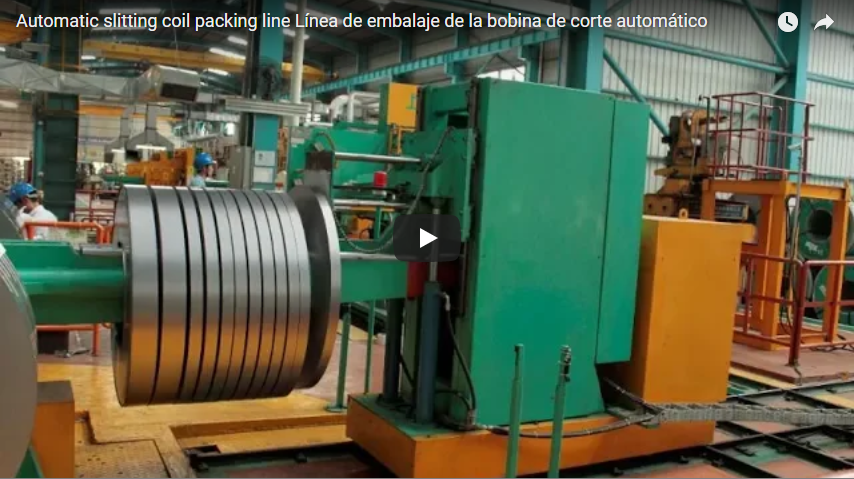
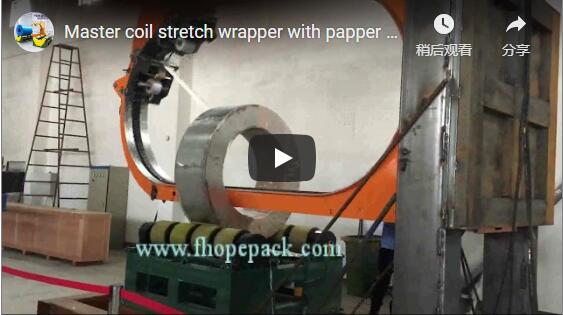
Executive summary An automatic copper strip coil packing line moves each coil from the slitter to a wrapped, labelled pallet with almost no manual lifting. In our clip, about 48 s long, a copper coil lying flat runs on a yellow roller conveyor, is wrapped in clear film, travels on a pallet, gets its label and leaves by forklift. The line is built for coils of 80 to 5,000 kg, 750 to 1,400 mm OD and 17 to 400 mm width.
Table of Contents
- What the clip shows, in order
- Stations of a copper strip coil packing line
- Line specifications
- Takt check
- Selection checklist for a copper strip coil packing line
- Controls and safety
- Engineering FAQ
- Next step
- Related reading
- Sources
What the clip shows, in order
The line combines yellow roller conveyors, a white and yellow handling frame with an overhead gantry, a wrapping station behind a yellow guard and a long white roller conveyor for pallets. A white control desk with two displays, a keypad, red and green buttons and a red emergency stop stands beside the conveyor.
- 0 to about 4 s. A reddish-brown copper strip coil, lying flat with its eye up, is transferred onto the yellow roller conveyor.
- About 4 to 8 s. A worker in an orange hard hat and yellow vest stands at the control desk while the coil moves on toward the next station.
- About 8 to 16 s. At the wrapping station, behind the yellow guard, the coil is wrapped in clear film until it is fully covered.
- About 16 to 32 s. The wrapped coil, now on a pallet, travels along the long conveyor under the overhead gantry.
- About 32 to 36 s. At the end of the line the worker adjusts the wrapped coil on its pallet by hand.
- About 36 to 40 s. A label printer at the control desk prints the coil label.
- About 40 to 48 s. A forklift picks the wrapped pallet off the conveyor and takes it to storage.
Stations of a copper strip coil packing line
A copper strip coil comes off the slitter with its eye horizontal on the turnstile. The line turns it, straps it, wraps it, stacks it and reports the data back to production.
| Station on our line | What it does |
|---|---|
| Coil turnstile (cross arm) | Takes coils off the slitter; 10 t per arm, 40 t total, 1,500 mm arm |
| Coil down-ender | Lifts and flips the coil eye-up; 20 to 30 s per cycle, handles widths from 15 mm |
| PET strapping machine | Straps through the eye, 3, 4 or 6 straps; about 15 s per cycle |
| Woven belt wrapping machine | Wraps the coil in PP woven sheet |
| Stacker with turntable | Six stations; stacks to 1,000 mm high and 6,000 kg per pallet |
| Industrial PC control | Takes data from the slitting line or barcode reader, prints labels, shares packing data |
The clip shows the conveying, wrapping, pallet transfer, labelling and forklift pick-up part of that chain. Clear film, as in the clip, or PP woven sheet is chosen per customer and per storage time.
Line specifications
| Copper strip coil weighing, packing and stacking line | Specification |
|---|---|
| Coil weight, handling and packing | 80 to 5,000 kg |
| Coil outer diameter | 750 to 1,400 mm |
| Coil inner diameter | 508 mm |
| Coil width | 17 to 400 mm |
| Strapping | PET, 0.80 mm thick, 16 mm wide, 3, 4 or 6 straps |
| Woven wrap material | 55 mm core, 100 to 450 mm OD, 90 to 100 mm wide |
| Stacking | 1,000 mm high with pallet, 6,000 kg per pallet, 4,000 kg per coil on the stacker |
| Power | 380 V, 50 Hz |
Takt check
For an illustrative target of 40 coils per hour, the takt is 3,600 ÷ 40 = 90 s per coil.
The down-ender needs 20 to 30 s and the strapping machine about 15 s per cycle, so both fit well inside 90 s. The strapping figure is the page value for one cycle. With 6 straps on a wide coil, we check the strapping time at your strap count, and add a second strapping head or a buffer if it runs close to the takt. Wrapping time depends on the coil width and the overlap, and we check it per coil range in the proposal.
Selection checklist for a copper strip coil packing line
- Coil weight, OD, ID and width range from the slitter.
- Output per hour, matched to the slitter cycle.
- Strap count, strap material and wrap material: clear film or PP woven.
- Stacking height and weight per pallet.
- Data link: slitting line, barcode reader, label content and the plant system.
- Forklift or conveyor take-off at the end of the line.
Controls and safety
On the clip the wrapping station sits behind a yellow guard, and the control desk carries a red emergency stop. At about 32 to 36 s the worker adjusts the wrapped coil on its pallet by hand at the end of the conveyor. A hand on a load that can still move is the move to design out. Adjustments on the pallet happen only with the conveyor stopped.
Stop, isolate and lock out the station before anyone reaches into the wrapping guard, clears a film break or works on the down-ender or stacker. The forklift pick-up zone at the end of the line is kept clear of people on foot while the forklift moves.
The standards that apply depend on the destination market. For CE markets, ISO 12100 sets the risk-assessment method and EN 415-10 covers general requirements for packaging machines, which fixes guarding and the stop arrangement.
Engineering FAQ
Q: Which coils does the copper strip coil packing line take? A: Coils of 80 to 5,000 kg, 750 to 1,400 mm OD, 508 mm ID and 17 to 400 mm width.
Q: How many straps does the line apply? A: The PET strapping machine straps through the eye with 3, 4 or 6 straps, at about 15 s per cycle.
Q: How high can the line stack coils? A: Up to 1,000 mm including the pallet and 6,000 kg per pallet. The stacker takes single coils up to 4,000 kg, below the 5,000 kg handling limit.
Next step
We size a copper strip coil packing line in three steps:
- Submit your layout drawing with the slitter exit, coil range, output target and stacking pattern, to info@fhopepack.com.
- Receive a proposal within 48 hours, with the station list and the takt check per station.
- Book a site survey so we confirm the floor space, the forklift route and the data link.
Related reading
- Copper strip coil weighing, packing and stacking line
- Slitting coil packaging line
- Coil packing machines
- Coil wrapping machine with taping and label printer
Sources
- Line specifications and stations: copper strip coil weighing, packing and stacking line product page
- Clip timing: scene timings taken from our clip, in steps of about 4 s
- Line in action: our video on YouTube
- Standards scope: ISO 12100:2010, EN 415-10:2014
Last reviewed: 2026-10-05