Executive summary Between the slitting line and the dispatch bay, a steel coil needs two outer layers of protection: high-tension strapping to hold the wrap against transit shear, and stretch film to keep dust, scuffs and moisture off the surface. This page covers FHOPE’s combined heavy-duty coil line, which straps and stretch-wraps coils on a single powered roller conveyor. It sets out how the two zones work together, the published capacity brackets, and what you specify at project engineering rather than assume.
Table of Contents
- Process architecture: two-zone integrated flow
- Strapping module: radial or circumferential
- Rotating-ring wrapping module
- Coil handling and saddle geometry
- Baseline engineering parameters
- Controls and safety
- Selection checklist
- Engineering FAQ
- Related reading
- Sources
- Next step
Process architecture: two-zone integrated flow
A combined strapping and wrapping line removes the crane rigging and forklift transfer that a separate strapper and a separate wrapper otherwise cost. The two stations sit on one powered roller conveyor, and the coil keeps a single orientation from infeed to discharge:
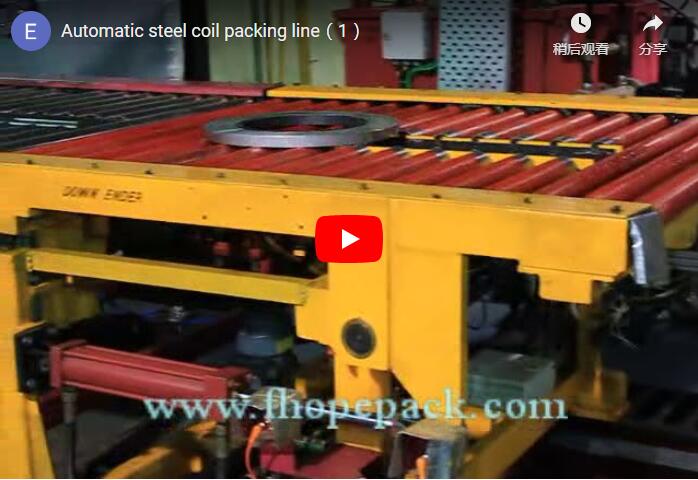
- Infeed and alignment. The coil arrives on the roller conveyor. A turnstile or down-ender is fitted upstream when the infeed is eye-horizontal, so the coil is presented in the wrapping orientation before it enters the cell.
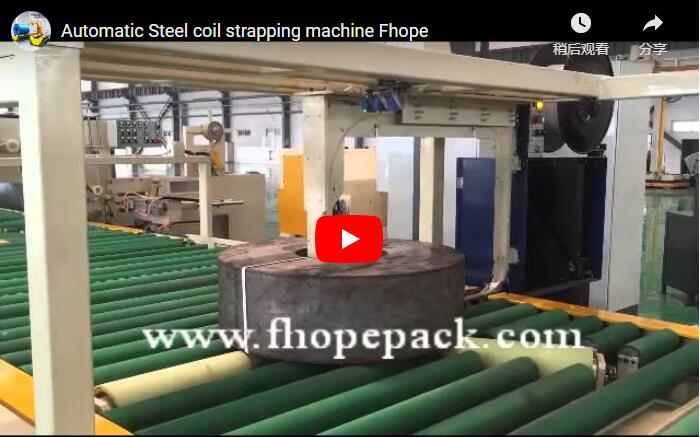
- Strapping. The coil stops under an overhead-gantry strapping head, which applies the strap, tensions it, joins it and shears it in one pass.
- Inline transfer. The strapped coil indexes on the same conveyor into the wrapping station, with no lift and no re-orientation between zones.
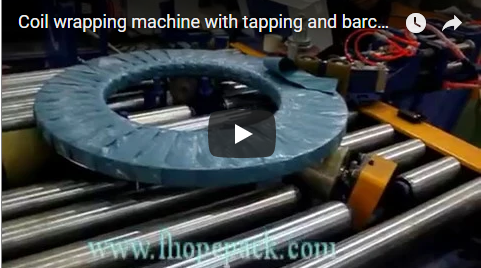
- Wrapping. A rotating-ring film carriage applies stretch film in overlapping bands. The ring travels over the coil for an eye-to-sky coil, or uses a through-the-eye path for an eye-horizontal coil.
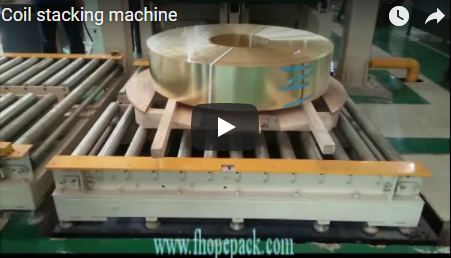
- Discharge. The sealed coil advances downstream to storage, or to a stacking station when stacking is in the line scope.
What this means on the floor: fewer coil handlings means fewer chances for a lifted coil to rock, tilt or pick up damage, and the cell does not need floor space for a crane swing between machines.
Strapping module: radial or circumferential
Strap geometry is the first decision a buyer makes, because it drives the strap count and the strap cost per coil. FHOPE offers automatic application in both arrangements (engineering review, 2026-10-08):
- Radial, through the eye. The strap runs across the coil width through the eye; used when axial retention of the wrap is the priority.
- Circumferential. The strap runs around the coil body; used to band the outer wrap against transit movement.
The standard offering runs high-tensile steel strap with a width of 32 mm. The strap is tensioned and joined automatically, and the joint and band pattern are matched to your packaging specification at project engineering. For lower volumes, a semi-automatic route uses a motor-driven strap feed arch, a semi-automatic head and a turntable, which engineering can price against your throughput.
Rotating-ring wrapping module
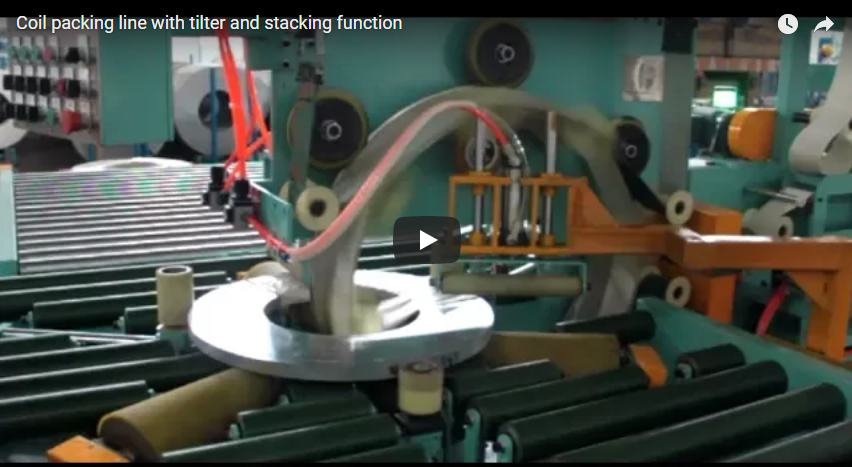
The line’s wrapping station is a rotating-ring film carriage: a large yellow ring that travels along the coil axis over the coil and applies film in overlapping bands around the outer circumference.
That geometry suits coils carried eye-to-sky, the orientation the two heads are built around. When a project’s coils arrive eye-horizontal, a through-the-eye orbital configuration carries the film through the coil eye instead. Both configurations are standard offers, and the film type and the overlap are set through the HMI program. The final choice is taken at project engineering with the coil envelope.
Coil handling and saddle geometry
Coils rest on rollers under the line with the eye pointing up and the axis horizontal, so the coil is neither lifted nor flipped inside the cell. Roller spacing and the saddle section are matched to the smallest coil you run, so a short coil cannot rock while a high-tension strap is pulled.
The coil OD, width and weight you confirm fix the roller pitch, the strap program and the ring clearance. The 508–610 mm ID band and the 700–1,600 mm OD band above set the starting geometry for an automatic line of this class. That is why the envelope in the next section is given as reference bands rather than a single figure.
Baseline engineering parameters
The values below are manufacturer-published model data and engineering records; they are reference bands, and your line is engineered to the coil envelope you submit.
| Parameter | Reference value | Basis |
|---|---|---|
| Coil inside diameter | 508–610 mm | FHOPE FPCA automatic line, published |
| Coil outside diameter | 700–1,600 mm | FHOPE FPCA-1000, published |
| Coil width | 20–500 mm | FHOPE FPCA-1200, published |
| Maximum coil weight | 2,500 kg on the conveyor-loaded automatic line; 4,500 kg on a trolley-loaded heavy slit-coil line | FHOPE FPCA-1200 / FPS-600, published |
| Heavy master-coil line | 10,000 kg, crane loaded | FHOPE FPS-2000, published |
| Steel strap width | 32 mm, standard | FHOPE engineering, 2026-10-08 |
| Minimum coil ID, minimized-section strapping | above 670 mm | FHOPE engineering, 2026-10-08 |
| Strap application | radial or circumferential, automatic | FHOPE engineering, 2026-10-08 |
| Wrapping configuration | rotating ring, or through-the-eye orbital | FHOPE line options |
| Loading | turnstile, down-ender or powered conveyor | FHOPE line options |
Reference larger or heavier envelopes than the bands above are handled as engineered lines rather than catalogue stock. Bands above are the widest published envelope across the FPCA conveyor-loaded models; per-model limits differ.
Controls and safety
As the manufacturer’s standard delivery specification, the safety architecture is engineered to CE (EN ISO 13849-1 / EN 415-10) and OSHA design requirements. Standard delivery includes interlocked perimeter fencing around the cell, muting safety light curtains at the conveyor apertures, and dual-channel emergency-stop circuits at each operator position. Personnel enter the cell only when the line is stopped and isolated.
The line runs an interlocked, PLC-based sequence, so the strapping head, the film carriage and the conveyor cannot act out of order. A control console at the line gives the operator the sequence status. Clause applicability for your destination market is confirmed at project engineering.
Selection checklist
- Smallest and largest coil OD, ID, width and weight, to size the roller pitch, the saddle and the ring clearance.
- Strap geometry: radial through the eye, circumferential, or both; the 32 mm steel strap is the standard baseline.
- Film and strap packaging spec, with the overlap and tension set through the HMI program.
- Rated capacity in coils per hour or tons per month, to size the line against slitting output.
- Infeed condition: eye-to-sky or eye-horizontal, which decides the turnstile or down-ender upstream.
- Stacking or palletizing behind wrapping, configured as separate scope when the process needs it.
- Safety scope and control protocol per destination market, including fencing, fieldbus and clause coverage.
Engineering FAQ
Q: Can this line apply both radial and circumferential strapping? A: Yes — FHOPE offers automatic radial (through-the-eye) and circumferential strapping; the standard strap is high-tensile steel at 32 mm wide, and the band pattern is set at project engineering.
Q: What coil envelope fits an automatic line of this type? A: The published conveyor-loaded FPCA line accepts coils with an inside diameter of 508–610 mm, an outside diameter of 700–1,600 mm and a coil weight up to 2,500 kg. Heavier lines run to 4,500 kg, and master coils to 10,000 kg.
Q: How is the line fed when coils arrive eye-horizontal? A: An inline turnstile or down-ender is fitted before the strapping station, so the coil is turned into the eye-to-sky orientation the heads are built around. This requires the infeed module to be included in the line scope.
Q: How many operators does the line need? A: The line is supervised from the local control console, and the wrapping and strapping sequence runs automatically when the line is in cycle. Staffing for your cell is confirmed at project engineering.
Q: What safety standards does the line meet? A: As standard delivery the line is engineered to CE (EN ISO 13849-1 / EN 415-10) and OSHA design requirements, with interlocked fencing, muting safety light curtains and dual-channel emergency stops. Clause applicability is confirmed at project engineering.
Related reading
- Automatic Coil Packing Line
- Steel Coil Strapping Machinery
- Steel Coil Wrapping Machine
- Rotary Ring Stretch Wrapper
- Master Coil Wrapper
Sources
- Demonstration footage: FHOPE heavy-duty steel coil strapping and stretch wrapping line, line in operation.
- Published line parameters: FHOPE Steel coil wrapping machine series (FPCA, FPS and FPW models).
- Strapping, strap width and option engineering data: FHOPE engineering review of coil packaging line records, 2026-10-08.
- Figures marked as reference above are manufacturer-published or engineering records; your line figures are confirmed at project engineering.
Next step
- Send your coil range and layout drawing to info@fhopepack.com — smallest and largest coil OD, ID, width and weight, plus your site footprint.
- Receive a tailored proposal within 48 hours with the station layout, coil handling and safety scope sized to your line.
- Book a free site survey so access, services and integration with your upstream and downstream lines are confirmed before you order.
Last reviewed: 2026-10-08