Executive summary
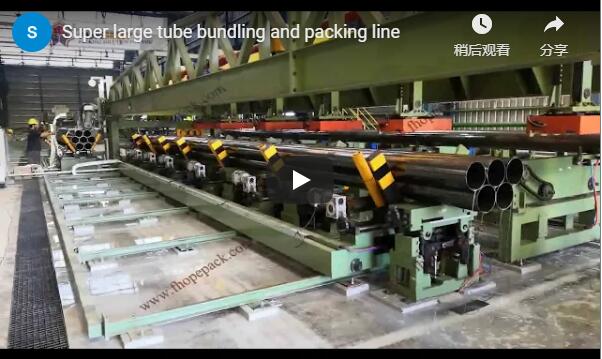
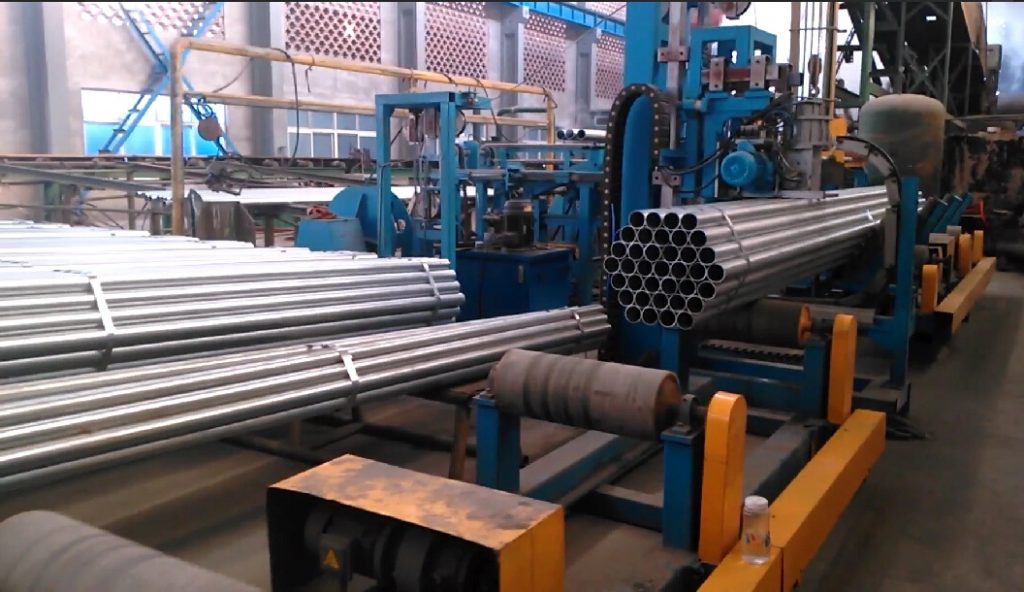
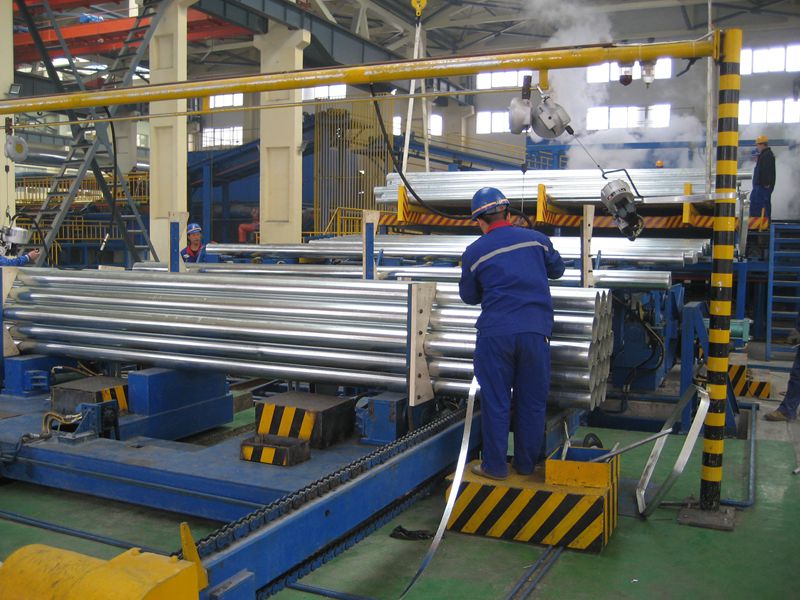
At the end of a tube mill, tubes arrive one by one and must leave as counted, tight bundles that a crane can lift safely. Stacking and strapping by hand is slow and gives loose, uneven bundles. Our steel tube bundle stacking and strapping line counts the tubes, stacks them in a forming cradle into a hexagon or square bundle and straps it with PET strap or 25 mm or 32 mm steel strap, depending on bundle weight. This page covers the process, the bundle maths, strap data and what to send for a quote.
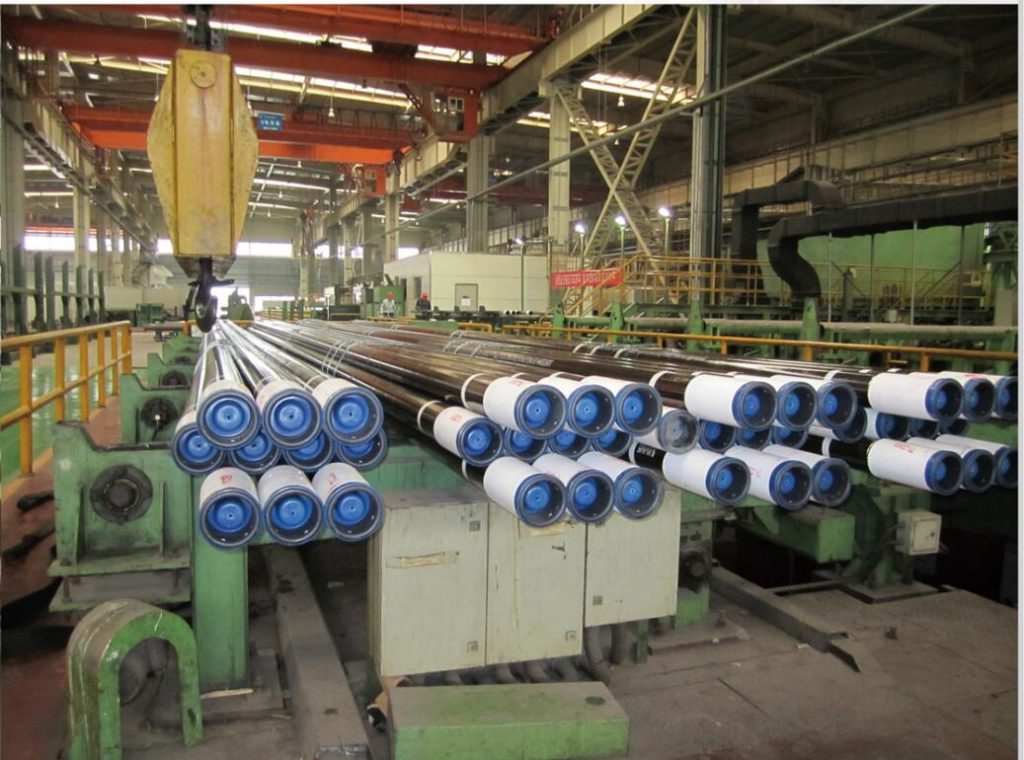
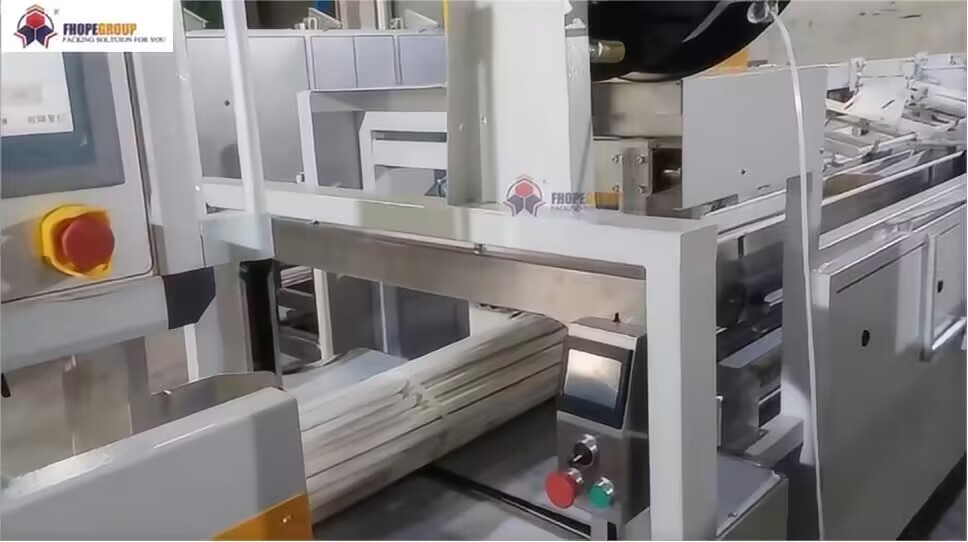
This line runs yellow-coated tubes. Pneumatic arms on cream-coloured frames along the line hold the layered tubes in position, and an overhead handling unit moves them. At the forming station, the tubes sit in a curved cradle as a round-sided hexagon bundle, with kraft paper fed lengthwise around it before the bundle is strapped with PET strap.
Table of Contents
- Why automate tube bundling
- How the line works
- Bundle count maths
- Strap data
- Selection checklist
- Safety
- Engineering FAQ
- Next step
- Related reading
- Sources
Why automate tube bundling
A tube mill can produce faster than a crew can count and stack. Hand-stacked bundles also vary in count and shape, and a loose bundle shifts when lifted, which bends tubes and loosens straps. An automatic line counts every tube, builds the same bundle shape every time and straps it at fixed positions. Paper or film under the strap protects coated tubes.
How the line works
- Run-out: tubes leave the mill on a roller conveyor; rejects are kicked out.
- Pick and count: tubes are picked up one by one and counted.
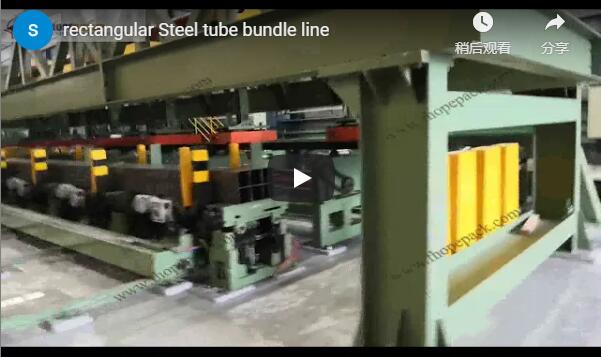
- Align: tubes are aligned end to end; rectangular tubes can be turned 90° automatically.
- Stack: each layer is placed in the forming cradle, and side arms hold the shape.
- Paper wrap: for coated tubes, kraft paper is fed lengthwise around the formed bundle.
- Strap: the strapping machine places the straps along the bundle; PET strap for coated, lighter bundles, or steel strap with 5 to 7 straps for heavy bundles.
- Out: the bundle runs to the out conveyor for weighing, labelling and lifting.
Bundle count maths
Hexagon bundle with n tubes per side: total tubes = 3n(n − 1) + 1.
Square bundle: tubes = tubes per row × rows.
Bundle weight (kg) = tubes × tube length (m) × tube weight (kg/m).
Example only: a hexagon with 6 tubes per side holds 3 × 6 × 5 + 1 = 91 tubes. With 6 m tubes at 2 kg/m, the bundle weighs 91 × 6 × 2 = 1,092 kg. Check this against the crane and the strap rating.
| Tubes per side (n) | Tubes in hexagon |
|---|---|
| 4 | 37 |
| 5 | 61 |
| 6 | 91 |
| 7 | 127 |
Strap data
For heavy bundles, steel strap data from our steel tube bundle strapping machine:
| Item | Data |
|---|---|
| Strap | steel, oscillate or ribbon wound coil |
| Strap width | 25 mm or 32 mm |
| Width tolerance | ±0.127 mm |
| Camber | less than 8 mm per 2,000 mm of strap |
| Straps per bundle | 5 to 7 |
Tube size, bundle size and line speed are confirmed at quote.
Selection checklist
- Tube shape, OD and wall thickness?
- Tube length range?
- Bundle shape and count?
- Coated or bare tubes, and paper or film?
- Mill speed in tubes per minute?
- Number and positions of straps?
Safety
We design tube handling lines to EN ISO 12100:2010 for risk assessment, EN 415-10 for packaging machine safety and EN 60204-1 for electrical equipment. The stacking and strapping zones are fenced and interlocked.
Engineering FAQ
Q: Can it build hexagon and square bundles? A: Yes. Round tubes usually go in hexagons; square and rectangular tubes in squares or rectangles.
Q: Why paper under the strap? A: It protects coated tubes from strap marks and dirt.
Q: Can the count change between orders? A: Yes, it is set on the HMI.
Q: Steel or PET strap? A: PET strap, as on this line, suits coated tubes and moderate bundle weights. Steel strap is used for heavy bare tube bundles. The choice is confirmed at quote from the bundle weight.
Next step
- Send your tube sizes, bundle and mill speed to info@fhopepack.com.
- We confirm the line layout.
- We reply within 24 hours with a proposal and quotation.
Related reading
- Automatic packing line for steel tube bundles (product)
- Steel tube bundle strapping machine (product)
- Automatic square tube bundle making and strapping machine (video)
- Automatic steel pipe bundling and strapping machine (video)
- Steel tube bundle packing line (video)
Sources
- FHOPE product pages: automatic packing line for steel tube bundles; steel tube bundle strapping machine
- EN ISO 12100:2010; EN 415-10; EN 60204-1
- The tube bundle line shown above
Last reviewed: 2026-10-20