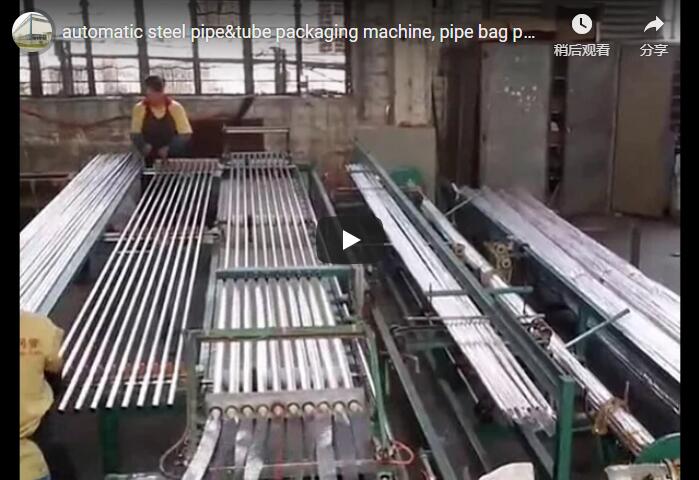
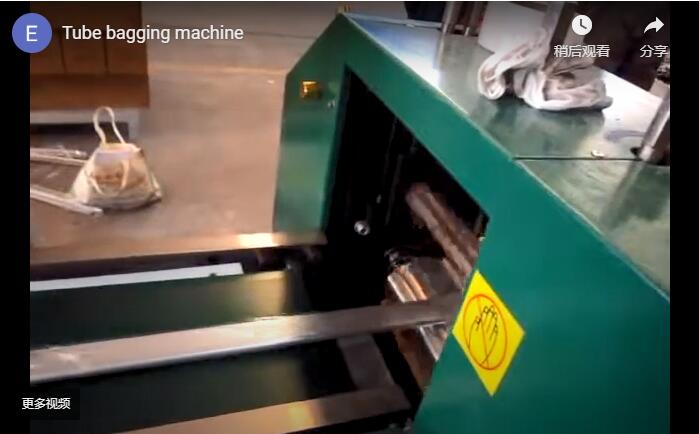
Executive summary Our online pipe bundling line takes plastic pipe straight from the extruder’s cutter, counts it by program, forms a round bundle and straps it. In this video the bundles are tied with PP strapping. The same line can band them with stretch film instead, and we choose the binding to suit your pipe and your customers. It builds bundles 150–350 mm across, 3–6 m long and 10–50 kg, at more than one bundle per minute.
Table of Contents
- How the bundling line works
- PP strap or film band
- Sizing the bundle
- Checking bundle weight
- Matching the extruder
- Line data
- Selection checklist
- Engineering FAQ
- Next step
- Related reading
- Sources
How the bundling line works
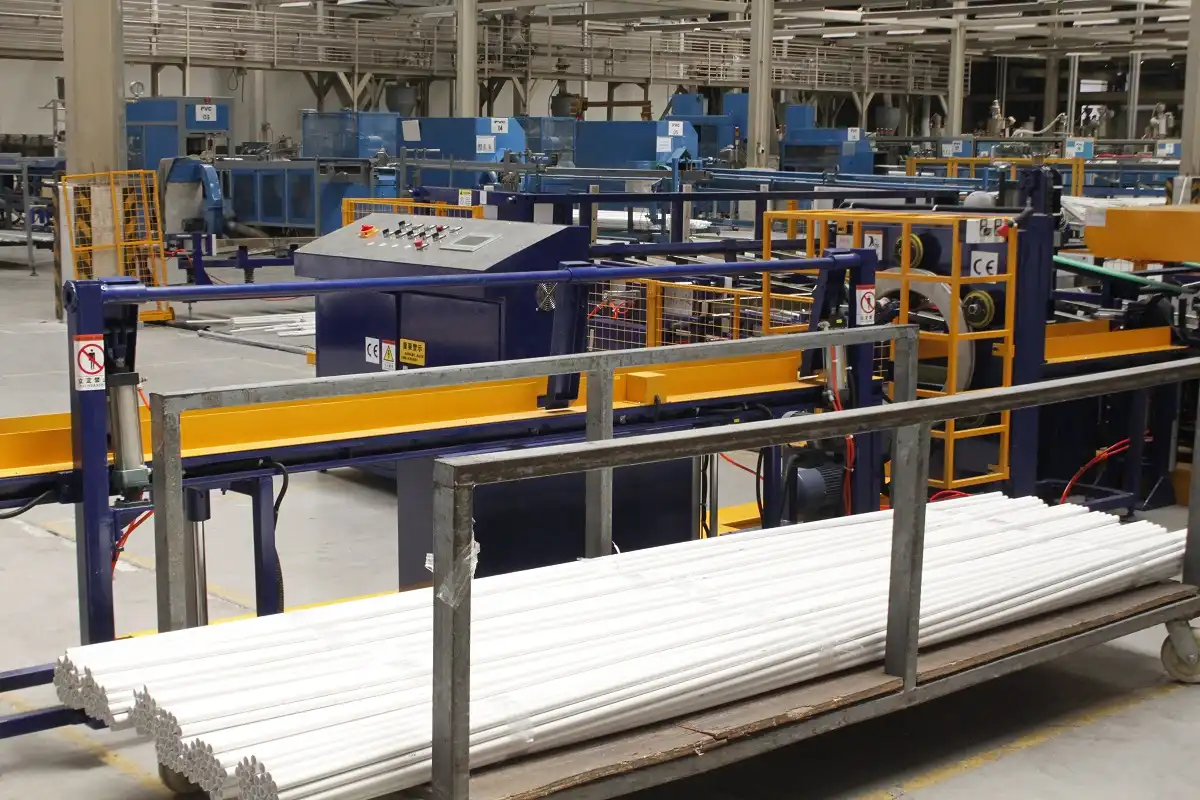
Cut pipes arrive from the extruder on the infeed rails. The line counts them automatically against the number set in the program, then lets them roll into a U-shaped forming trough. A pressing arm closes over the group and pulls it into a round bundle. At the strapping station, the PP band runs around the bundle, is tensioned and sealed, and the finished bundle moves out to the collection side.
In our video, the pressing arm rounds the group in the trough before the strapping head ties it, which is what keeps the bundle round when it is lifted.
The pipe count is set on the touch screen of the main cabinet, which also switches between manual and automatic mode. A second operating box along the line has start, stop and an emergency stop for work at the strapping station. Feeding can be online from the extruder or offline from a pipe rack.
PP strap or film band
| Binding | How it holds | Best for |
|---|---|---|
| PP strapping | Several tight bands along the bundle | Stiff PVC and PPR pipe, bundles that are lifted by hand or crane |
| Stretch film band | A wide film ring at each tie point | Pipe that must not be marked by a narrow band, softer PE pipe |
A PP band gives a strong, tight tie in a narrow strip, so the bundle stays round when it is lifted. A film band spreads the pressure over a wider area, which is gentler on the pipe surface. The line layout stays the same; only the binding head changes, so we fit the one your market prefers.
Sizing the bundle
Round pipes pack best in a hexagonal pattern. Each full ring around the centre pipe adds six more pipes than the ring before, which gives standard counts of 7, 19, 37 and 61 pipes. The bundle is then about (2k + 1) pipe diameters across, where k is the number of rings.
| Rings around the centre (k) | Pipes | Across, 20 mm pipe | Across, 32 mm pipe |
|---|---|---|---|
| 1 | 7 | 60 mm (below window) | 96 mm (below window) |
| 2 | 19 | 100 mm (below window) | 160 mm |
| 3 | 37 | 140 mm (below window) | 224 mm |
| 4 | 61 | 180 mm | 288 mm |
The line builds bundles from 150 to 350 mm across, so check your pipe size against that window. A 37-pipe bundle of 32 mm pipe at 224 mm fits well. The same count in 20 mm pipe gives only 140 mm, so it needs the next ring (61 pipes, 180 mm) to reach the window.
Checking bundle weight
The line handles bundles of 10–50 kg. Illustrative check for 32 mm PVC pipe with a 2 mm wall, cut to 4 m, with PVC at about 1.4 g/cm³:
| Item | Value |
|---|---|
| Wall cross-section, π × (16² − 14²) | 188.5 mm² |
| Weight per metre | about 0.26 kg |
| Weight per 4 m pipe | about 1.06 kg |
| 37-pipe bundle | about 39 kg |
That bundle is inside the 10–50 kg range. A 61-pipe bundle of the same pipe weighs about 64 kg at 4 m, so large bundles of long pipe go above the standard range.
For those, we size the forming trough, the strapping station and the outfeed for your heaviest bundle, so check the heaviest pipe on your list.
Matching the extruder
The line makes more than one bundle per minute. Divide your extruder output in pipes per minute by the pipes per bundle to see the bundle rate you need. Illustrative example: an extruder cutting 4 m pipe at 12 pipes per minute fills a 37-pipe bundle in about 3 minutes, so the line has plenty of spare capacity.
Line data
| Item | Pipe bundling line |
|---|---|
| Bundle diameter | 150–350 mm |
| Pipe length | 3–6 m |
| Bundle weight | 10–50 kg |
| Counting | Automatic, by program setting |
| Bundling speed | More than 1 bundle per minute |
| Binding | PP strapping or LLDPE stretch film |
| Feeding | Online or offline |
| Air supply | 5–7 bar |
Selection checklist for a pipe bundling line
- Pipe material: PVC, PE or PPR.
- Pipe ODs and wall thicknesses.
- Pipe lengths, and plain or socketed ends.
- Pipes per bundle, or target bundle size.
- Extruder output in pipes per minute.
- PP strap or film band, and how many tie points.
- Bagging after bundling, if needed.
Engineering FAQ
Q: Does the line strap with PP band or with film? A: Either. Our video shows PP strapping, which gives a strong tie for stiff PVC and PPR pipe that is lifted by sling. A stretch film band spreads the pressure and suits pipe that a narrow band could mark.
Q: How many pipes go in a bundle? A: You set the count in the program. Hexagonal counts of 7, 19, 37 or 61 pipes give the roundest bundles.
Q: What bundle sizes can it make? A: 150–350 mm across, 3–6 m long and 10–50 kg.
Q: How fast is it? A: More than one bundle per minute, which is usually faster than the extruder fills a bundle.
Q: Can it bag the bundles too? A: Yes. Bundle bagging can be added to the same packing line.
Next step
We plan your pipe bundling line in three steps:
- Submit your layout drawing with pipe sizes, lengths and extruder output to info@fhopepack.com.
- Receive a proposal within 48 hours, with the bundle plan and binding choice.
- Book a site survey to check the extruder outfeed and the collection area.
Related reading
- Plastic pipe bundle packing machine
- Pipe bag packing machine
- Video: PVC pipe bag packing machine
- Video: automatic steel tube bundling and strapping machine
Sources
- Line data: plastic pipe bundle packing machine page
- PP strapping in this video, film banding as an option: FHOPE engineering team, 2026-10-04
- Machine in action: our pipe bundling and PP strapping video on YouTube
- Bundle size and weight examples: our worked examples, illustrative values
Last reviewed: 2026-10-04