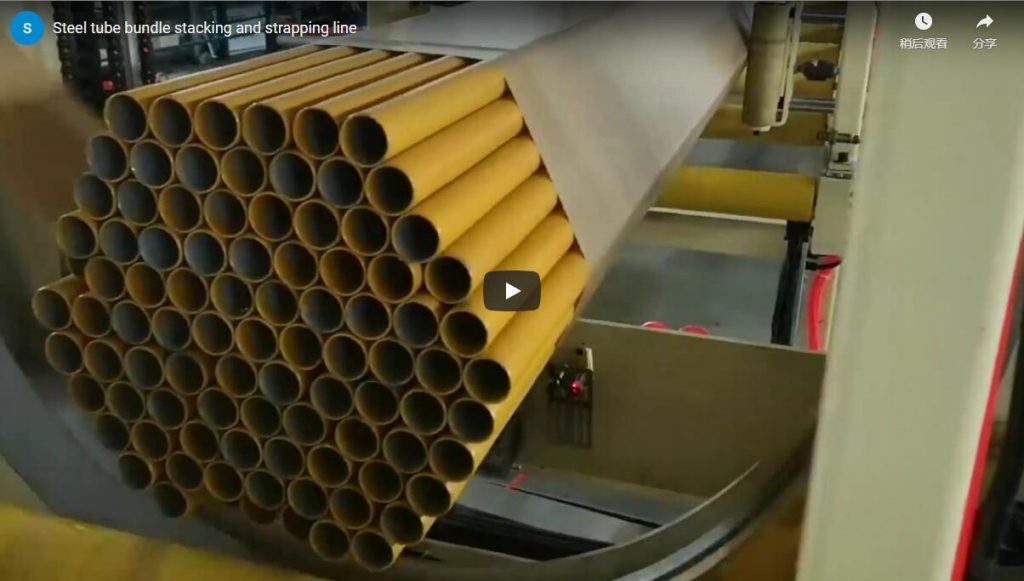
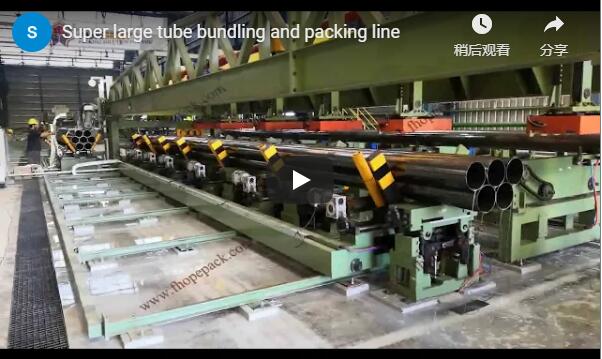
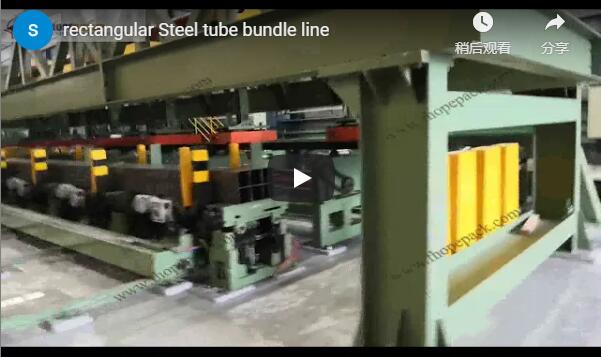
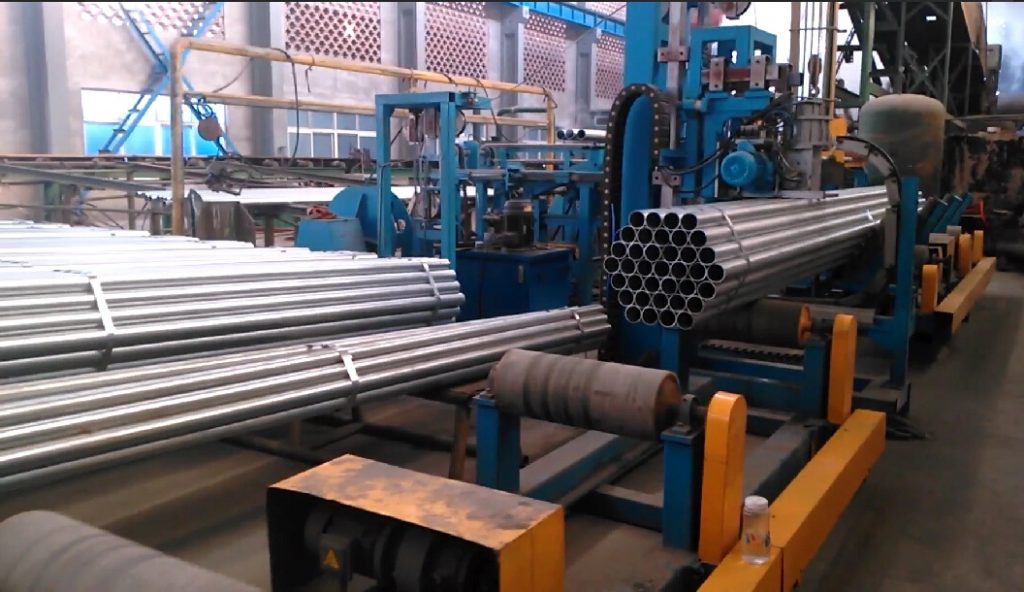
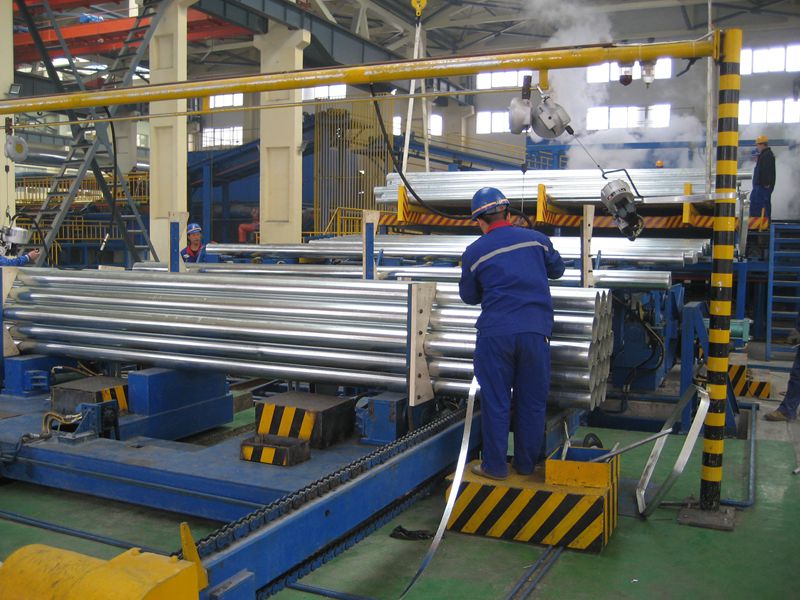
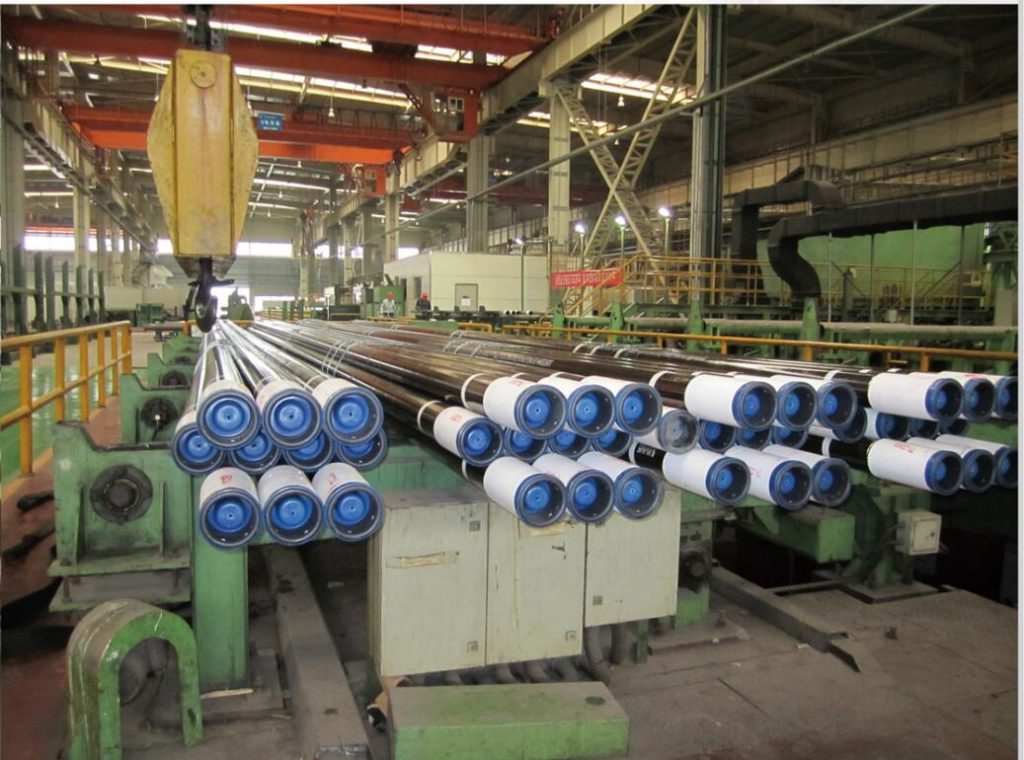
Executive summary In this clip a bundle of square steel tubes runs through our automatic strapping station, with timber blocks set at the strap positions. The yellow strapping head in the blue arch clamps the bundle and bands it at one position. The conveyor advances and the next band goes on, so each strap holds the tubes and a timber block together. Below we explain why the blocks go in at strapping, the cycle in the clip, our strap data and how to size the band.
Table of Contents
- What the clip shows
- Why strap timber blocks into the bundle
- Strap and head data
- Band length with a block
- Selection checklist
- Safety
- Engineering FAQ
- Next step
- Related reading
- Sources
What the clip shows
| Clip time | Step | What happens |
|---|---|---|
| 0–16 s | Infeed | The square tube bundle arrives on the blue conveyor and is centred; the timber block is already at the strap position; the strap reel stands beside the arch |
| 20–28 s | Clamp | The yellow head comes down over the middle of the bundle and clamps it |
| 32–48 s | Strapping | The strap is fed round bundle and block, tensioned and sealed; the conveyor advances and the next band goes on behind the first |
| 52–56 s | Release | After the last band the head lifts and the bundle moves on to the outfeed |
Later shots show the arch from the side and the control cabinet with its touch panel next to the line.
Why strap timber blocks into the bundle
A bundle of square tubes lies flat on flat. Without spacers there is no gap for forks or slings, and stacked bundles press tube on tube. Strapping a timber block in at each strap position fixes that at the source:
- Lifting space. The block raises the bundle so forklift forks or slings go under it without hitting the tubes.
- Stacking. Blocks carry the load of the bundle above, not the tube walls.
- No loose dunnage. The block is held by the same steel band as the tubes, so it cannot slide out in transit.
- One pass. Bundling, block placing and strapping happen at one station, with no extra handling. On a full steel tube bundle packing line this station sits after bundle forming.
Strap and head data
Our steel tube bundle strapping machine runs with this data:
| Item | Published value |
|---|---|
| Strap material | Cold-rolled low-carbon steel, blued and waxed |
| Strap thickness | 0.8 mm or 1.0 mm |
| Seal width | 25 mm or 32 mm |
| Strap tension | 7,000–18,000 N |
| Feed and take-up | 2–3 m/s |
| Tension speed | 6 m/min |
| Hydraulic pressure | 100 bar (work pressure 80–90 bar) |
| Straps per bundle | 5 to 7 |
Band length with a block
For a square or rectangular bundle on a timber block, the band runs round the bundle and the block. Band length ≈ 2 × (W + H + h), where W is bundle width, H bundle height and h block height.
Worked example (illustrative). A bundle 400 mm wide and 300 mm high on a 100 mm block: 2 × (400 + 300 + 100) = 1,600 mm of strap per band, before the seal overlap. With 5 bands that is about 8 m of strap per bundle.
Selection checklist
- Tube size, wall thickness and length.
- Bundle width, height and weight.
- Timber block size and who supplies the blocks.
- Block placing: by the operator or by an automatic feeder.
- Straps per bundle and their positions.
- Strap thickness and seal width you buy today.
- How bundles are lifted and stacked after the line.
Safety
The head clamps with force and the strap is tensioned up to 18,000 N. While the line runs, the strapping zone is closed off and blocks are placed only with the head parked. Hydraulic work is done with the system stopped and pressure released.
For CE markets we apply ISO 12100 for the risk assessment and EN 415-10 for general packaging-machine requirements.
Engineering FAQ
Q: Why put the timber block in at strapping? A: The band then holds tubes and block together, so the bundle leaves the line with lifting space and no loose dunnage.
Q: Is the block inserted by the machine? A: In the clip the block is already in place when the head closes. Automatic block feeding can be added; tell us the block size.
Q: How tight is the strap? A: We set the hydraulic strapping head within its 7,000–18,000 N tension range to suit the tube wall and bundle.
Q: How many bands go on a bundle? A: 5 to 7, placed along the bundle length as the conveyor advances.
Q: How long is each band? A: About 2 × (W + H + h); a 400 × 300 mm bundle on a 100 mm block needs about 1,600 mm.
Q: What strap and hydraulic supply does the head use? A: Cold-rolled low-carbon steel strap, blued and waxed, 0.8 mm or 1.0 mm thick; the hydraulic system is rated at 100 bar with 80–90 bar work pressure.
Q: Which standards apply? A: For CE markets, ISO 12100 and EN 415-10.
Next step
We size a strapping station with timber blocks in three steps:
- Submit your layout drawing with tube size, bundle size, block size and bands per bundle, to info@fhopepack.com.
- Receive a proposal within 48 hours with the station layout and strap data.
- Book a site survey so we confirm the floor space, lifting and guarding.
Related reading
- Steel Tube Bundle Strapping with a Travelling Head
- Automatic Steel Tube Bundling and Strapping Solution
- Automatic Plasterboard Strapping Machine with Timber Feeding and Edge Protection
- Steel tube bundle strapping machine
Sources
- Machine in action (our footage): the video on YouTube
- Strap, seal, tension, speed, hydraulic and bands-per-bundle data: Steel tube bundle strapping machine
- Band length: our worked geometry from the values above
- Standards scope: ISO 12100:2010; EN 415-10:2014
- Proposal timing: approved house CTA (proposal within 48 hours)
Last reviewed: 2026-10-09