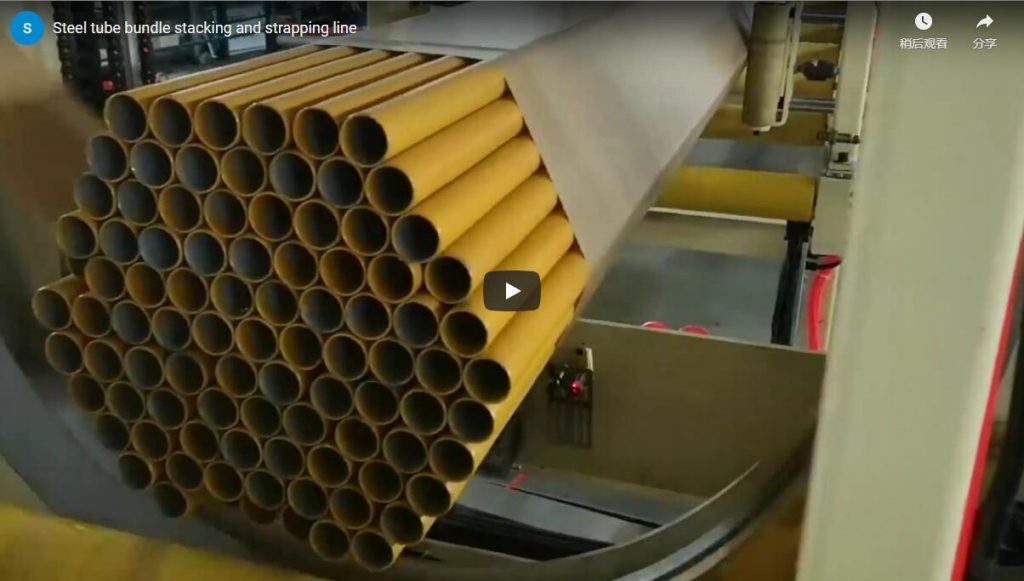
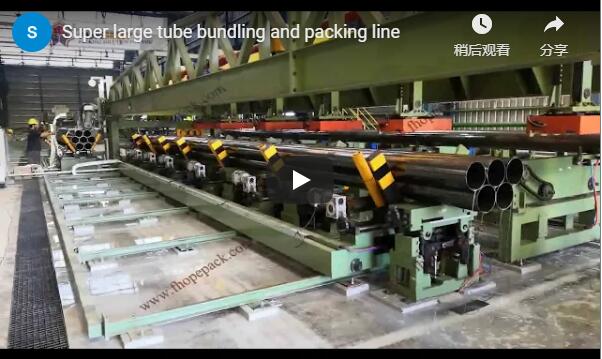
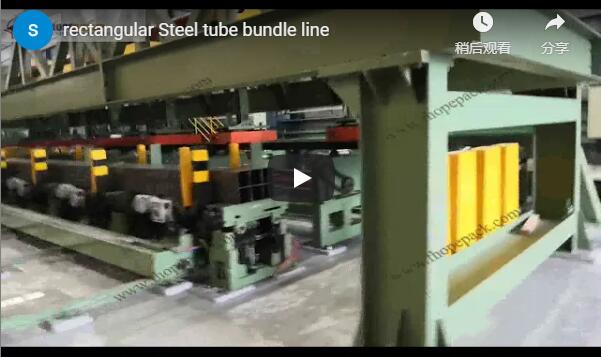
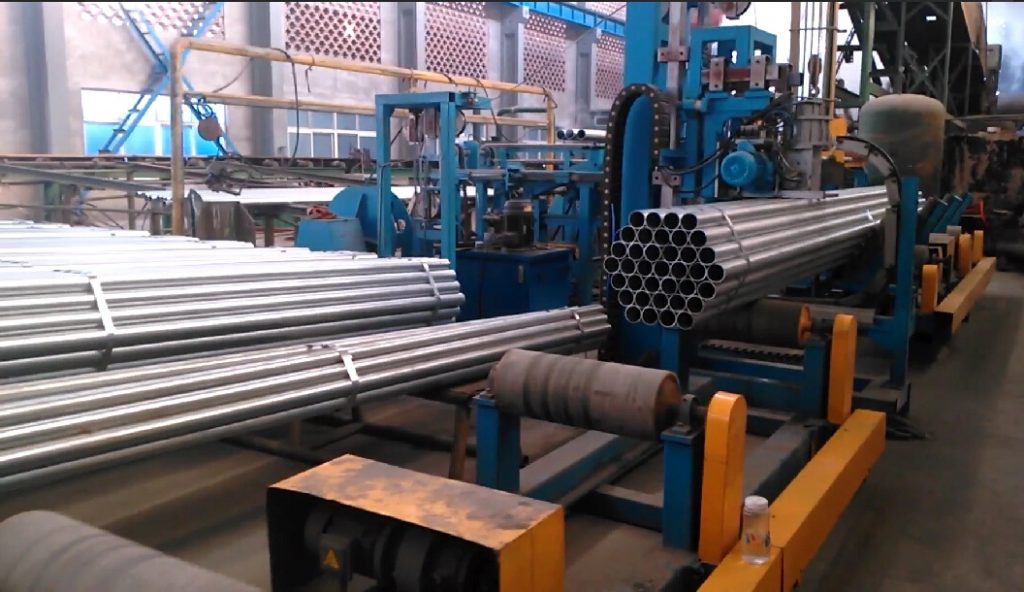
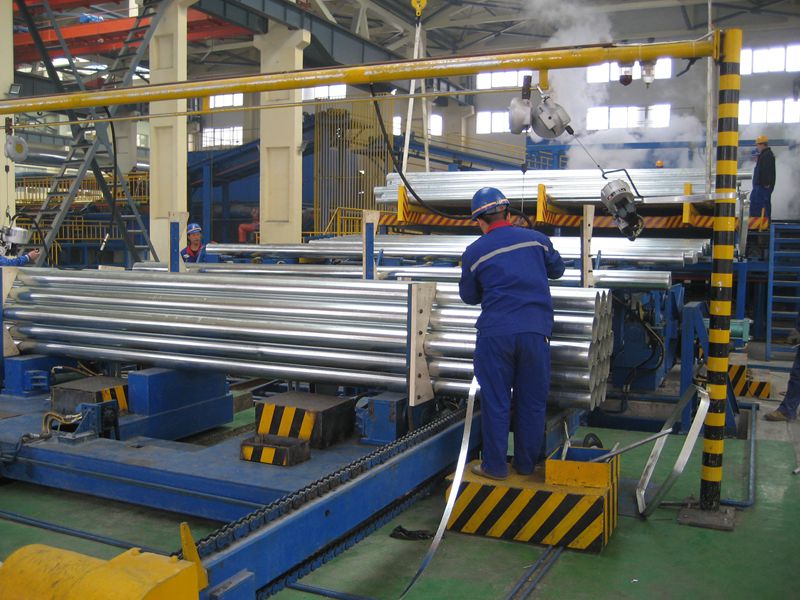
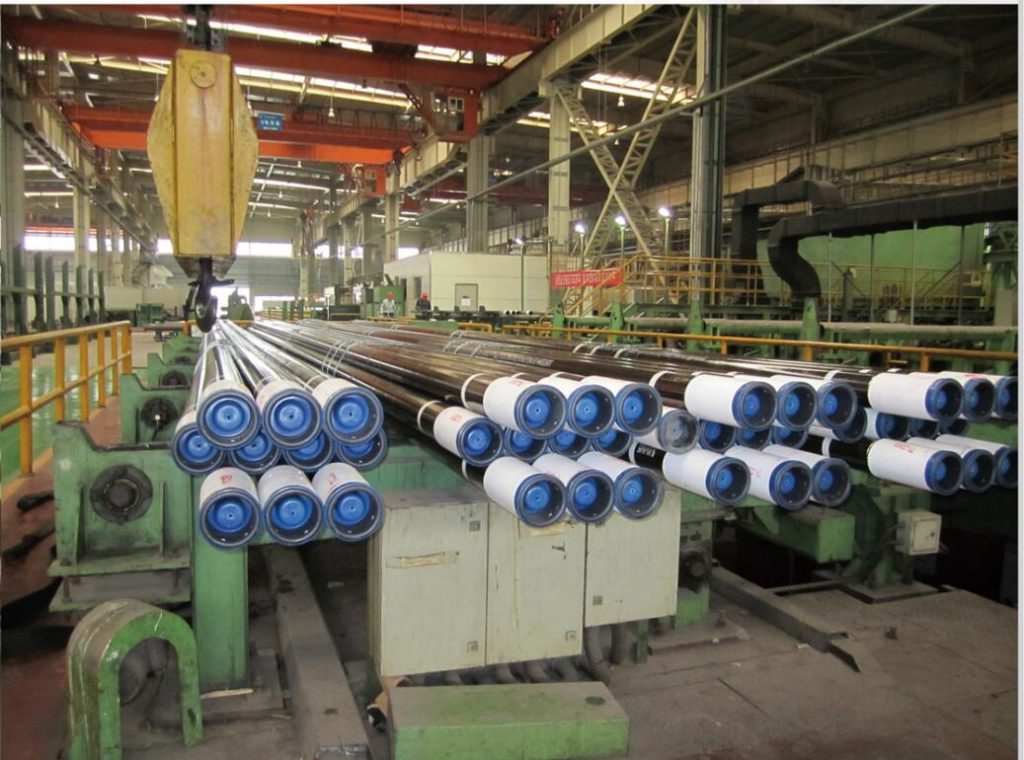
Executive summary This 55 s clip from our factory floor shows our steel tube bundle strapping machine banding a bundle of rectangular steel tube. A yellow strapping head on a vertical carriage comes down to the bundle, a blue steel strap is run round it, and the joint is closed with a crimped steel seal. The machine is fixed and the bundle moves through it, so each band lands at its own position along the bundle. Below we set out the cycle, our published strap and seal data, and a worked example for band count and strap use.
Table of Contents
- What the clip shows
- Why a seal joint on tube bundles
- Strap, seal and head data
- Band count and strap use
- Selection checklist
- Safety
- Engineering FAQ
- Next step
- Related reading
- Sources
What the clip shows
The clip is filmed in portrait and runs about 55 s.
| Time | What you see |
|---|---|
| Start | A square bundle of rectangular steel tube sits on a blue roller bed under the yellow strapping head |
| Early | The head travels down its vertical guides until it sits on the bundle |
| Middle | Close views of the head at the side of the bundle as the strap is tensioned and sealed |
| Middle | The bundle moves on along the rollers and the next band is set further along |
| End | Close-ups of a finished band: blue steel strap across the tube faces, closed by a crimped steel seal |
The footage is ours. Tension and cycle time are not on screen, so the figures below come from our machine data page.
Why a seal joint on tube bundles
- Heavy, rigid loads. A tube bundle is lifted by crane and stacked, so the band has to hold its tension through handling. A crimped seal locks the two strap ends together.
- Square bundle faces. Rectangular tube packs flat, and the band pulls the outer tubes tight against the inner ones, so the bundle keeps its shape.
- Painted or coated strap. The seal grips mechanically, so it does not depend on the strap surface.
- Fixed head, moving bundle. Because the head stays in one place, the band spacing is set by how far the bundle moves between cycles.
Strap, seal and head data
Our published data for the automatic steel strapping head:
| Item | Published value |
|---|---|
| Strap material | Cold-rolled low-carbon steel, blued and waxed |
| Strap thickness | 0.8 mm or 1.0 mm |
| Seal width | 25 mm or 32 mm |
| Joint | Double seal notch |
| Seal magazine | About 180 seals |
| Strap tension | 7,000–18,000 N |
| Feed and take-up | 2–3 m/s |
| Tension speed | 6 m/min |
| Hydraulic pressure | 100 bar (work pressure 80–90 bar) |
| Bands per bundle | 5 to 7, positioned by bundle length |
Every line is built to order, so the arch, roller bed and band positions follow your tube sizes and bundle length.
Band count and strap use
Band length depends on the bundle section. One band needs about 2 × (W + H) of strap, plus the seal overlap.
Worked example (illustrative). A bundle 400 mm wide and 400 mm high has a perimeter of 2 × (400 + 400) = 1,600 mm, so each band needs 1,600 mm of strap before the seal overlap. With 6 bands the bundle uses about 9.6 m of strap plus overlaps, and 6 seals. With a 180-seal magazine, that is about 30 bundles before the magazine is refilled.
Selection checklist
- Tube shape (round, square, rectangular) and size range.
- Bundle section, length and weight.
- Bands per bundle and their positions.
- Strap width (25 mm or 32 mm seal) and thickness.
- Bundles per hour.
- Upstream bundle forming and downstream stacking, such as a steel tube bundle strapping line with a travelling head.
Safety
The head travels down onto the bundle and the strap is tensioned up to 18,000 N. We guard the head and roller zone to the risk assessment, so nobody reaches into the strap path while the machine runs. Hydraulic work is done with the system stopped and pressure released.
For CE markets we apply ISO 12100 for the risk assessment and EN 415-10 for general packaging-machine requirements.
Engineering FAQ
Q: How is the strap joint closed? A: With a steel seal crimped by a double seal notch, fed from a magazine of about 180 seals.
Q: Which seal widths do you supply? A: 25 mm or 32 mm, to match the strap width.
Q: How tight is the band? A: Strap tension is set within 7,000–18,000 N.
Q: How many bands go on one bundle? A: Our data gives 5 to 7 bands, positioned by bundle length.
Q: How much strap does one band use? A: About 2 × (W + H) plus the seal overlap; a 400 × 400 mm bundle uses about 1,600 mm per band.
Q: Does the head move along the bundle? A: No. The head is fixed and the bundle moves on the roller bed between bands, so band spacing is set by the bundle travel.
Q: How often is the seal magazine refilled? A: A 180-seal magazine covers about 30 bundles at 6 bands per bundle.
Q: How fast are strap feed and tensioning? A: Feed and take-up run at 2–3 m/s, and tensioning at 6 m/min.
Q: What hydraulic pressure does the head use? A: The system is rated at 100 bar, with a work pressure of 80–90 bar.
Q: Which standards apply? A: For CE markets, ISO 12100 and EN 415-10.
Next step
We size a steel tube bundle strapping machine in three steps:
- Submit your layout drawing with tube sizes, bundle section and length, bands per bundle and bundles per hour, to info@fhopepack.com.
- Receive a proposal within 48 hours with the arch size and strap data.
- Book a site survey so we confirm the floor space and line links.
Related reading
- Steel Tube Bundle Strapping with Timber Blocks
- Automatic Steel Tube Bundling and Strapping Solution
- Steel Sheet Bundle Strapping Machine with Hold-Down Head
- Steel tube bundle strapping machine data
Sources
- Clip (our footage): the video on YouTube
- Strap, seal, tension, speed, hydraulic and band-count data: Steel tube bundle strapping machine data
- Strap use: our worked arithmetic
- Standards scope: ISO 12100:2010; EN 415-10:2014
- Proposal timing: approved house CTA (proposal within 48 hours)
Last reviewed: 2026-10-10