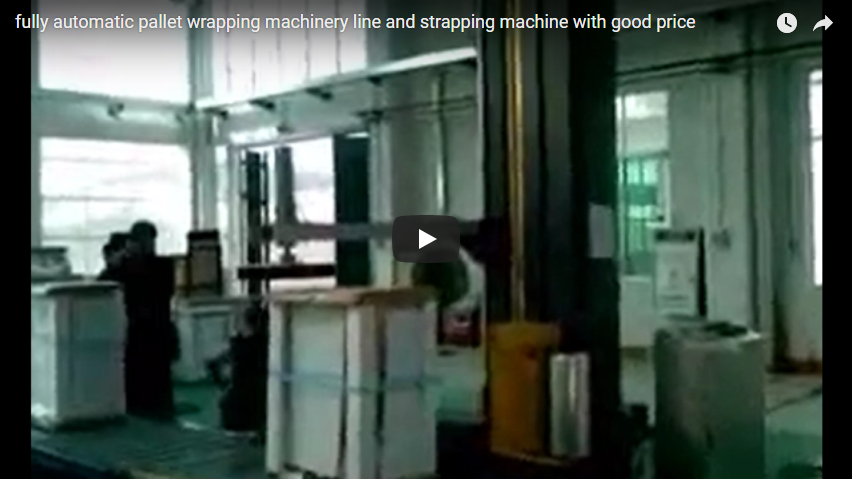
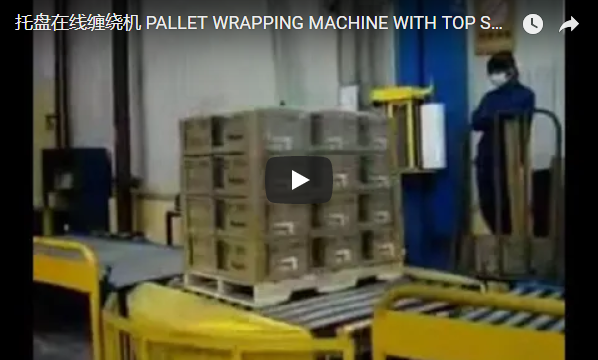
Executive summary A pallet wrapping machine with a top press lowers a platen onto the top of the load and holds it down while the turntable spins, so tall, light or unstable stacks do not shift or tip under film tension. In this clip the press comes down at about 9 s, the load is wrapped until about 30 s, and the press is back up by about 33 s. Our A600 pallet stretch wrapper carries a top press device driven by a motor or a pneumatic cylinder, configured per project.
Table of Contents
- What the clip shows, in order
- What the top press does
- Wrapping cycle time on the clip
- Takt check
- Selection checklist for a top press pallet wrapper
- Controls and safety
- Engineering FAQ
- Next step
- Related reading
- Sources
What the clip shows, in order
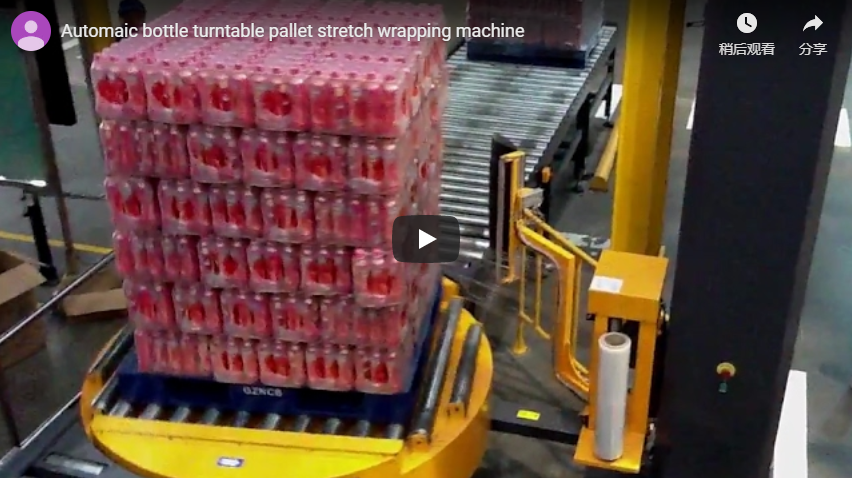
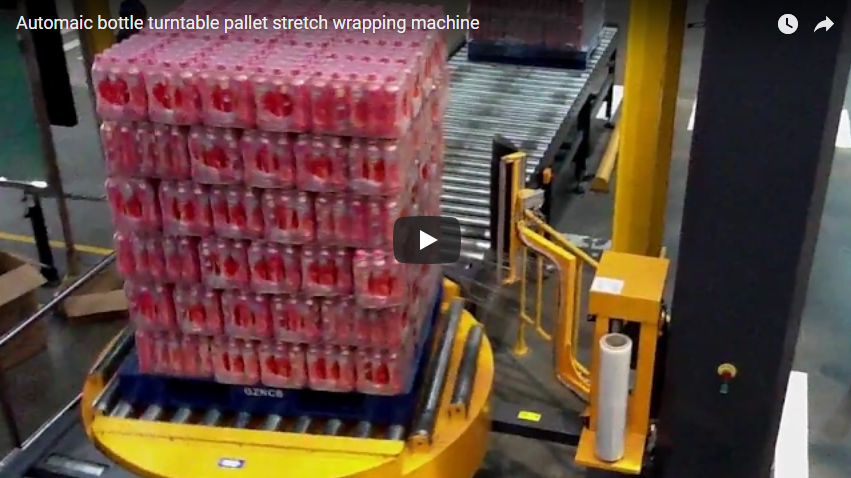
The machine has a tall dark-grey mast on the left, carrying the control panel and a yellow film carriage housing, a horizontal arm across the top with the press device, and a yellow round turntable. A loaded pallet stands on the turntable.
- 0 to about 6 s. The pallet sits on the turntable and nothing moves.
- About 9 to 18 s. The top arm lowers the press device onto the top of the load and presses it down. The turntable starts to turn.
- About 21 to 30 s. The press stays down while the turntable keeps turning, and the stretch film builds up tightly on the sides of the load.
- About 33 s. The press device has risen back to its top position, while the turntable is still turning slowly and the load is covered in several layers of film.
A person moves about in the background, away from the machine, throughout the clip. The times are read from frames 3 s apart, so each step boundary falls somewhere inside the 3 s gap between two listed times.
What the top press does
Film tension pulls sideways on a load every time the turntable comes round. A heavy, square stack resists that pull. A tall, light or loose load does not: empty containers, chairs, cans, foam or small cartons can lean, shift or topple before the film has built up enough to hold them.
The top press solves that with a platen lowered onto the top of the load before wrapping starts. It holds the stack against the pallet until the film has taken over, then lifts clear. Our A600 does this with a motor or a pneumatic cylinder, and the press plate shape is chosen for the load.
| Load type | Why a top press helps |
|---|---|
| Tall, light stacks | Keeps the stack upright under film tension |
| Loose items such as chairs or cans | Holds them in place until the film binds them |
| Slippery layers | Stops layers sliding against each other |
Wrapping cycle time on the clip
| Step on the clip | Time window | Duration |
|---|---|---|
| At rest | 0 to about 6 s | about 6 s |
| Press down, turntable starting | about 9 to 18 s | about 9 s |
| Wrapping with the press down | about 21 to 30 s | about 9 s |
| Press back up | by about 33 s | about 3 s |
| Press down to press up | about 9 to 33 s | about 24 s |
Most of the press time overlaps with wrapping, so the press itself adds little to the cycle: only the lowering before the turntable starts and the lift at the end.
Takt check
For an illustrative target of 40 pallets per hour, the takt is 3,600 ÷ 40 = 90 s per pallet. The press-down to press-up window on the clip is about 24 s. The wrap programme sets the rest: the number of bottom, middle and top wraps, the carriage speed and any re-wrap. Add the fork-lift time for putting the pallet on and taking it off, and check the total against 90 s.
Selection checklist for a top press pallet wrapper
- Load height, footprint and weight, with the pallet.
- How stable the load is without support, and which layers move.
- Press drive: motor or pneumatic cylinder, and the air supply if pneumatic.
- Press plate size and shape to suit the top of the load.
- Wrap programme: bottom, middle and top wraps, film type.
- Output per hour and the loading method.
Controls and safety
The turntable, the film carriage and the space under the descending press are the danger zones. In the clip the person in the background stays well away from the turntable. Keep everyone out of the turntable area while the machine runs, and never reach between the press plate and the load. Stop, isolate and lock out the machine before anyone adjusts the load, changes the film or works under the raised press.
The standards that apply depend on the destination market. For CE markets, EN 415-6 covers pallet wrapping machines and ISO 12100 sets the risk-assessment method, which fixes guarding and the emergency-stop arrangement.
Engineering FAQ
Q: When does a pallet wrapper need a top press? A: When the load is tall, light or loose enough to move under film tension, for example chairs, cans or small cartons. The press holds it down until the film binds it.
Q: How is the top press driven? A: On our A600 the press device is driven by a motor or by a pneumatic cylinder; the pneumatic option needs a compressed air supply at the machine.
Q: Does the top press slow the cycle? A: Only slightly. On the clip the press is down from about 9 s to about 30 s, overlapping the wrap, and is back up by about 33 s.
Next step
We size a top press pallet wrapper in three steps:
- Submit your layout drawing with the load height, footprint, weight, load type and output target, to info@fhopepack.com.
- Receive a proposal within 48 hours, including the press drive, the press plate and the cycle check against your takt.
- Book a site survey so we confirm the floor space, the loading method and the air or power supply.
Related reading
- A600 pallet stretch wrapper with top press device
- Semi-automatic pallet wrapping machines
- Semi-automatic rotary arm pallet stretch wrapper
- Semi-automatic orbital wrapper for long profiles
Sources
- Top press device and drive options: A600 pallet stretch wrapper product page
- Clip timing: frame timings taken from the clip, 3 s between frames
- Machine in action: our video on YouTube
- Standards scope: ISO 12100:2010, EN 415-6:2013
Last reviewed: 2026-10-05