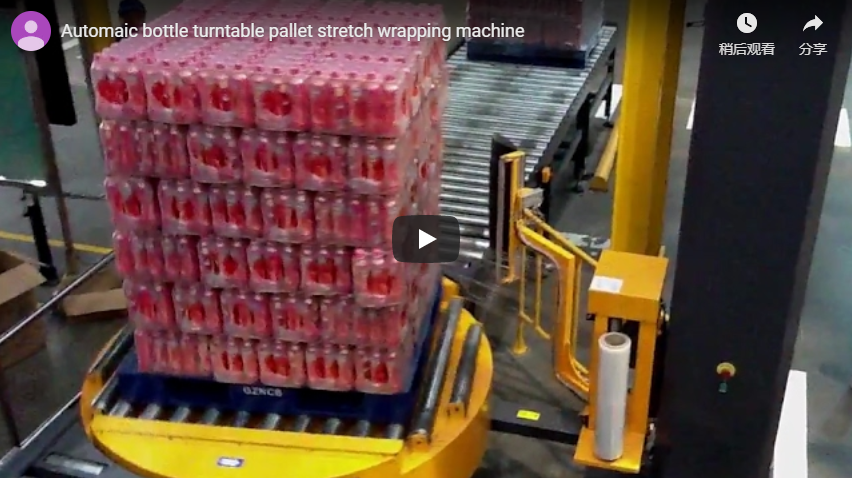
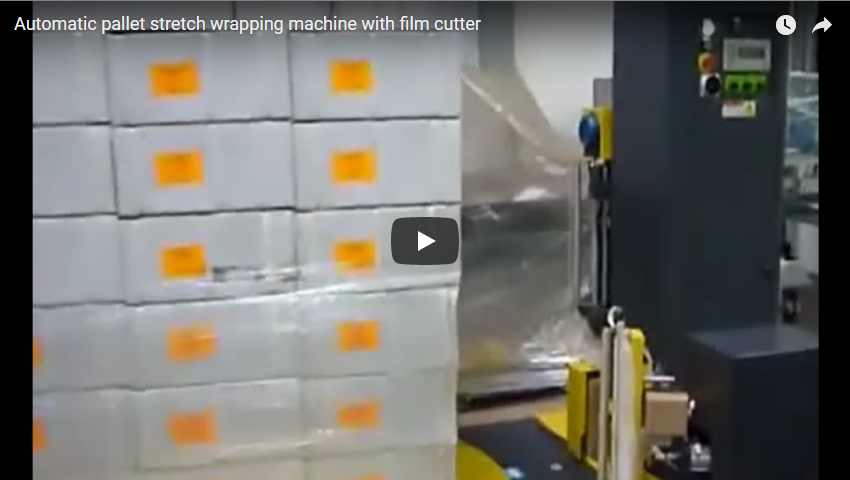
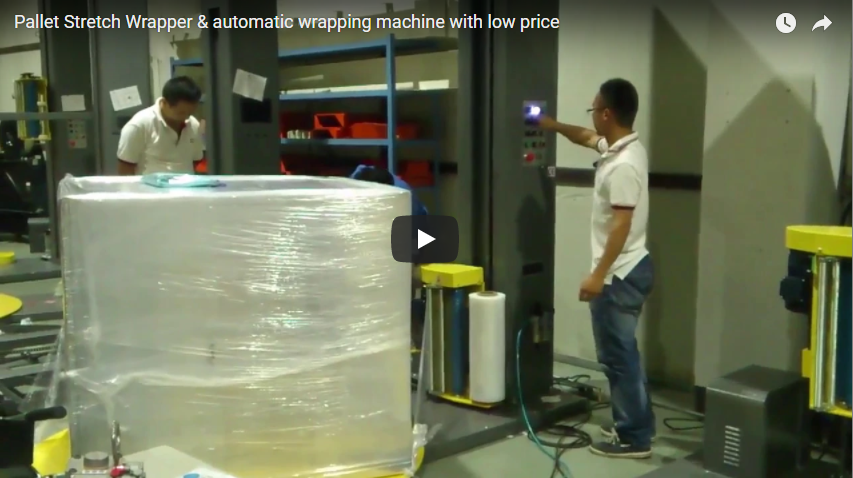
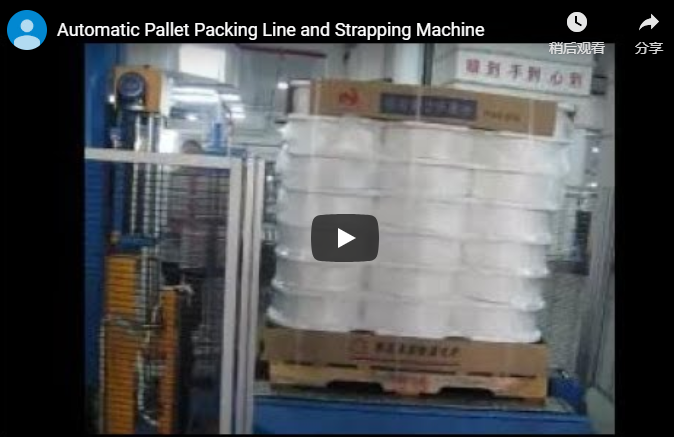
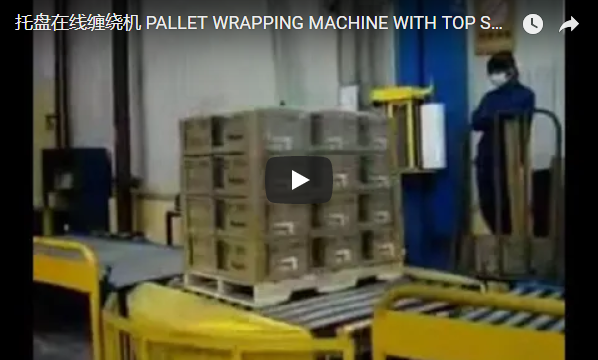
Executive summary Our A600 vertical turntable pallet wrapper with a top press wraps more than square pallets. A top press device comes down onto the load and holds it still while the turntable turns and the carriage wraps. That lets the same machine wrap cable and yarn rolls, stacked chairs, canned food and ordinary pallets. A worked example wraps a large roll and checks it against our A-series turntable data.
Table of Contents
- Why awkward loads need a top press
- The A600 top press device
- Wrapping cycle with the press
- A600 features and A-series reference data
- Worked example: a large cable roll
- Selection checklist: what to send us
- Safety and EN 415-6
- Engineering FAQ
- Next step
- Related reading
- Sources
Why awkward loads need a top press
A square pallet of cartons sits firmly on a turntable. A round roll, a stack of chairs or a light, tall load does not. As the turntable turns, the film pulls on the load at each pass. A round or light load can rock, slide or turn on its base before the film has hold of it.
The A600 solves this from above. Its top press fixes the load against the turntable, so it turns as one with the table and keeps its shape while the film goes on.
The A600 top press device
The press is driven by a motor or by a pneumatic cylinder, chosen for your site. Its contact plate comes in different shapes, so it can sit flat on a pallet, centre on a roll or bear on the top of a chair stack. The press face is made of durable material that protects the load from scratches.
The press also keeps the operator’s hands away from the load during wrapping. We redesigned wearing parts with a special bearing to cut friction between washers and bolts, for a longer service life.
Wrapping cycle with the press
- Load. A forklift sets the load on the turntable, centred under the press.
- Press. The top press lowers until it holds the load.
- Wrap. The turntable turns while the carriage climbs and descends. The control sets the turns at the bottom, middle and top.
- Release. The press lifts, and the operator cuts and tucks the film tail.
The automatic control system runs the press, turntable and carriage through the whole wrap from one start. Film tie-on and cutting stay with the operator on the A600. Our A400 adds an automatic film cutting device where you need hands-off cutting.
- Unload. The forklift takes the wrapped load away.
A600 features and A-series reference data
The A600 adds the top press to our A-series turntable wrapper. Its turntable and carriage figures are confirmed per order. For reference, our A300 data sheet lists:
| Item | A300 reference |
|---|---|
| Maximum load size | 1,500 × 1,500 mm footprint |
| Minimum load size | 500 × 500 × 500 mm |
| Maximum load height | 1,800 mm |
| Maximum weight | 2,000 kg |
| Turntable speed | 13 r/min, adjustable by inverter |
| Pre-stretch | 250%, optional 100% to 300% |
| Stretch film | LLDPE, 500 mm wide, 0.025 mm, 76 mm core |
| Extra wraps | 0–99 at bottom, middle and top |
| Output | 20–40 loads per hour |
| Power supply | 220 V, 1 phase, 50 Hz |
The top press reduces the clear height above the load, so tell us your tallest load.
Worked example: a large cable roll
Take a cable roll 1,200 mm in diameter and 1,000 mm high, standing on end and weighing 800 kg. These are illustrative customer figures, inside the 1,500 × 1,500 mm footprint and 2,000 kg limit.
Film per turn. A round load’s perimeter is π × D, so each turn lays π × 1.2 = 3.77 m of film.
Turns. At 50% overlap, 500 mm film climbs 250 mm per turn. Up and down the roll is 1,000 ÷ 250 × 2 = 8 turns. With 2 extra turns at the bottom and 2 at the top, that is 12 turns.
Film. 12 × 3.77 = 45 m of film goes on the roll. At 250% pre-stretch, 45 ÷ 3.5 = 12.9 m leaves the roll.
Wrap time. At the reference speed of 13 r/min, 12 turns take 12 ÷ 13 × 60 = 55 s. Add the press stroke, the film cut and the forklift trips at your site.
Selection checklist: what to send us
- Each load type: shape, size and weight.
- The tallest load, including any pallet.
- Whether a motor or pneumatic press suits your site.
- The press plate shape your loads need.
- Loads per hour.
- Power supply and compressed air.
Safety and EN 415-6
We build the A600 to EN 415-6 for pallet wrapping machines, with an ISO 12100 risk assessment. The turntable, the carriage and the descending press are the hazard points; the press stroke is a crush point, so hands stay clear of the load top while it moves. The press holds the load so no one needs to steady it by hand. A red mushroom-head emergency stop and a lockable electrical disconnect are fitted, and we add guarding to suit your floor.
Engineering FAQ
Q: Can one machine wrap pallets and rolls? A: Yes. With a suitable press plate, the A600 wraps both.
Q: Motor or pneumatic press? A: Either drive works. A pneumatic press needs compressed air at site; a motor press does not.
Q: Does the press mark the load? A: The press face is made of durable material chosen to protect products from scratches.
Q: Which safety standards apply? A: For CE markets, EN 415-6 applies to the wrapper and ISO 12100 to its risk assessment.
Next step
- Email the shapes, sizes and weights of your loads to info@fhopepack.com.
- We reply within 24 hours with a proposal, including the press drive and plate shape.
- We send a drawing of the machine with your tallest load in place.
Related reading
- A600 pallet stretch wrapper with top press device
- A300 pallet stretch wrapping machine
- Online pallet wrapper with top press
- Height pallet packing machine with top press device
- Turntable stretch wrapper B200
- Inline turntable pallet wrapper
Sources
- Specifications: FHOPE A600 top press pallet wrapper and A300 pallet stretch wrapping machine product pages
- Machine video: vertical pallet wrapper for multipurpose use on YouTube
- Film and time: our worked example, illustrative roll figures
- Standards: EN 415-6 (pallet wrapping machines); ISO 12100:2010
Last reviewed: 2026-10-17