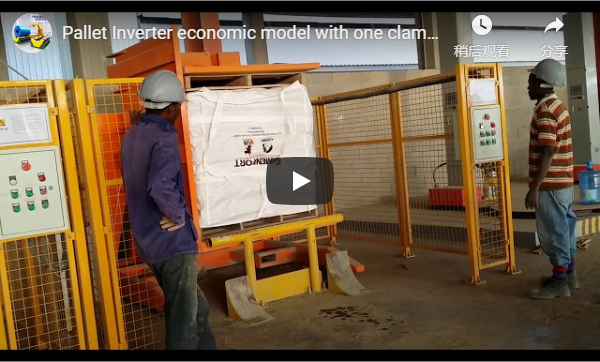
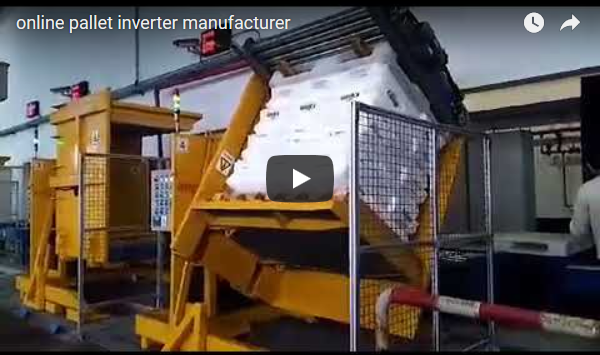
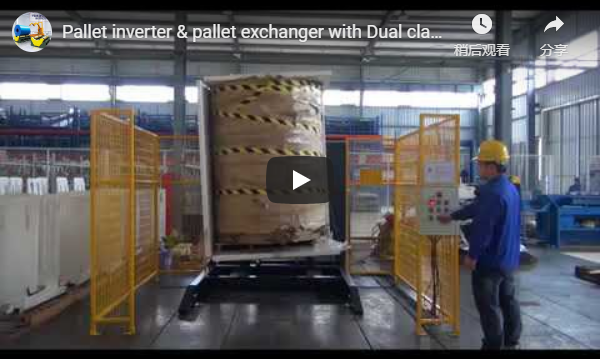
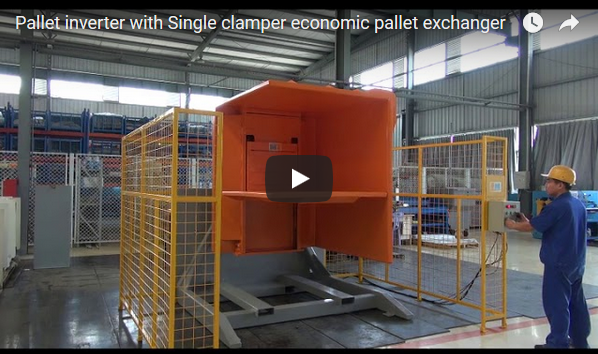
Executive summary A load of glass bottles cannot be restacked by hand, so the pallet underneath is swapped by turning the whole load over. Our dual-clamp 180° pallet changer clamps the load from above and below, between two pallets, and turns it 180 degrees. The new pallet then sits underneath and the old one is lifted off the top. Our FPFZ-1 180° inverter turns loads up to 1.2 t in about 50 s, and frame size and clamping are configured per project.
Table of Contents
- What the video shows
- Why the top pallet goes on first
- Glass bottle loads
- Cycle time
- 180° inverter data
- Utilities and safety
- Selection checklist
- Engineering FAQ
- Next step
- Related reading
- Sources
What the video shows
A tall, film-wrapped load of glass bottles stands in the grey turning frame with a blue plastic pallet underneath and a second blue pallet on top. The frame clamps the two pallets together and turns the load over through 180 degrees, so the pallet that was on top ends up underneath.
A black mesh fence with a door guards the turning area. Spare blue plastic pallets and wooden pallets are stacked beside the machine.
The bottles do not move against each other during the turn because the clamp holds the whole stack between the two pallets.
Why the top pallet goes on first
| Sequence | What happens | Turns |
|---|---|---|
| New pallet on top, then turn | The new pallet ends up underneath, the old one on top is lifted away | 1 |
| Turn, lift off old pallet, place new one, turn back | Goods end upright on the new pallet | 2 |
Putting the new pallet on top first saves the second turn, but the goods end up upside down. Bottles that go straight to a depalletiser usually have to stand mouth-up, so that load needs the two-turn sequence, which doubles the turning time. One turn suits loads that can travel inverted.
Glass bottle loads
Glass bottles for a filling line often arrive in layers separated by sheets and wrapped in film. A wooden pallet from the supplier often has to come off before the load goes into a clean area. A 180° changer swaps it for a plastic pallet without restacking a single bottle. The pressing device is adjustable to the load height, so it clamps the stack firmly without crushing the top layer.
Cycle time
Illustrative one-turn cycle, with 60 s of forklift or pallet truck handling and 30 s to lift the old pallet off:
| Step | Time |
|---|---|
| Turning, about 50 s per turn | 50 s |
| Load in and out (illustrative) | 60 s |
| Old pallet off (illustrative) | 30 s |
| Total cycle | 140 s |
| Pallets per hour | about 26 |
The handling around the machine takes longer than the turn itself, so a conveyor feed raises output more than a faster turn would.
180° inverter data
| Item | FPFZ-1 |
|---|---|
| Turnover angle | 180° |
| Turnover capacity | Max. 1.2 t |
| Turnover time | About 50 s |
| Load size | L 1,200 × W 1,100–1,200 × H 1,200–2,000 mm |
| Fixing | Dead weight, no anchoring |
| Operation | Wireless remote control or control panel |
| Motor power | About 2.2 kW |
The machine in the video is built for its bottle load. Frame size, clamping and power are configured per project, so yours is sized to your heaviest and tallest pallet.
Utilities and safety
The turning speed is adjustable, and the machine starts and stops automatically. Mechanical and electrical stop blocks end the turn at the right position, and the electrical box is separate from the frame. In the video, a mesh fence with a door closes off the turning area.
The standards that apply depend on the destination market. For CE markets, ISO 12100 sets the risk-assessment method and EN 415-10 sets general requirements for packaging machines.
Selection checklist for a 180° pallet changer
- Pallet length and width, old and new.
- Load height, smallest to largest.
- Heaviest load.
- Can the goods travel upside down?
- Wood to plastic swap, or pallet-less loading.
- Pallets per hour needed.
- Forklift, pallet truck or conveyor feed.
Engineering FAQ
Q: Why put the new pallet on top before the turn? A: After the 180° turn it ends up underneath, so the swap takes one turn instead of two.
Q: How heavy a load can it turn? A: Our FPFZ-1 turns up to 1.2 t. Heavier frames are configured per project.
Q: How long does a turn take? A: About 50 s. In our example, a full one-turn swap takes about 140 s.
Q: Will the bottles shift during the turn? A: Not when the pressing device is set to the load height and the stack is clamped between the two pallets. Test the clamp setting on your own load first.
Q: Does it need a foundation? A: No. It is fixed by its own weight, so it needs a level floor but no anchor bolts.
Next step
We plan your pallet changer in three steps:
- Submit your layout drawing with your pallet sizes and load weights to info@fhopepack.com.
- Receive a proposal within 48 hours, with the frame size and cycle plan.
- Book a site survey to check the floor and pallet access.
Related reading
Sources
- FPFZ-1 data and features: 180° pallet inverter page
- Machine in action: our 180° pallet changer video on YouTube
- Configuration per project: FHOPE engineering team, 2026-10-04
- Standards scope: ISO 12100:2010, EN 415-10:2014
Last reviewed: 2026-10-04