Executive summary
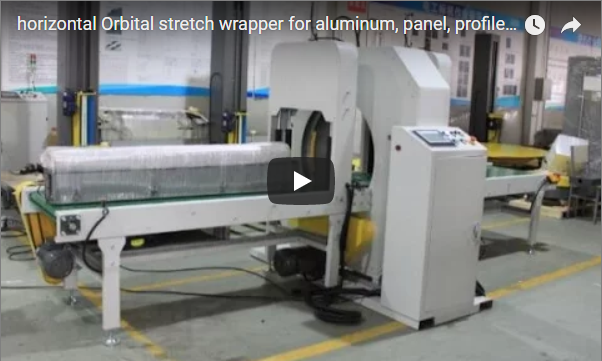
Partial film wrapping uses an orbital ring to put film bands at set points along a bundle instead of covering it end to end. The bands hold the bundle like straps, cost far less film, and leave the product visible and the ends open to air. Our horizontal orbital wrappers switch between full and partial wrapping by program, and wrap and cut the film automatically in both modes.
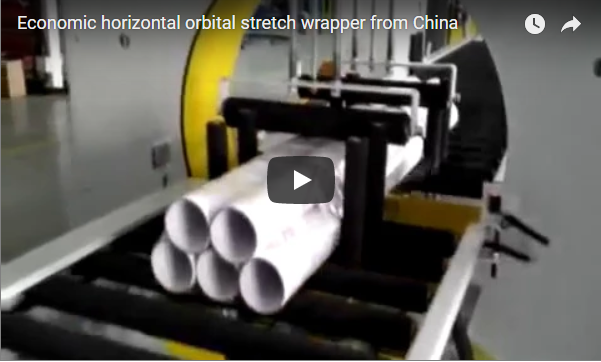
In this setup a bundle of seven stainless tubes, pre-tied and laid on a blue chain conveyor, stops at each band position. The yellow ring rotates a preset number of turns to apply a multi-layer, tensioned film band, and the conveyor then indexes the bundle to the next position.
Table of Contents
- What partial wrapping is
- Partial or full wrapping: when to use which
- How a partial wrapping cycle runs
- E500 orbital wrapper data
- Worked example: a 7-tube bundle
- Selection checklist
- Safety: EN 415-10 and ISO 12100
- Engineering FAQ
- Next step
- Related reading
- Sources
What partial wrapping is
In full wrapping the conveyor moves the bundle steadily through the turning ring, so the film runs in a spiral from end to end. In partial wrapping the conveyor stops the bundle at a set position. The ring lays several turns of film in one place to form a band, and the conveyor then moves on to the next position. The result is a bundle held by film bands, a film strapping.
Bands can also be placed only at the top and bottom of a stack, or at two points on a short pack. The positions and the number of turns per band are set in the program.
Partial or full wrapping: when to use which
| Point | Partial wrapping (bands) | Full wrapping (spiral) |
|---|---|---|
| Job | Holds the bundle together | Holds and protects the whole surface |
| Film use | A fraction of full wrap | Highest |
| Product visible | Yes, between bands | Through the film only |
| Moisture | Ends and gaps open to air | Sealed along the length |
| Replaces | Steel or PP straps | Straps plus a cover |
| Typical use | Tubes, bars and profiles kept indoors or shipped dry | Bundles stored outside or shipped by sea |
Film bands do not mark a polished tube the way a steel strap can, and they are cut off without a strap cutter. For outdoor storage, choose full wrapping or film covering.
How a partial wrapping cycle runs
- The bundle enters on the infeed conveyor; sensors find its front end.
- The conveyor stops with the first band position in the ring.
- The ring turns the set number of times to build the band.
- The conveyor indexes to the next band position. If the film stays attached, a roped film tail runs along the bundle between bands; if the program cuts and clamps after each band, every band stands alone. Which suits your product is confirmed at quote.
- After the last band the film is cut and the bundle leaves on the outfeed conveyor.
E500 orbital wrapper data
| Item | E500 |
|---|---|
| Bundle length | > 1,500 mm |
| Bundle OD | 200–500 mm |
| Bundle weight | 50–500 kg |
| Infeed / outfeed conveyor | 2,000 mm L × 700 mm W each |
| Conveyor speed | 3–12 m/min |
| Ring speed | approx. 10–60 r/min |
| Film | width 150–300 mm, roll OD 100–250 mm, core ID 50 mm |
| Air supply | 5–8 kgf/cm² (about 0.5–0.8 MPa) |
| Power | about 4.5 kW, AC 380 V 50 Hz 3 phase |
| Machine size | approx. L 5,200 × W 1,600 × H 1,800 mm |
Worked example: a 7-tube bundle
Take seven stainless tubes, 76 mm OD × 2 mm wall × 6,000 mm, packed in a hexagon, wrapped with 250 mm film. Stainless density is 7,930 kg/m³.
| Step | Calculation | Result |
|---|---|---|
| Bundle envelope | 3 × 76 | 228 mm |
| Tube mass per metre | π × 0.074 × 0.002 × 7,930 | about 3.7 kg/m |
| Bundle weight | 7 × 3.7 × 6.0 | about 155 kg |
| Fits E500? | > 1,500 mm; 200–500 mm; 50–500 kg | yes |
| Turn length | π × 0.228 | about 0.72 m |
| Partial: 4 bands × 3 turns | 12 × 0.72 | about 8.6 m film |
| Full: 50% overlap, 125 mm advance | 6,000 ÷ 125 = 48 turns × 0.72 | about 34.6 m film |
| Film saved | 1 − 8.6 ÷ 34.6 | about 75% |
Cycle time. Full wrapping at 60 r/min with a 125 mm advance needs 7.5 m/min, so the 6 m bundle takes about 48 s. Partial wrapping needs 12 ring turns, about 12 s at 60 r/min, plus about 30 s to index 6 m at 12 m/min, so about 42 s before stop and start time. The time is similar; the saving is in film.
Result. Four bands use about a quarter of the film of a full wrap. Note the size limit too: with 60 mm tubes the envelope would be 3 × 60 = 180 mm, below the E500’s 200 mm minimum, so a smaller wrapper is needed for that bundle.
Selection checklist
- Product: tube, bar or profile, and its surface.
- Bundle envelope, length and weight.
- Number of bands and their positions.
- Partial only, full only, or both by program.
- Storage: indoor, outdoor, sea freight.
- Bundles per hour and line connections.
Safety: EN 415-10 and ISO 12100
The wrapper is built to EN 415-10, the general safety requirements for packaging machines, with the risk assessment done to ISO 12100. The ring zone is guarded, and nobody reaches into the ring while the bundle is indexing.
Engineering FAQ
Q: Can the same machine do full and partial wrapping? A: Yes. The program is switched between full spiral wrapping and partial wrapping.
Q: Is the film cut automatically? A: Yes, in both partial and full wrapping.
Q: Can partial wrapping replace straps? A: For holding a bundle in dry conditions, yes. Heavy loads or crane lifting may still need straps, confirmed at quote.
Q: What size bundle does the E500 take? A: Over 1,500 mm long, 200–500 mm OD and 50–500 kg.
Next step
- Send your bundle size, weight and band layout to info@fhopepack.com.
- We match the wrapper and program to your bundles.
- We reply within 24 hours with a proposal and quotation.
Related reading
- E500 horizontal wrapping machine (product)
- E600 horizontal stretch wrapper (product)
- Stretch film strapping machine
- Aluminum horizontal wrapping machine with spacer feeder
Sources
- FHOPE product pages: E500 and E600 horizontal stretch wrappers
- FHOPE engineering replies on partial wrapping
- EN 415-10; ISO 12100:2010
Last reviewed: 2026-10-19