Executive summary Our turntable pallet wrapper with automatic film cutting wraps, cuts and finishes each load without the operator cutting film by hand. It takes loads up to 2,000 kg and 1,800 mm high, at 20–40 loads per hour. Pre-stretch at 250% turns 1 m of film from the roll into 3.5 m on the load. Bottom, middle and top layers are each set from 0 to 99 winds.
Table of Contents
- How the cycle runs
- Specifications
- Film use per load
- Wrap settings
- Cycle time and throughput
- When to move to a conveyor line
- Controls and safety
- Selection checklist
- Engineering FAQ
- Next step
- Related reading
- Sources
How the wrap cycle runs with automatic film cutting
On a standard turntable wrapper, the operator ties the film tail at the start and cuts it at the end of every load. Our machine adds an automatic film cutting device, so the operator only places the load and starts the cycle:
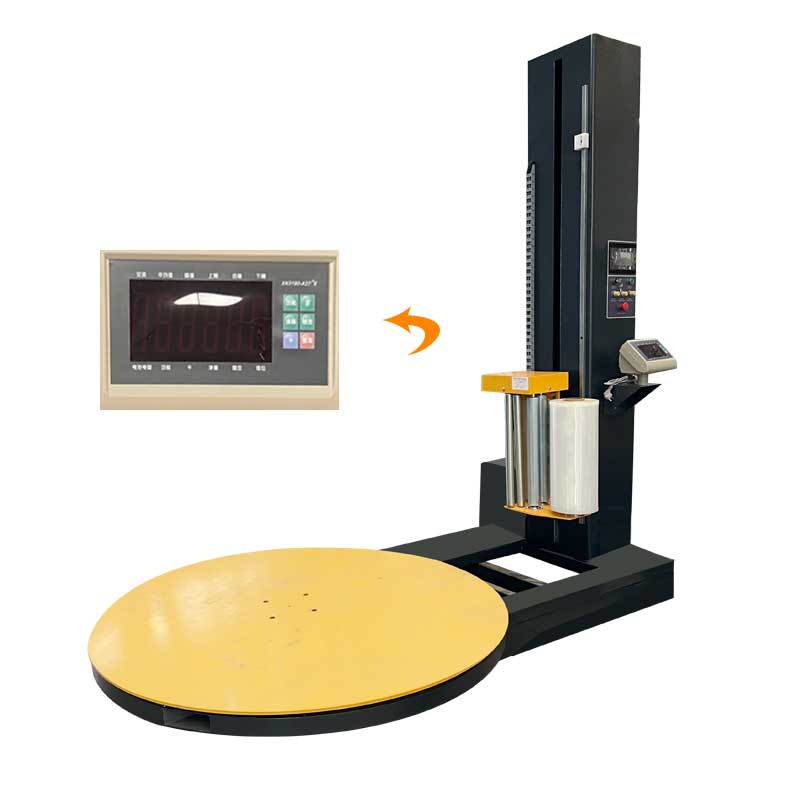
- Load. A forklift places the pallet on the turntable. The turntable is 100 mm high, and the machine can be moved by forklift from the front or rear.
- Measure. A photocell sensor detects the load height, so the carriage stops at the top of the actual load.
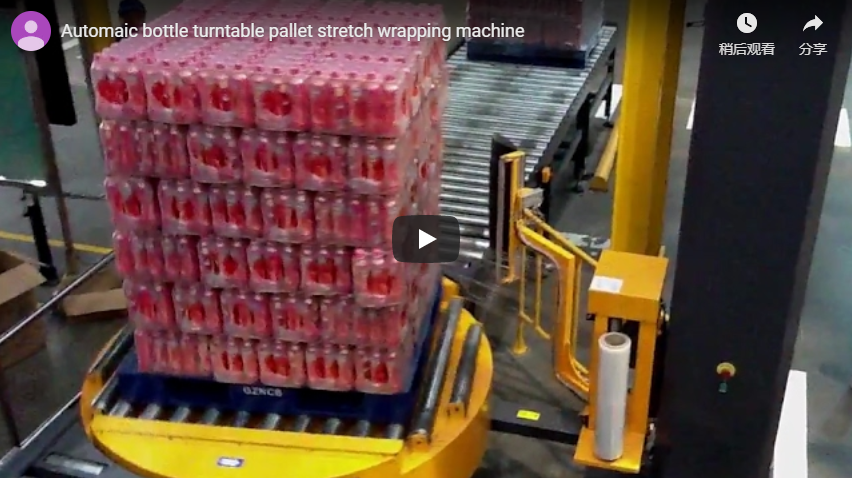
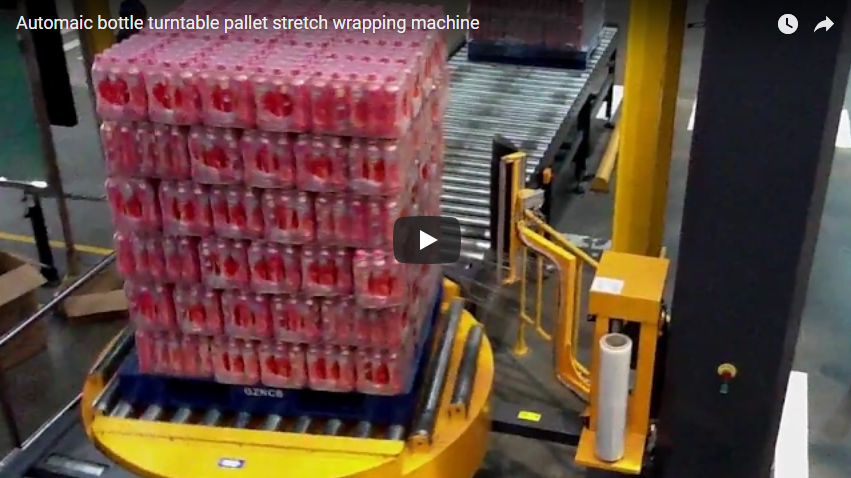
- Wrap. The turntable turns while the film carriage travels up and down the mast. The pre-stretch unit stretches the film before it reaches the load.
- Cut. At the end of the cycle the device cuts the film, so the load is ready to leave.
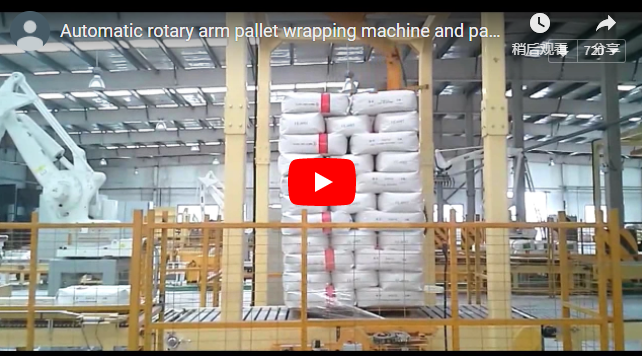
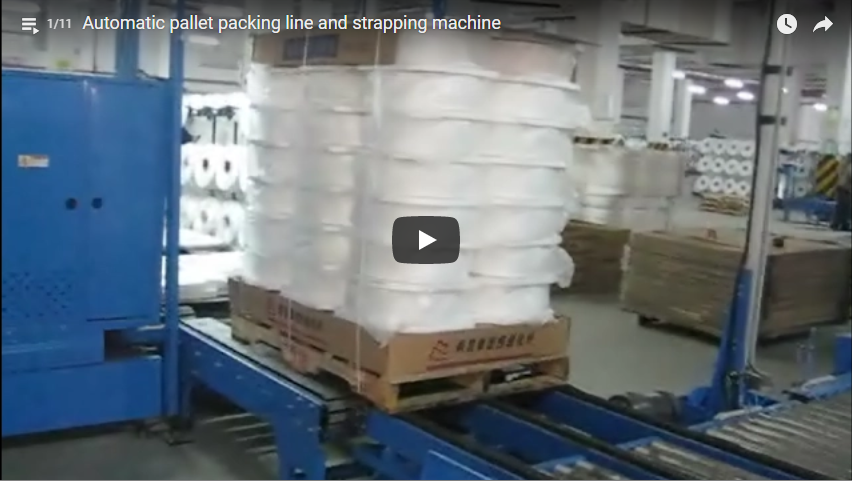
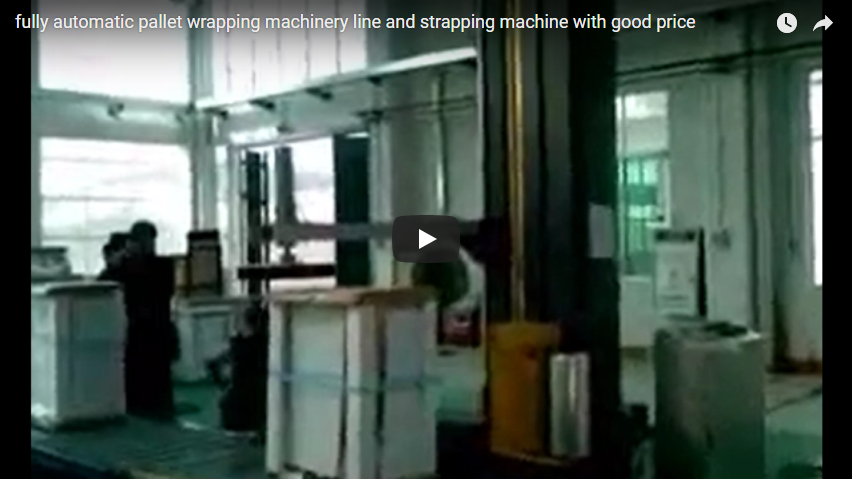
We built this machine so the operator never handles film during a cycle; the tall carton load in our video is wrapped from base to top and cut without anyone stepping onto the turntable.
Pallet wrapping machine specifications
| Parameter | Value |
|---|---|
| Load size | from 500 × 500 × 500 mm; diagonal within 2,000 mm |
| Max load height | 1,800 mm |
| Max load weight | 2,000 kg |
| Turntable | 2,000 mm diameter, 13 r/min (adjustable) |
| Film | LLDPE, 500 mm wide, 0.025 mm thick, 76 mm core |
| Pre-stretch | 250% (100–300% optional) |
| Power | 220 V, 1 phase, 50 Hz (adjustable) |
The load diagonal must fit inside the 2,000 mm maximum turning diameter. A 1,200 × 1,000 mm pallet has a diagonal of about 1,562 mm and fits with margin. The diagonal must also clear the mast and film carriage, so we confirm clearance for square or oversize loads.
Pre-stretch is set per project against the film gauge and puncture resistance you need. An extended mast is selected where load height exceeds 1,800 mm, and an oversized turntable where the load diagonal exceeds 2,000 mm. The turntable plate is 10 mm thick to resist deformation under heavy loads. Extended height and larger turntables are available.
Film use per load: what 250% pre-stretch saves
Pre-stretch of 250% means the film leaves the carriage 3.5 times longer than it came off the roll. An illustrative load shows the effect:
- Load perimeter. A 1,200 × 1,000 mm pallet has 2 × (1.2 + 1.0) = 4.4 m around it.
- Film per wind. 4.4 m ÷ 3.5 ≈ 1.26 m from the roll for each wind.
- Film per load. With 12 winds in total, the load takes about 12 × 1.26 ≈ 15 m from the roll.
- Loads per roll. A roll of 500–1,500 m covers roughly 33–100 loads at that rate.
Without pre-stretch, the same 12 winds would need about 53 m from the roll. Stretched film also narrows a little, so we set the overlap to keep full spiral coverage. We use your pallet size and wind settings to estimate film cost per load in the proposal.
Wrap settings for stable loads
The PLC stores the wrap pattern, and the operator sets it with separate buttons and the display:
- Layer winds. Bottom, middle and top layers are each set from 0 to 99 winds. More bottom winds tie the load to the pallet.
- Re-wrap. A re-wrap function adds a second pass where the load needs it.
- Overwrap and overlap. Both are adjustable, so the film covers the top edge and each spiral overlaps the last.
- Counters. Independent top, middle and bottom wrap counters, plus a total and a resettable cycle counter.
Cycle time and throughput
The machine wraps 20–40 loads per hour. At 13 r/min, the 12-wind example above takes 12 ÷ 13 ≈ 0.9 min of turntable time. Forklift loading and unloading take the rest of each cycle. That is why the range depends mostly on how fast loads arrive and leave.
When to move to a conveyor line
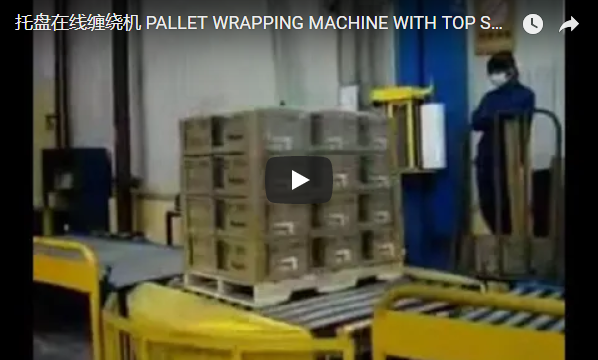
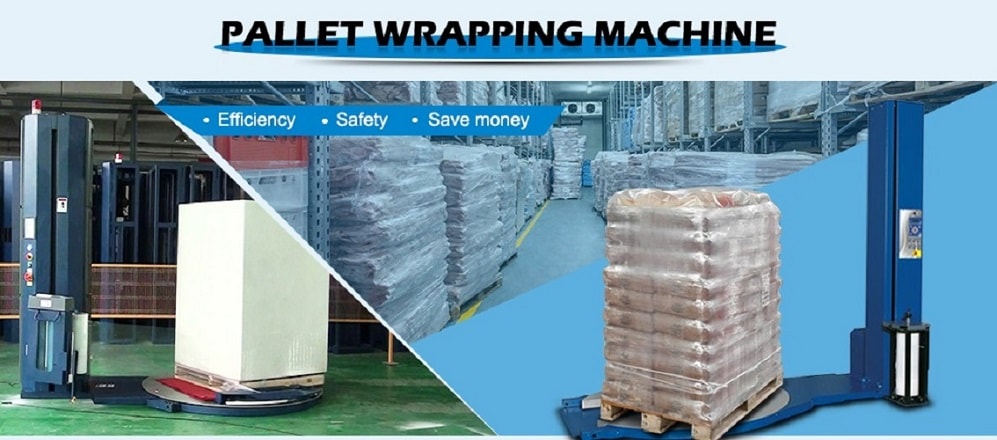
If forklift staging limits output, or you want the wrapper to run without an operator, our automatic B-series wrappers add infeed and outfeed conveyors. They are rated at a minimum of 24 loads per hour, fed straight from your production line. Their automatic mechanical hand clamps the film with scissors-like gripper bars, cuts it with an instant heating wire, and a soft brush wipes the tail onto the load.
Controls and safety
The machine runs on a PLC with a pre-stretch controller. Safety features include:
- Emergency stop. Red mushroom-head button.
- Electrical disconnect. Lockable.
- Film loading. A lock on the film carriage door, and a shut-off switch that cuts power in automatic mode when film is loaded.
The standards that apply depend on the destination market. For CE markets, ISO 12100 sets the risk-assessment method and EN 415-10 sets general requirements for packaging machines.
Selection checklist for a pallet wrapping machine with film cutting
- Largest and smallest load size, height and weight.
- Loads per hour, and how they arrive (forklift or conveyor).
- Wind pattern needed for bottom, middle and top.
- Film width, thickness and roll length you buy today.
- Loading by forklift, or by hand pallet truck (needs the access ramp option).
- Light or tall carton loads that need the top press option.
- Extended height for loads over 1,800 mm.
- Power supply at site.
Engineering FAQ
Q: Does the operator still cut the film? A: No. At cycle completion the integrated cutting unit cuts the film automatically, so the driver removes the pallet immediately after the cycle.
Q: How many loads per hour can it wrap? A: 20–40 loads per hour, depending mostly on forklift loading and unloading time.
Q: How much film does pre-stretch save? A: At 250% pre-stretch, 1 m from the roll becomes 3.5 m on the load. A 1,200 × 1,000 mm pallet with 12 winds uses about 15 m instead of 53 m.
Q: What is the heaviest load it takes? A: 2,000 kg, on a 2,000 mm turntable with a 10 mm plate.
Q: Can I wrap loads taller than 1,800 mm? A: Yes. On this machine an extended mast is available for loads over 1,800 mm; conveyorized models such as the B200 reach a 2,800 mm packing height as an option.
Q: How does the machine handle pallets of varying heights? A: A photocell sensor detects load height automatically during the cycle, so the carriage stops at the top of the actual load.
Q: What electrical supply does this turntable wrapper require? A: It runs on a standard 220 V, single-phase, 50 Hz supply, adjustable to the site.
Q: How does an operator customize the wrap pattern? A: From the PLC panel: independent bottom, middle and top layer winds from 0 to 99, plus adjustable overwrap and spiral overlap.
Next step
We size the wrapper to your loads in three steps:
- Submit your layout drawing with load sizes, weights and loads per hour to info@fhopepack.com.
- Receive a proposal within 48 hours, with the model, wind settings and film use per load.
- Book a site survey to plan forklift access or a conveyor link.
Related reading
Sources
- Specifications, controls, safety, wrap settings, film cutting device: A400 pallet stretch wrapping machine page
- Conveyor line, film clamp and heating-wire cut: B100 automatic pallet wrapping machine page
- Machine in action: our pallet wrapping machine video on YouTube
- Standards scope: ISO 12100:2010, EN 415-10:2014
Last reviewed: 2026-10-09